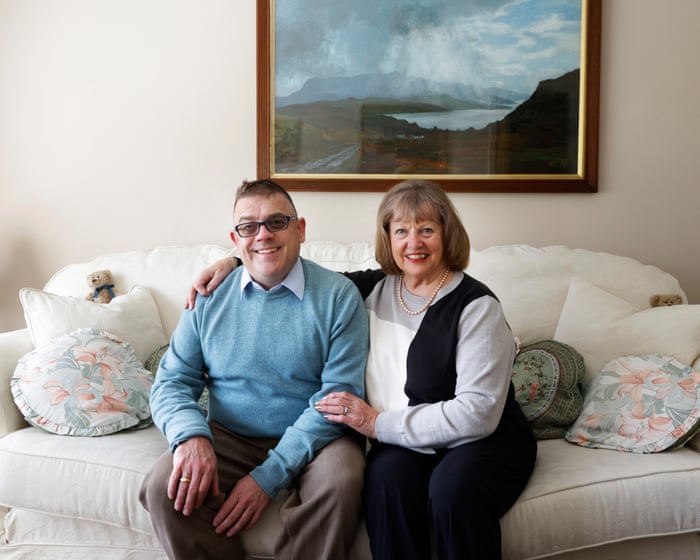
I was 26 when my gynecologist told me my fallopian tubes were blocked and I could never get pregnant. I was devastated. I had always wanted children. It was 1972; I was living in Bishopbriggs, near Glasgow, and working as a college lecturer. IVF didn’t exist, and when my husband and I applied to adopt a baby, we were told we had very little chance because few babies were available for adoption at the time. Meanwhile, my gynecologist tried to open my fallopian tubes, but it didn’t work.
I refused to accept that I had no options. I read every article I could about fertility treatment. After three years, I heard about a medical breakthrough by gynecologist Patrick Steptoe and physiologist Robert Edwards. It was described as very experimental and new.
I wrote to Patrick about my situation. It took almost a year, and my husband and I had to go through a lot of tests, but eventually Patrick told me I was an ideal candidate for their free, pioneering IVF programme.
Bob explained it all in simple terms—how the egg would be retrieved, placed in a petri dish, fertilized with my husband’s sperm, and then, at the right stage, put back into my womb. While there was a lot of skepticism about the procedure in the press, I didn’t feel scared at the thought of having a “test-tube baby.” I felt delighted. It was my only chance.
I started to live with a sliver of hope. But in February 1977, when my first IVF attempt failed, it broke my heart. I remember crying on the train home. With help from Bob, Patrick, and the nurse embryologist Jean Purdy—the most supportive person I’d ever met—I picked myself up. The following May, I started my second attempt. Another woman on the programme, Lesley Brown, was pregnant with Louise by then, which gave hope to all of us. Louise became the first baby to be born by IVF, in 1978.
After the egg was implanted, I believed this time it would work. Two weeks later, when my period didn’t arrive, I felt blessed. I was pregnant with only the second IVF baby in the world.
I went into labour during a snowstorm. Bob and Patrick started driving to Glasgow—the plan was for Patrick to deliver my baby by caesarean section. But because of the storm, it took them hours, and they kept stopping on the way to call and give advice to my gynecologist.
They didn’t manage to get there in time but, with the help of the gynecologist, my son Alastair was born on 14 January 1979, weighing 5lb 12oz. He was the first IVF boy in the world. My longed-for baby was suddenly here. I was overcome with emotion. When they handed him to me and I got to hold him, I started to cry.
The funny thing was, he didn’t cry. He just looked at me. It was a look I’ll never forget. I told him I loved him and that it was about time—I’d waited so long for him. My husband was also over the moon, and so were Patrick and Bob when they arrived an hour later.
Alastair is 46 now, a first officer in the Royal Fleet Auxiliary, and my pride and joy. We both love travelling, and a few years ago, we went around the world together. We slept out under the stars in Australia and climbed the Fox Glacier in New Zealand. I feel grateful for every moment I spend with him. He is still the most important person in my life.
I remain very close to four other women from the programme. I will never forget the camaraderie we shared, how each of us understood what the others were going through. We created an unbreakable bond. I remember one saying to me, “If it’s not going to happen for me, you do it for the rest of us.”Sign up to receive our weekly newsletter with the latest stories and columns, delivered directly to your inbox every weekend.
Enter your email address to subscribe.
Privacy Notice: Our newsletters may include information about charitable causes, online advertisements, and content supported by external organizations. If you don’t already have an account, we will set up a guest account for you on theguardian.com to deliver this newsletter. You can complete the full registration process at any time. For further details on how we handle your data, please review our Privacy Policy. We use Google reCaptcha to secure our website, and the Google Privacy Policy and Terms of Service apply.
—
Experience: My babies were born seven weeks apart
Looking back, I feel blessed to have gone through everything, because I have Alastair. I’m so glad that IVF is now widely accepted as a normal path to parenthood, and I feel honored to have played a small part in this medical breakthrough.
The miracle of Alastair’s life is entirely thanks to Bob, Patrick, and Jeanie. Since then, over 13 million deeply wanted babies have been born through IVF, made possible by their dedication and belief. I was simply in the right place at the right time—and I will always consider myself blessed because of it.
As told to Donna Ferguson
Do you have a personal experience you’d like to share? Email us at experience@theguardian.com.
Frequently Asked Questions
Frequently Asked Questions About the Worlds First IVF Baby Boy
Q1 What does worlds first baby boy conceived through IVF actually mean
A It means this was the first successful birth of a male baby using In Vitro Fertilization In IVF an egg and sperm are combined in a lab to create an embryo which is then transferred to the uterus This specific birth marked the first time that process resulted in a healthy baby boy
Q2 Who were the parents and when was he born
A The baby boy named Alastair MacDonald was born on January 14 1979 His parents were Grace and James MacDonald from Glasgow Scotland
Q3 Wait wasnt Louise Brown the first IVF baby How is this different
A Yes Louise Brown was the worlds first ever IVF baby Alastair MacDonald was the first boy born via IVF about six months later His birth proved that IVF could successfully result in babies of either sex
Q4 Why was this such a big deal at the time
A It was a huge medical milestone After Louise Browns birth there were still many doubts The successful birth of a boy helped silence critics proved the technique wasnt a oneoff fluke and showed IVF could work for different families paving the way for millions of future births
Q5 What were the main challenges the doctors faced
A The main challenges were the same as for the first IVF births perfecting the timing of egg retrieval successfully fertilizing the egg outside the body ensuring the embryo developed normally and achieving a successful implantation and pregnancyall with very limited prior experience
Q6 Did they use any special technique to have a boy
A No At that time there was no method for sex selection The fact that the baby was a boy was completely natural and random just like in any conception It simply demonstrated that the IVF process did not inherently favor one sex over the other
Q7 How is IVF for a boy different today compared to 1979