Above the school’s pastel murals of trees, paintbrushes, crayons, and microscopes, black smoke drifts upward. The blast has blown out the glass windows, leaving the curtains hanging in shreds from the frames.
Against a charred wall, the wreckage of a playground is scattered: a red plastic slide and a pile of small chairs. On a toppled bookshelf, a pair of pink plastic sandals sit neatly, now coated in dust.
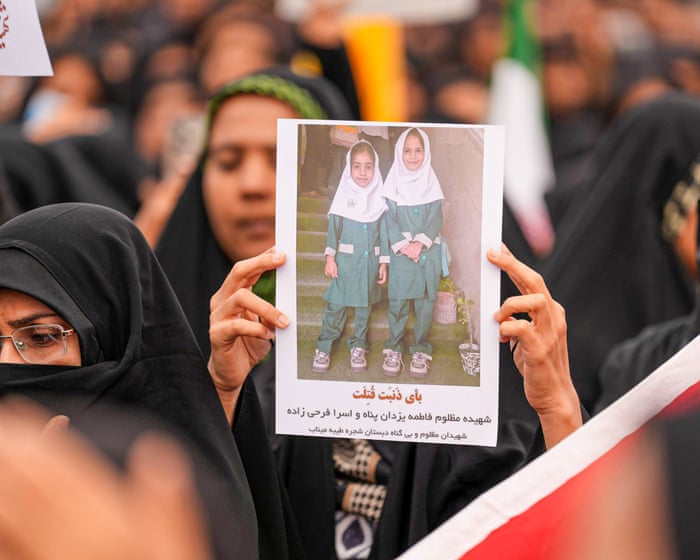
The missile struck during morning classes. In Iran, the school week runs from Saturday to Thursday, so when U.S. and Israeli bombs began falling around 10 a.m. on Saturday, students were in their lessons. Between 10 and 10:45 a.m., a missile hit Shajareh Tayyebeh school in Minab, southern Iran, collapsing the concrete building and killing dozens of girls, aged seven to twelve.
Verified photos and videos from the site—which the Guardian has not published due to their graphic content—show children’s bodies partially buried in the rubble. In one video, a very small child’s severed arm is pulled from the debris. Colorful backpacks, stained with blood and dust, lie among the ruins. One girl wears a green dress with gingham patches on the collar and pockets, her body partly covered by a black bag. Screams echo in the background.
A distraught man stands in the ruins, waving textbooks and worksheets as rescuers dig through the debris by hand. “These are the schoolbooks of the children under these ruins,” he shouts. “You can see their blood on these pages. These are civilians, not soldiers. This was a school, and they came to learn.”
According to Iranian state media, the strike killed up to 168 people and injured 95—figures the Guardian has not independently verified. With independent reporting heavily restricted in Iran and internet blackouts widespread, the Guardian used verified video, geolocated images, satellite imagery, and interviews to piece together a clearer account of the bombing at the Minab girls’ school. It is the deadliest single event in the U.S.-Israeli-led attacks so far and has been condemned by UNESCO as a “grave violation” of international law.
Cross-referencing verified videos with satellite imagery confirms the school’s location. Shajareh Tayyebeh school was next to a group of buildings that serve as local Islamic Revolutionary Guard Corps (IRGC) barracks and support facilities. The adjacent complex includes a medical clinic and pharmacy bearing the IRGC logo, labeled “Islamic Revolutionary Guard Corps Navy Medical Command.” Also nearby is a structure that appears to be a gymnasium or event space, marked “Seyyed al-Shohada Cultural Complex of the Revolutionary Guard.” The school’s location has been confirmed by open-source researchers, the Iranian student network, and the independent Farsi fact-checking service Factnameh.
There is no evidence, however, that the school served any military purpose. Its classrooms and playground are separated from the IRGC compound by a wall, and its colorful murals are visible in satellite images. Nor were its classes limited to children from military families, according to Shiva Amelirad, a Canada-based representative of the Coordinating Council of Iranian Teachers’ Trade Associations.A school official told the Guardian that the institution enrolled many children from the local community, especially those unable to afford private school fees. “Because its tuition was lower than many other private schools, and due to the severe overcrowding in public schools, ordinary families had been compelled to enrol their children there,” said Amelirad. Early videos from the scene also show thick smoke rising from at least one nearby building.
The school’s location, the nearby smoke, and the timing of the bombing—during the first round of strikes by US and Israeli forces—lend credence to the assertion that the school was hit as part of a series of strikes on or around an IRGC complex. The US military stated it was “looking into” the bombing.
Capt Tim Hawkins, a spokesperson for US Central Command, said the US was “aware of reports concerning civilian harm resulting from ongoing military operations. We take these reports seriously and are looking into them.” US Secretary of State Marco Rubio said the Department of War “would be investigating that if that was our strike,” and that the US “would not deliberately target a school.”
Iranian authorities began ordering schools to close shortly after the US-Israeli attack began at 9:40 a.m. It is unclear whether the bomb hit the school before those warnings reached Minab, or just after, leaving parents no time to act. Amelirad of the Teachers’ Council said they were told that “the time between the announcement of the school’s closure and the moment of the explosion was very short,” so “families had not yet arrived to pick up their children.”
It is not yet clear how many of the dead were teachers or staff, although the state-affiliated Iranian Student News Agency (ISNA) reported that the school’s headteacher was among the fatalities. According to the human rights organization Hengaw, the school’s morning session typically included 170 children. A local official told AP that casualties from Saturday’s strike included students, parents, and school staff.
Amelirad told the Guardian that the number of dead overwhelmed the local morgue, stating: “Due to the limited capacity of the hospital morgue, refrigerated vehicles have reportedly been used to store the bodies of the victims.”
Shortly after the attack, misinformation spread online. Some social media accounts falsely claimed the footage of the school was old footage from Pakistan. Several X accounts also made viral claims that the school had been struck by a misfired IRGC missile, but the photographs presented as evidence were taken about 1,600km away from Minab, in the city of Zanjan.
The US-led war on Iran has already resulted in a high civilian toll. The Iranian Red Crescent Society said on Monday that at least 555 people had been killed across the country. The US-based Human Rights Activist news agency reports at least 742 civilian deaths, with 85 confirmed and verified. The reported fatalities include 176 children.
In a statement, UNESCO called for all parties to protect schools, students, and teachers. “The killing of pupils in a place dedicated to learning constitutes a grave violation of the protection afforded to schools under international humanitarian law.”
For Minab—a relatively small town near the Sea of Oman, where the primary industries are agriculture, particularly date and citrus cultivation—the loss of up to 168 of its young girls will be devastating. “Among the victims were children…””Children from many different families were affected,” Amelirad said. “In some cases, more than one child from the same family lost their lives.”
Frequently Asked Questions
Of course Here is a list of FAQs about the Minab school bombing designed to provide clear and direct information in a natural tone
BeginnerLevel Questions
1 What was the Minab school bombing
It was a devastating aerial attack during the IranIraq War where Iraqi warplanes bombed the Shahid Bahonar Primary School for Boys in Minab Iran It is widely considered one of the deadliest single attacks on civilians in the entire war
2 When did it happen
The bombing occurred on October 30 1980 very early in the war
3 Where is Minab
Minab is a city in Hormozgan Province in southern Iran near the Strait of Hormuz It was not on the main front lines making the attack on a civilian area particularly shocking
4 Why is this attack so famous or significant
Its infamous for the extremely high number of child casualties The school was in session and the victims were almost entirely young schoolboys It became a powerful symbol of the wars brutal impact on civilians and children
5 How many people were killed or injured
Estimates vary but most sources report that over 200 people were killed with many more injured The vast majority were students between the ages of 7 and 12 along with some teachers and staff
Advanced Detailed Questions
6 Why would Iraq bomb a school so far from the battlefield
Military analysts suggest several possible reasons to terrorize the Iranian population disrupt life far behind the front lines or potentially due to faulty intelligence Some reports at the time incorrectly suggested the school might have been used as a military barracks a claim strongly denied by Iran
7 What kind of weapons were used
Iraqi Air Force jets likely Sovietmade Sukhoi or Tupolev bombers carried out the raid They dropped highexplosive bombs designed to destroy buildings
8 How did Iran and the world react at the time
Iran used the attack for domestic propaganda to galvanize support for the war effort framing it as a massacre of innocents Internationally it was condemned but the ongoing war and geopolitical complexities limited concrete action
9 Is there a visual guide or famous imagery from the attack
Yes Iranian