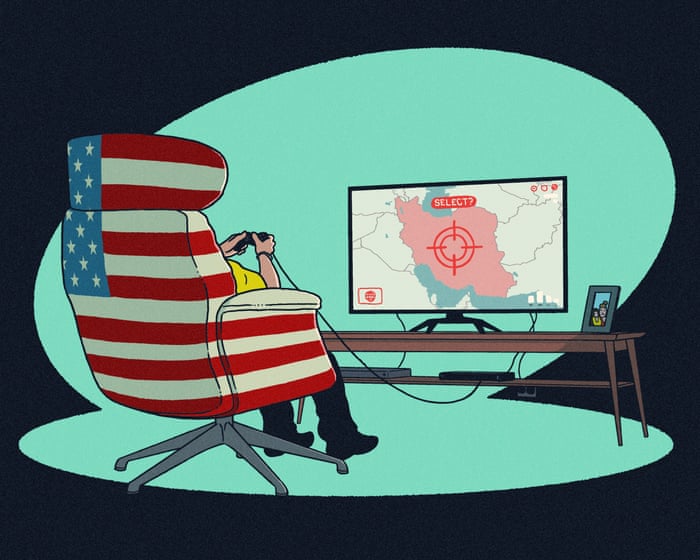
The war on Iran, even as it spreads and destabilizes the Middle East and the global economy, is not portrayed as real. This is the narrative crafted by the Trump administration. The conflict is depicted as a video game, a spectator sport, a social media spectacle of one-upmanship. The architects of this war have turned stupidity into a virtue, aided by a bewildering information ecosystem. The U.S.-led conflict feels like the first of its kind in the modern era: distinctly remote and profoundly ignorant.
A week into the war, the White House posted a clip on its social media channels featuring montages from Top Gun, Braveheart, and Breaking Bad, captioned “Justice the American way”—a repurposed Superman motto. Another video, titled Touchdown, showed NFL players tackling each other; upon contact, boom, footage of a strike explosion tagged “unclassified.” SpongeBob SquarePants also appeared, asking, “Wanna see me do it again?” followed by an explosion. In yet another, Operation Epic Fury was presented as a Nintendo Wii game.
“We’re over here just grinding away on banger memes, dude,” a senior White House official told Politico. “There’s an entertainment factor to what we do.” This approach is pure Donald Trump and his MAGA base, for whom everything is not just a game but a competition. Politics, both domestic and foreign, is about scoring points, winning, and humiliating the opposition. For that competition to be entertaining, it must be portrayed as low-stakes as possible. Thus, the war is not about death, destruction, or catastrophic economic and geopolitical fallout, but about the boom, the score, the fist pump. “Wake up, Daddy’s home,” begins one clip. The Trump administration is like a gamer in a dark basement, downing beers, nursing deep insecurities, frantically self-soothing through flashes of color and noise on a large screen. Maximum hit, minimum effort.
But beyond sublimated masculine anxiety, the Trump machine’s portrayal of this war serves a political purpose, eliminating the need for complex narratives or justifications. Trump and his regime are incapable of developing sophisticated reasoning for the war, both because they lack the intellectual capacity and because the war floundered from the start. The original goal of creating conditions for regime change was not achieved. Iran pummeled Gulf countries and Israel with drones and missiles, shut the Strait of Hormuz, blocked the passage of oil, gas, and commodities, and immediately spiked energy costs. What was supposed to be a quick win turned into a quagmire, so it must all be simplified into something triumphant for viral dopamine hits.
Deepening this state of unreality is the remote nature of the conflict. Never before has a war with such devastating and wide-reaching consequences been waged with such physical detachment. AI has been deployed on an unprecedented scale. In a video posted by the CENTCOM commander for Operation Epic Fury in mid-March, Adm. Brad Cooper summarized that in the more than 5,500 strikes on Iran, AI played a crucial role. “Humans will always make final decisions on what to shoot and what not to shoot and when to shoot,” he said, “but advanced AI tools can turn processes that used to take hours and sometimes even days into seconds.”
This process is grimly known as “streamlining the kill chain,” reducing the effort to surveil, collect intelligence, and select a target. In this sense, the war is an actual video game, with yet another layer of human connection to the ground details removed and outsourced to code. There are no boots on the ground, no one seeing the whites of the eyes of those who are killed, no sense of the colossal incursion into the lives and lands of those on the other side of the bombs and missiles.The American and Israeli side has seen relatively few casualties given the scale of the assault. Unlike the invasion of Iraq—with its direct civilian killings, torture in places like Abu Ghraib, and significant losses among U.S. and European troops—this conflict lacks that visceral human toll. Instead, there is a faceless enemy, and success or failure is measured only in terms of blows or boosts to America’s pride.
This war is also unfolding within an information environment already conditioned for grotesque detachment. Gone are the days when war coverage was dominated by rolling news on CNN or the BBC, with a limited number of correspondents and camera crews on the ground, or by newspaper investigations. Now, everything—from the ordinary to the intense—is flattened into the endless scroll. On Instagram, TikTok, and X, you can swipe between recipes, influencers, official White House videos, and scenes of smoke rising over Tehran, Doha, or Dubai. Through mindless scrolling, seeing without truly absorbing, many of us have become numb to the overwhelming flood of life—and to the torrent of hot takes, shitposting, AI-generated fake footage, and countless talking heads on YouTube and streaming platforms.
I’ve lost count of the “breaking news” posts and videos about the war that, upon closer look, turn out to be completely fabricated by authoritative-looking accounts chasing engagement. When truth and falsehood constantly collide in the content stream, nothing feels real. Entire industries have sprung up to exploit this confusion. On Polymarket, an online prediction platform where users can bet on anything—including conflict—the stakes grew so high and intricate that earlier this month, a journalist received death threats from users who lost money because of his reporting.
Amid these chaotic forces, it is incredibly difficult to hold onto empathy, to follow a moral compass, to remember that thousands of innocent people are dying, their homes destroyed, their countries destabilized for a generation. And to recognize that we have a duty toward them—one that can be exercised by pressuring those responsible for their suffering. This is the challenge of this war, and indeed of our entire age: to retain and insist on our humanity in the face of political leaders who benefit from erasing it, and platform owners who profit from its erosion.
Frequently Asked Questions
FAQs Trumps Video Game War AI Memes and Simplistic Narratives
BeginnerLevel Questions
1 What is meant by Trumps video game war
This phrase criticizes how complex geopolitical conflicts during the Trump administration were often portrayed through simplistic dramatic and gamelike rhetoric on social media reducing them to a shallow spectacle
2 How did AI and memes play a role in this
AIpowered social media algorithms amplified sensationalist posts and viral memes that framed military actions or diplomatic threats like highstakes drama or a game prioritizing engagement over nuanced understanding
3 Whats the main problem with turning war into a spectacle
It distracts from real human consequences complex histories and strategic realities It can desensitize the public oversimplify difficult decisions and make foreign policy seem like entertainment rather than a matter of life and death
4 Can you give a specific example
A key example is the January 2020 drone strike on Iranian General Qasem Soleimani The event was heavily discussed through meme formats boastful tweets comparing it to a video game move and AIcurated news feeds that highlighted the drama while often burying analysis of the severe escalation risks
5 Was this phenomenon unique to Trump
While all leaders use media strategically the Trump era was distinctive for the direct personal and often casual use of social media by the CommanderinChief to announce or discuss serious national security matters in a tone that mirrored online banter
Advanced Analytical Questions
6 How does this simplistic narrative affect actual military and diplomatic strategy
It can create pressure for theatrical oneoff actions that look strong for a news cycle potentially at the expense of longterm coherent strategy It also makes deescalation or quiet diplomacy harder when the public expects a winning narrative
7 What role does algorithmic curation play in shaping public perception of conflict
Algorithms on platforms like X Facebook and YouTube are designed to maximize watch time and shares They naturally promote content that is emotionally charged visually striking and simplisticperfect for warasspectacle contentover careful contextual reporting
8 Isnt using memes and simple messaging just effective communication
While effective