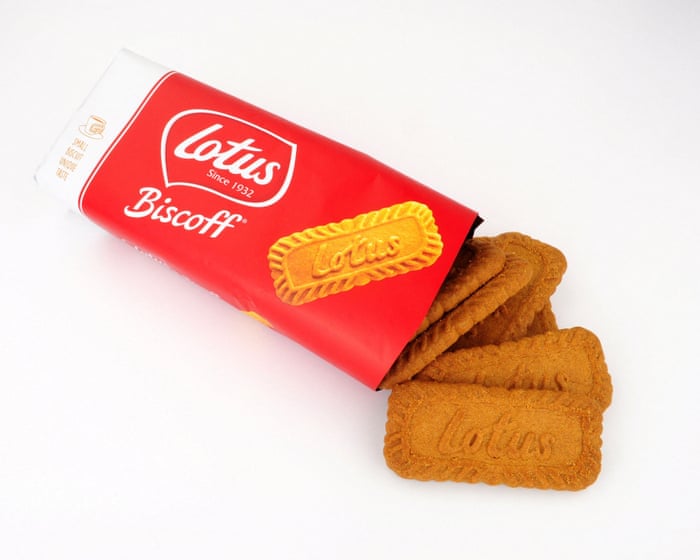
About 15 years ago, Ashley Markle was let in on a secret world and introduced to the treasures of an exclusive supply chain. She was staying at her aunt’s house when, one morning, her aunt made her a coffee and placed a little plastic-wrapped biscuit on the side. “I’d never seen them before,” says Markle. She took a bite: “It was a warm flavor I’d never really had in a cookie. I thought, what is this?”
Her aunt had discovered the small, gently spiced Biscoff biscuits as an airline snack. She loved them so much that she contacted the maker, the Belgian company Lotus, and asked them to ship a box to her in the U.S. At the time, Markle says, “I think she was the only person who actually had them in her home.” But, as we all know, the world changes fast. Last year, Biscoff was the fastest-growing biscuit brand in the U.S.
Created in 1932, the spiced caramel biscuit has been called a “Gen Z obsession” by the Times, and this spring Biscoff-branded treats—or rival companies’ “caramelised biscuit” products—seem to be everywhere, from Easter eggs to hot cross buns. Biscoff has had peaks every few years over the last decade. In 2014, the spreadable version was described as “crack in a jar.” In 2016, Biscoff was stirred into the freakshake trend. By 2021, fueled by the Covid lockdown home-baking boom, the brand took off across social media, while chef Jon Watts demonstrated three Biscoff recipes in just under seven minutes on the daytime TV show This Morning. “That was my worst ever TV appearance,” he says with a laugh.
In January this year, Biscoff took off once again, with people across TikTok and Instagram obsessing over a viral “Japanese cheesecake”—so named because it started with Japanese creators soaking biscuits in a tub of yogurt and leaving it overnight.
Markle is a social media creator who posts snack recipes on her channels daily. Whenever she does a Biscoff post—French toast sticks and milkshakes, among others—her videos always take off; her attempt at the cheesecake in January has had over 4 million views on TikTok, and her two-ingredient Biscoff cookies from last summer have 5.6 million. “I think it’s kind of like a cult following at this point,” she says.
My friend Raj, a teacher, developed a taste for Biscoff around 2014 after raiding someone else’s stash. He bought her a replacement packet, plus 10 more for himself (ordering online, he accidentally bought 10 boxes full of multipacks, ending up with a huge stockpile). At his school, a colleague keeps a packet of Biscoff as an incentive for Year 11 students to show up for out-of-hours tutoring. “I ate them all. From his drawer,” Raj says. “I bought him a replacement pack, too. I’d smoke Biscoff if I could.”
What makes a viral food trend? Manufacturers are desperate to know. Lisa Harris, co-founder of the food and drink consultancy Harris and Hayes, says Biscoff isn’t a single trend in itself, but more an “expression of various converging trends.” The first element is nostalgia. Biscoff is a modern version of the traditional Belgian speculoos, spiced biscuits that have been around since the Middle Ages, when they were eaten to celebrate December’s feast of Saint Nicholas. For consumers in the U.K. and U.S., the Proustian rush is a more recent phenomenon—a faux-fancy biscuit with its individual wrapper and exotic Euro-feel, the kind of thing you’d find served with coffee on a flight in the ’80s or at the hairdresser’s in the ’90s. “It’s quite an old-fashioned flavor,” says Harris. “I associate it with being on the side of a cup of tea.””It has nostalgic relevance,” she says. Another trend is “accessible indulgence,” which fits within most people’s budgets. With the cost of living rising, people are looking for simple ways to feel like they’ve done something special.
Biscoff’s versatility is another reason for its popularity: “It can be used in drinks, ice cream, desserts, hot chocolate.” Harris notes that Biscoff’s partnerships with other brands—an example of modern “collab culture”—are also a major trend. Often, products with distinctive or strong flavors, like Marmite, Nutella, Guinness, and Biscoff, take on a life of their own among consumers. “Fans run with it and feel as if they have ownership over the product as much as the brand itself does,” says Harris. This plays out across social media. “Because of the democratization of content creation, it’s often fans who create these trends, more so than the brands—although I’m sure brand managers are absolutely rubbing their hands with glee.”
The success of Biscoff, she says, “is a confluence of those larger trends. The active ingredient, the kind of spark, is really that it’s a social media-first recipe.” It’s a self-sustaining relationship—social media creators know that jumping on the Biscoff bandwagon is an easy way to get views and followers.
Niamh Leonard-Bedwell, fast-moving consumer goods editor at the trade publication The Grocer, has been following Biscoff’s rise. She says the makers haven’t been particularly active in driving social media trends, but they are responsive to them, posting customers’ and influencers’ videos on their own channels. They are also in the process of removing the Lotus embossing from the biscuits themselves, replacing it with the word “Biscoff.” “I suppose that was in response to the popularity they were seeing on social media. They updated their branding to resonate more with younger shoppers.” The Japanese cheesecake trend, says Leonard-Bedwell, “had a real impact on sales. In the week leading up to January 17, their volume sales were up 30% compared to the same time last year.”
In its 2025 annual results, released last month, Lotus announced a 10% revenue increase, with more than half of that revenue coming from the Biscoff brand (Lotus also owns other products, including the snack brands Trek and Bear, and the sourdough crackers Peter’s Yard). Last year, it opened a factory in Thailand to expand into the Asia-Pacific market, after launching its first factory outside Belgium in the U.S. in 2019. Still owned by the founding Boone family (alongside another Belgian baking dynasty), the company is now run by the founder’s grandson and namesake, Jan Boone, said to be one of only five people who know Biscoff’s secret recipe. Last year, he told The Times: “We want to conquer the world.”
There have been signs that Biscoff has its sights set on more than just sweets—it could be coming for our main courses as well. In a promotional cookbook created by the company, Lotus included some “surprisingly savory” recipes—with the word “surprisingly” doing a lot of heavy lifting—such as prawns in Biscoff sauce, creamy Biscoff duck breast, and a warm goat’s cheese and Biscoff salad. Watts, book in hand, says he can’t really see this taking off, even if the product is now a staple in teatime treats and puddings. (He himself likes the “very distinct, caramelly flavor,” and his latest cookbook features a recipe for Biscoff cheesecake.)
Watts got into Biscoff during the pandemic, through its jarred, spreadable form. “It’s very easy to use in desserts: things like brownies, blondies, cheesecakes.””Blondies, cheesecakes, those no-bake or simple bakes that everyone was making at the time,” he says. The simplicity of the recipes works well on Watts’s social media; one cake is made with just a whole jar of spread, eggs, and baking soda. Whenever he posted a Biscoff recipe, he says, “it went viral.”
The brand received a major boost during the lockdowns, according to Kiti Soininen, category director for food and drink research at Mintel. “After that, there was an increase in the speed of product launches specifically containing Biscoff-branded ingredients,” she says. Its partnership with Mondelēz, the owner of Cadbury, led to chocolate bars and Advent calendars. “And now this spring, you have the Easter eggs. It helps to keep visibility up, to just keep re-energizing that interest beyond what happens organically online,” she adds.
Soininen notes that part of Biscoff’s success is its “quite universally likable flavor, especially when compared to something like the matcha trend, which has gotten into lots of products but is a bit more divisive.” Consumers love novelty, she says, but only to a point, so collaborations with familiar brands help. “If it’s that sort of safe adventure—where it has newness and freshness, but pairs that with familiarity—that really hits the mark with a lot of people.”
Will Biscoff survive the wellness trend or shoppers’ growing concern about ultra-processed foods (UPFs)? Biscoff biscuits contain palm oil—as do the sandwich biscuit version and the spread—along with an emulsifier. “What we’re seeing in our consumer research is that most people have a moderation mindset,” says Soininen. “There’s a very small percentage of people trying to eat healthily all the time. Lots of people try to eat healthily most of the time and think it’s okay to have a treat now and then.” She points out that the Japanese cheesecake trend took off partly due to the health benefits of yogurt—”but it still has that indulgent element.”
Biscoff’s traditional feel may also protect it somewhat from negative associations with UPFs. Soininen observes a disconnect between how a product is actually classified “and the intuition that says, ‘Well, if my grandmother could have bought this, then it can’t be truly ultra-processed.'”
Few observers see the trend ending anytime soon. “I think the fact that many retailers are using Biscoff as inspiration for their own brands shows there’s a clear appetite for that flavor,” says Leonard-Bedwell, pointing to products like porridge, tea, popcorn, and breakfast cereal. Markle, who is planning more Biscoff recipes, adds: “I don’t see anybody deciding they don’t like Biscoff anymore.”
Frequently Asked Questions
Of course Here is a list of FAQs about the viral phenomenon of Id smoke Biscoff if I could
Beginner Definition Questions
Q What does Id smoke Biscoff if I could even mean
A Its a hyperbolic humorous phrase people use online to express an extreme almost absurd love for Lotus Biscoff cookies Its not a literal suggestion but a way of saying the cookie is so good it feels like an addictive experience
Q What is Lotus Biscoff
A Its a brand of speculoos cookie from Belgium They are thin caramelized spiced biscuits known for their crunchy texture and unique taste Theyre famously served on many airlines
Q Where did this phrase come from
A It exploded on social media platforms like TikTok Twitter and Instagram It started as a niche meme among food lovers and grew into a widespread cultural catchphrase used in memes videos and comments
Q Is this about actually smoking cookies
A No not at all Its purely a metaphor and a joke The phrase uses the slang smoke to amplify how much people enjoy the flavor
Cultural Social Media Impact
Q Why did this cookie become a social media star
A A perfect storm its unique nostalgic flavor is instantly recognizable it was already a hidden gem for frequent flyers the phrase is catchy and absurd making it highly shareable and creators used it to make relatable funny content about craving and obsession
Q What kind of content do people make about it
A Common formats include What I ordered vs What I got memes where Biscoff is the ideal ASMR videos of crunching the cookie skits about hoarding Biscoff spreads and using the audio over clips of something intensely satisfying
Q Has the meme helped Biscoffs sales
A While the company doesnt always release specific numbers viral trends like this consistently lead to a significant surge in interest online searches and sales as people are driven to try the hype