On March 5, a post appeared on the X account of Iran’s late Supreme Leader, Ali Khamenei, managed by his staff after his death in an Israeli airstrike on February 28. The tweet featured stark propaganda: a gleaming, oversized missile arcing across the sky as a city below burned. The caption read: “Khorramshahr moments are on the horizon.”
The Khorramshahr missile, Iran’s most advanced ballistic missile, is believed capable of carrying a cluster warhead dispersing up to 80 submunitions. Since that post, it has become a major concern in Israeli threat assessments, posing a persistent challenge for a country equipped with a multi-layered missile defense system widely regarded as the world’s most sophisticated.
The latest attack using cluster munitions occurred on Sunday when an Iranian ballistic missile struck central Israel, injuring 15 people.
According to the Israel Defense Forces, roughly half of the missiles launched from Iran since the escalation have carried cluster warheads.
The Guardian, which reviewed the impact of dozens of Iranian strikes alongside statements from Israeli officials, has identified at least 19 ballistic missiles carrying cluster warheads that penetrated Israeli airspace and struck urban areas since the war with Iran began on February 28. Those attacks have killed at least nine people and wounded dozens, reflecting a broader shift in Iran’s tactics that appears to have exposed a vulnerability in Israel’s air defenses.
Since the start of the war, Iran’s cluster munitions—which disperse dozens of bomblets mid-air—have tested Israel’s highly advanced, multi-tier missile defense network, including Iron Dome, which is designed to counter threats across ranges, altitudes, and speeds. This has exposed gaps that interception alone has struggled to close.
“Intercepting cluster munitions is fundamentally more difficult than stopping unitary missiles due to several technical shifts in the engagement profile,” said Tal Inbar, a missile expert who consults for Israeli defense companies. “To be effective, an interceptor must strike the carrier vehicle before dispersal.”
Cluster bombs are designed to release dozens of smaller bombs, called submunitions, over a wide area. Smaller munitions do not always explode immediately, posing a future risk to civilians. When cluster munitions are suspected, military teams sweep wide areas in coordinated searches before police bomb-disposal units move in to neutralize unexploded bomblets.
To limit the damage, weapons experts say cluster munitions must be intercepted as far from their target as possible—ideally outside the atmosphere. Once the submunitions are released mid-air, interception becomes virtually impossible, even with the most sophisticated missile defense systems.
Cluster munitions are inherently indiscriminate, and their use in populated areas is prohibited under international humanitarian law. While the 2008 Convention on Cluster Munitions bans them for signatory states, neither Israel nor Iran are party to it.
Amnesty International condemned Iran’s use of cluster munitions last June—during its 12-day war with Israel—as a “flagrant violation” of international law. The organization accused Israel of similar breaches over its use of the weapons in Lebanon in 2006. Israel has acknowledged deploying cluster munitions in the past, maintaining that it does so in line with international law, but described Iran’s use of bomblets toward a center of mass population as “a war crime by the Iranian regime.”
Since early March, videos have circulated online showing cluster munitions descending as dozens of bright points of light, slicing through the night sky.The night sky over greater Tel Aviv lights up before impact. These clips have become the defining visual shorthand of the war with Iran for Israeli civilians.
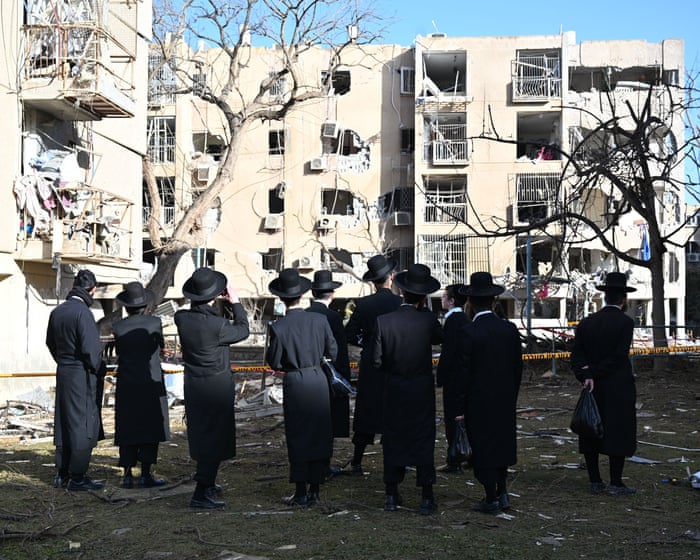
A firefighter inspects damage to an apartment block in Ramat Gan caused by an Iranian cluster munition.
Two such strikes in the early hours of March 18th killed a couple in their 70s in Ramat Gan, just east of Tel Aviv, and a 30-year-old Thai worker in Adanim, central Israel.
Israeli officials say that even a direct intercept of a ballistic missile, before its warhead splits and scatters, does not always fully neutralize the smaller bomblets.
Iran’s strategy also appears to have a pragmatic aim: beyond slipping smaller payloads through Israel’s air defenses, the use of cluster munitions may be designed to drain interceptor stocks—forcing Israel to use dozens of missiles against a single incoming threat.
The site where a Thai worker was killed by shrapnel in Adanim on March 19th.
Analysts also point to a significant economic constraint: intercepting these missiles is not cost-effective, as it would require using expensive interceptors to target each individual bomblet.
Speculation is growing that interceptor supplies may be under strain, though the true size of Israel’s stockpile remains a closely guarded secret.
Israel’s military claims it has destroyed over 70% of Iran’s ballistic missile launchers and says it has nearly achieved total control over Iranian airspace.
Remnants of a cluster munition found in southern Lebanon last year.
Yet Tehran still manages to breach Israel’s skies.
Over the weekend, Iranian ballistic missile barrages wounded nearly 200 people in southern Israel, striking the cities of Arad and Dimona after air defenses failed to intercept at least two projectiles.
Meanwhile, the constant blare of sirens—sending Israelis scrambling for shelter at all hours—and the increasing use of cluster munitions are deepening a sense of fatigue. Many are now quietly asking how much longer the war can go on, and to what end.
A Guardian investigation last year found evidence that Israel used cluster munitions in Lebanon during its war with Hezbollah, which began in October 2023. Images reviewed by multiple arms experts identified remnants of at least two types of Israeli weapons in areas south of the Litani River.
The Guardian does not have information about the specific strikes in which these shells were used, as the remnants were found afterward.
Frequently Asked Questions
Of course Here is a list of FAQs about Irans cluster munitions and their interaction with Israels Iron Dome structured from beginner to more advanced questions
Beginner Definition Questions
1 What are cluster munitions
Cluster munitions are weapons that release dozens or even hundreds of smaller explosive submunitions over a wide area They are designed to attack multiple targets like personnel or vehicles simultaneously
2 What is the Iron Dome
The Iron Dome is Israels mobile air defense system It uses radar to detect incoming shortrange rockets artillery and mortars calculates their trajectory and fires interceptor missiles to destroy them in the air before they hit populated areas
3 Did Iran directly fire cluster munitions at Israel
In the context of recent conflicts Iran primarily launched cruise missiles ballistic missiles and drones However Iran has supplied cluster munition warheads to its proxies who have fired them into Israel The munitions themselves are often launched via rockets or artillery
Mechanisms Tactics Questions
4 How could cluster munitions potentially challenge the Iron Dome
They present a saturation challenge A single rocket carrying a cluster warhead releases many small fastmoving bomblets The Iron Dome has to engage each bomblet as a separate threat which can overwhelm its finite number of interceptor missiles and radars by creating too many targets at once
5 Is the Iron Dome ineffective against them
Not ineffective but its efficiency is reduced The Iron Dome is designed to prioritize threats headed for populated areas Against a cluster attack it may not be able to intercept every single bomblet allowing some to get through and cause damage It forces the system to make difficult choices
6 Whats the main danger of these weapons
There are two primary dangers First the initial widearea blast effect which is harder to fully intercept Second many bomblets are duds that fail to explode on impact becoming de facto landmines that pose a threat to civilians long after the conflict ends
Strategic Advanced Questions
7 Why would Iran or its proxies use these weapons
They are a costeffective asymmetric warfare tool A relatively inexpensive rocket with a cluster war