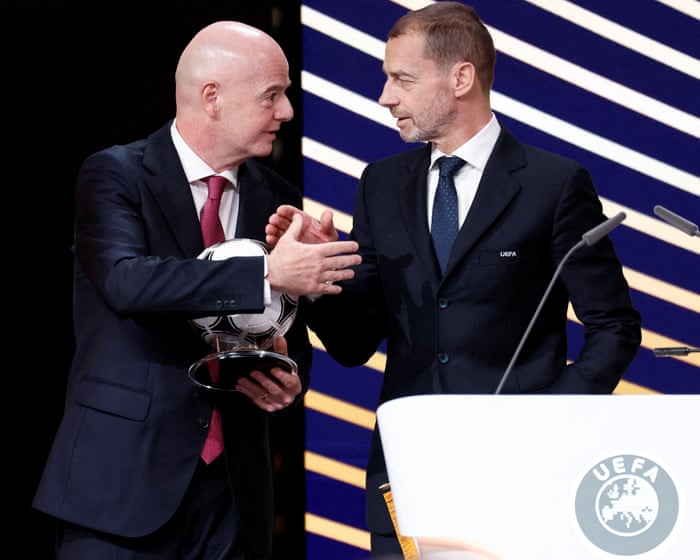
It’s a phrase you don’t often hear when Europe’s football associations get together to talk about a tough issue. “Touchingly unanimous” was how a senior Uefa executive described it, just moments after Thursday afternoon’s huge decision to boycott Fifa tournaments unless Gianni Infantino drops his private investment plan. Getting this level of unity is incredibly rare, and there’s now a short window to make it count.
Fifa pushed back overnight with “clarifications” that blamed the media for disrupting the “consultation process” of a plan that had been put together in secret. There was no sign they’d back away from their 19 September deadline to push the Fifa Forward Enterprise (FFE) proposal through. It’s easy to wonder why the rush, but Uefa and its allies can’t afford to let the next seven weeks drag on.
Infantino is under growing pressure after a senior adviser quit over the World Cup sell-off plans. Read more.
The European stance is a big win for Uefa and its president, Aleksander Ceferin, whose time in charge may have just hit a high point. People close to him often describe the Slovene as a “no nonsense” operator, and his tough talk has been backed up by action in standing up to Infantino. But neither Ceferin nor his team will be planning a victory parade. Things will move fast, and it’s vital that the agreement among Uefa’s 55 members holds strong.
Infantino and his people will be looking for weak spots. It took a lot of behind-the-scenes effort to get Uefa to line up behind one cause. One mid-sized federation, tempted by the money Fifa was offering, was brought back into line after that country’s biggest club was used to talk the FA president around. A smaller nation was caught off guard when two others, who it thought shared its interest in Infantino’s offer, changed their stance late on. Another had wanted more time in Thursday’s two-hour meeting to share its views.
None of this is unusual; it’s just politics. European football has plenty of internal battles to sort out on its own. It was no small feat to leave the meeting with sources at every level talking about unity. Only 48 hours had passed since news of Fifa’s plan broke, and especially after looking at a rushed sales pitch that many found insulting, everyone could at least agree they’d been pushed aside by global football’s governing body.
There was shock at Fifa’s timing, given the Folarin Balogun affair just three weeks earlier had made Uefa more eager to oppose Infantino. Several western European FAs are said to have been rallying their peers ever since Donald Trump revealed he’d repeatedly called Infantino to ask him to overturn the USA striker’s suspension for their match against Belgium. Balogun was eventually given a reprieve.
While only the German and Norwegian FAs publicly backed Belgium’s complaints, others, including the English FA, were involved in talks behind the scenes. “Balogun was the moment everything changed,” a European FA chief told the Guardian. “We’ve been working together since then, and this week has sped things up.”
View image in fullscreen. Spain celebrate after their World Cup triumph this month. Photograph: Allstar Picture Library Ltd/Richard Sellers/Apl/Sportsphoto.
They’ll need to move even faster if Infantino is to be removed or, at the very least, his investment plan is to be stopped. The less wealthy nations could still be won over if Fifa gets more time. Some countries privately point out the irony of bigger states asking for their support when it hasn’t always been given in the other direction. Maybe more money can be found for those who are wavering.
Uefa is encouraged by positive talks with individual countries in Asia, many of whom have expressed frustration with Infantino. It felt like a significant move when, on Friday morning, the Asian FootThe Asian Football Confederation (AFC) issued a strong statement, saying it believes “the proposed FFE cannot realistically achieve the necessary broad consensus and unity required to move forward.” There are also signs of widespread loss of confidence in Infantino within Concacaf, which covers North, Central America and the Caribbean. However, Concacaf and the AFC have not gone as far as Uefa’s threatened boycott; their public comments have focused on serious worries about governance, lack of consultation, and the rushed timeline, rather than the details of Fifa’s proposals. Concacaf did, though, point out that Fifa’s $4bn cash reserves could easily provide extra funding.
What happens next? Anyone hoping that such unprecedented opposition might force Infantino to resign will likely be disappointed. There are similarities to his earlier attempt to change world football’s structure five years ago, when he suggested the World Cup should happen every two years. Uefa blocked that plan, but Infantino came out of it with a stronger position. Less than a year later, he had gained support to expand the World Cup to 48 teams.
If Fifa’s mid-September deadline seems like a turning point for global football, the real deadline may come two weeks earlier. The Under-20 Women’s World Cup starts on 5 September, and as things stand, it would be the first test of whether those promising a boycott will follow through. It is in everyone’s interest, including the players caught in the middle, to find a clear solution by then.
Infantino’s opponents would have enough support to call for an extraordinary Fifa congress, where a no-confidence vote could be held. Only 43 countries would need to formally request it. But sources close to Uefa have warned that this would be difficult to arrange, especially because Fifa can delay convening such a meeting for up to three months. An extraordinary congress is already set for 23 November, when the hosts for the 2031 and 2035 Women’s World Cups will be officially approved.
Meanwhile, talk within Europe about a possible candidate to challenge Infantino in next year’s election is getting louder. Nasser al-Khelaifi, the Paris Saint-Germain president and head of the European Football Clubs organisation, has supporters, but he has shown no sign of wanting to run, even though history suggests the Qatari often takes key roles after appearing reluctant. Any serious contender would realistically need support from Europe and at least one other confederation, but there are more urgent matters to deal with first.
Those involve building on the momentum Uefa has created, quickly stopping Infantino’s project, and preventing football from falling into complete chaos. No one involved can afford to be complacent. As one FA president put it after Ceferin’s rallying call: “The game has started now.”
Frequently Asked Questions
Here is a list of FAQs regarding the fragile unity between UEFA and FIFA written in a natural clear tone
General Background
1 What is actually going on between UEFA and FIFA
UEFA and FIFA are in a major power struggle They are fighting over who controls the international match calendar how much money is distributed and the future format of the World Cup UEFA feels FIFA is trying to expand its power and competitions without properly consulting them which threatens the domestic leagues and player welfare
2 I thought UEFA worked for FIFA Why are they fighting
Technically UEFA is a confederation under FIFA but in practice they operate as a powerful wealthy partner UEFA generates a huge portion of FIFAs revenue Because of that financial power UEFA is pushing back against FIFAs topdown decisions essentially saying We pay the bills so we should have a say
3 What does fragile show of unity mean in this context
It means UEFA and FIFA have agreed to work together on a specific issue but the truce is tense They are not friends they are rivals who have temporarily decided that cooperation is better than open war but everyone knows the peace could break down at any moment
The Core Conflict
4 Why is FIFA expanding the World Cup causing so much tension
FIFA wants to grow the World Cup to include more countries which means more global revenue and political goodwill However UEFA argues that expanding the tournament adds more games to an already congested calendar increases player fatigue and dilutes the quality of the competition UEFA also fears that FIFA will use the expanded format to squeeze in more games that compete with European domestic leagues
5 What is the Club World Cup dispute about
FIFA has revamped the Club World Cup into a massive 32team tournament scheduled for the summer UEFA sees this as a direct threat because it
Takes the best players away from European clubs during the summer rest period
Competes directly with UEFAs own club competitions for prestige and TV money
Forces European clubs to play more games