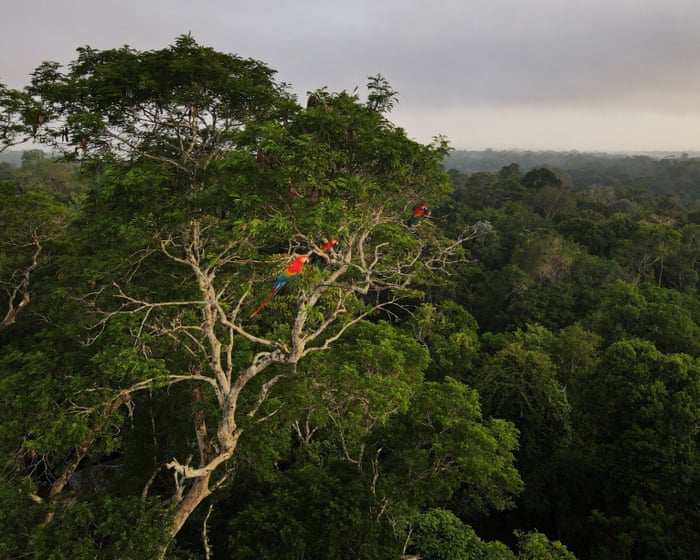
A 2021 study found that the Amazon rainforest is losing its ability to absorb carbon and now releases more than it takes in. In the tropics, marine scientists report that coral reefs are declining, which threatens fish populations. Equally worrying is research on the Atlantic Meridional Overturning Circulation (Amoc)—a vast system of ocean currents that helps regulate the climate—which is at risk of collapsing this century. The entire global ecosystem seems to be losing its ability to function.
We see this view in newspapers, magazines, technical reports, and academic journals. But thinking about the environment in terms of its functions is also how many of us naturally understand the world. We might think forests exist to produce oxygen, wetlands to filter water, and bees to pollinate our crops.
There’s a problem with this way of thinking: ecosystems don’t exist to achieve goals. The Amazon absorbs carbon, but it doesn’t “aim” to do so. It simply exists. Any standards of operation we find in nature come directly from our own desires—for things like climate stability, abundant fisheries, beauty, or cultural meaning.
So why do we keep thinking ecosystems have functions they could fail to perform?
I came across this puzzle as a graduate student in the late 1990s, when research on biodiversity and ecosystem function was growing quickly. At first, I planned to write my dissertation on a conventional ecological topic: whether species richness drives productivity. Instead, I got involved with the philosophy of science group, attended their seminars, and eventually earned a master’s degree in philosophy alongside my work in ecology. There, I found a rich debate about the concept of function—what it means, when it applies, and what work it does. But no one seemed to connect that debate to how ecologists were using the same word, without much thought, to describe what ecosystems do. This essay is an attempt to bring those conversations together.
My concern with ecosystems and function was never just academic. I’m an environmentalist, troubled by the loss of natural places. And as a father, I worry that my generation will leave our children a planet that is less rich and less resilient. These commitments also drive my interest in debates about function. If the way we think about ecological crisis is shaky, we risk missing what’s really at stake.
I worry that the ways we often understand the problems before us are not enough. Because if ecosystems have no intrinsic goals and can’t truly “break down,” how do we repair them? How do we respond to environmental crises in a world of aimless ecosystems?
Approaches to conservation have long been shaped by debates about whether nature has a purpose or whether we are projecting our own goals onto it. Behind every attempt to justify new protections lies an unspoken answer to the question: what is the environment for?
In the United States and the United Kingdom during the 19th century, these answers were rooted in game laws and hunting traditions that aimed to maintain populations of species valued for sport or resource use. By the mid-20th century, American forester and early conservationist Aldo Leopold offered a broader answer by suggesting that our moral community should include “the land” itself: soils, waters, plants, and animals.
In the 1970s and 80s, conservationists’ answers were increasingly based on the intrinsic value of specific species, as seen in laws like the US Endangered Species Act. But a decade later, many felt that the species-focused approach of “conservation biology” was lacking. It targeted only rare organisms that contributed little to the circulation of their ecosystems—species like the spotted owl and the snail darter fish. Some researchers worried that this approach might have overlooked more important concerns, including the major “services” that ecosystems provide.Ecosystems provide essential benefits like food, clean water, drought protection, storm buffers, timber, and fiber.
In the late 1990s, this crisis sparked a new research focus called “biodiversity and ecosystem function” (BEF). This approach offered a scientifically rigorous framework while also serving as a powerful argument for conservation. Unlike the previous focus on rare species, BEF considered all biodiversity important.
In the early 2000s, this idea grew bigger, supporting UN projects and international science policy. Governments started creating natural-capital accounts, trying to put a monetary value on things like pollination, flood control, carbon storage, and other natural processes. The answer to “What is nature for?” became: nature exists for the services it provides to people. The concept of ecosystem function was the bridge that made this answer seem scientific, not just political.
As a result, the idea of function now shapes how we describe and understand ecosystems. Think about how you view the ecosystems around you. If you’ve ever called a forest a carbon sink or a wetland a natural filter, you’re using BEF thinking. If you’ve thought of a rainforest as providing oxygen for humans, or a reef as supplying protein through fish, you’re using the logic of “ecosystem services.”
What do we mean by “function”? Sometimes, it refers to designed purposes. For example, a clock’s function is to tell time, or a carburetor’s function is to mix air and fuel for combustion. In these cases, the object was intentionally made for a specific purpose. This logic applies up a hierarchy: the carburetor is part of the engine, the engine part of the car, the car part of a transport system.
Other functions come from using something for a different purpose than intended. Writing at a picnic table, I might use a book or a rock to hold down my papers. The rock wasn’t designed for this, and the book was meant for reading, but both can serve my goal. I give them their function by using them in a certain way.
Still other functions arise without any intention, especially in nature. Philosopher Karen Neander gives the example of penguins, once thought to be nearsighted on land. If true, it doesn’t mean their eyes are flawed; instead, they’re optimized for seeing underwater, where they hunt. Land nearsightedness is a side effect of a visual system shaped for a different environment.
View image in fullscreen: A group of king penguins on South Georgia Island. Photograph: Mint Images/David Schultz/Getty Images
Although “function” is used in several ways, two main theories guide how scientists typically think about it: causal role theory and selected effects theory.
Robert Cummins developed causal role theory in response to Ernest Nagel’s argument in The Structure of Science (1961) that science should avoid teleological language. Nagel suggested scientists shouldn’t explain things in a way that implies specific goals or purposes.
For example, instead of saying, “The function of the lungs is to oxygenate the blood,” Nagel might say, “Given the structure of lung tissue, the properties of gases, and the pressure differences during breathing, oxygen diffuses into the bloodstream and carbon dioxide diffuses out.” This becomes a scientific explanation based on laws and initial conditions.
Cummins, however, thought this missed how scientists actually think about function. He saw that references to function could be a useful shortcut when explaining how things work.Cummins proposed a different approach. According to him, saying something has a function is just a way of describing how a part contributes to the overall “capacity” of the system it belongs to. In this view, using functional language is fine. For example, the carburetor in a car helps the engine turn chemical energy into mechanical energy; the engine helps the car transport people; and so on.
It’s easy to see why this idea appeals to ecologists, who often focus on tracing cause-and-effect chains. From their perspective, the function of bacteria and other decomposers is to break down dead organisms into smaller pieces and change their chemical makeup. The function of green plants is to turn carbon dioxide into a form of carbon that herbivores can use. In this view, everything exists for the sake of something else.
However, Cummins’s causal role theory has some serious drawbacks. First, it doesn’t really give us a way to decide which processes count as genuine capacities. The capacities we choose depend on what scientists happen to be interested in, not on what is objectively important to the system. Philosopher Ruth Millikan illustrates this problem: the heart pumps blood, but it also makes a thumping sound. Doctors might use that sound for diagnosis, but they don’t treat it as a function of the heart. Why not? In causal role theory, there’s no way to tell the difference between genuine functions and side effects.
Another limitation is that causal role theory can’t explain how something might malfunction. As philosopher Ema Sullivan-Bissett explores in her 2016 essay “Malfunction Defended,” any good theory of function must be able to explain how biological things can fail to do what they’re supposed to do. While causal role theory can say that a heart with a bad valve is still doing something (moving blood, even if poorly), it can’t say that the heart is doing its job badly. It offers no way to describe what the standard for doing a good job should be.
The alternative to causal role theory, and probably the most common view among philosophers of biology today, is the selected effects theory. This was developed by Larry Wright, along with Neander and Millikan. In this view, saying a trait has a function means telling its history—identifying the reason it exists and persists. According to this theory, any biological function is the effect for which the trait was chosen by natural selection. You’ve probably understood the world this way too. You might think the function of the heart is to pump blood because pumping blood is why proto-hearts were favored by animals in the evolutionary past. This historical focus sets selected effects explanations apart from causal role accounts, which only look at what a trait does today, not how it came to be.
This theory matters because it gives scientists a standard for success or failure. If a trait has a function rooted in evolutionary history, then it can malfunction when it fails to do what that history selected it to do. The question is whether ecosystems can also have this kind of standard.
As we’ve seen, “function” doesn’t mean the same thing in every case. We can tell apart two broad uses of the word. The first is descriptive: explaining how a system works. The other is goal-directed (or teleological): it says what a system is for (and how it can fail). This distinction becomes especially important when we look at rainforests, coral reefs, and other systems that have effects we can describe but no clear goals they’re meant to achieve. Without goals, the idea that an ecosystem can “malfunction” starts to fall apart.
In the early 20th century, ecologist Frederic Clements suggested that ecosystems develop through predictable stages…Ecologists used to think that ecosystems go through predictable stages of change, leading to a stable “climax” community, much like an organism growing and maturing. Some even called ecosystems a “superorganism,” suggesting they had a built-in path and a kind of unified purpose. This idea was influential for decades, but it has long been abandoned.
Today, ecologists believe that ecosystems are mostly not like organisms at all. They aren’t shaped by natural selection, they don’t reproduce, and it’s even debatable whether they are clear biological entities (unlike, say, a heart or a cell receptor). Instead, ecosystems are open, dynamic systems made up of countless interactions between organisms and their local environments. They are chance combinations of living things that we identify and name mainly to help us understand them. If you randomly put a bunch of organisms in one place, you have an ecosystem.
Yet ecologists still borrow the language of “function” to describe what happens at the ecosystem level. Wetlands “function” to filter surface water; forests “function” as carbon sinks.
The launch of the journal Functional Ecology in the 1980s marked a key moment in this shift in thinking. Articles in this journal began exploring how individual species use their “functional traits” to affect major ecological processes. Take how vultures scavenge animal carcasses. For the vulture, scavenging provides food. But at the ecosystem level, this same behavior can be described differently: in “trait-based ecology,” scavenging becomes just one of many processes that break down organic matter. In other words, it contributes to large-scale processes that ecologists call “ecosystem functions,” like nutrient cycling, primary production, and decomposition. By describing vulture behavior this way, ecologists turn a goal-driven function for the organism into a contribution to the ecosystem.
Once species are given roles like this, they start to resemble carburetors in an engine or organs in a body. This is where the language becomes shaky.
From a functional perspective, descriptions of how biodiversity shapes ecological processes can blur into judgments about what those processes are for, and whether they are being maintained or lost. For example, a decline in insect populations can be described as a change in pollination rates, but it can also be reframed as a loss of the ecosystem’s “ability” to support crops. Similarly, reduced microbial activity in soil can be described as leading to slower decomposition, but also as a failure of the system to keep soil fertile.
The difference between describing how something happens and making value judgments about what the resulting processes are for matters if we want to think clearly about what’s going on when ecosystems change. When these two are not kept separate, the idea of “ecosystem function” starts to carry more weight than it can handle.
What about the usual reasons for using functional language? For ecosystem processes, the “selected effects” theory doesn’t work. First, ecosystems are not shaped by natural selection as unified units. A forest like the Amazon is often called “the lungs of our planet,” but it has nothing in common with human organs or any other unified unit shaped by natural selection. Rainforests, like all ecosystems, don’t have selected effects. They don’t reproduce. Their boundaries are often temporary. It’s even debatable whether they are clear biological entities.
Plants fix carbon, microbes break down organic matter, and forest animals spread nutrients. These processes can be described simply. But it’s all too easy to take the next step and say the rainforest is for storing carbon.When we talk about an ecosystem maintaining stability, it can start to sound like we’re saying what the system is supposed to do. But any claim like that is necessarily human-centered. So if we say an ecosystem is malfunctioning, we also have to ask: malfunctioning for whom, and for what purpose? These questions reveal the hidden assumptions in our language and show the risks of mixing up ecological processes with human goals.
Were ecologists aware of the deeper meanings behind the words they used to describe ecosystems? Yes, they were. I asked Peter Calow, the founding co-editor of Functional Ecology, how the journal got its name and whether he had concerns about applying the word “function” to ecosystems. He told me he was “comfortable with the notion of function applying to adaptation within species through natural selection” but “less comfortable with it being applied to ecosystems.” The British Ecological Society’s publications committee, which oversees the journal, debated the issue at length before, in Calow’s words, “getting tired of discussing it” and settling on the title. He recalled that the term “functional” wasn’t used without thought—it was chosen despite conceptual unease, mainly because the journal wanted to publish papers that connected ecology with physiological research, where functional concepts were well established and mostly understood through the selected-effects account.
Another place to look is the landmark book Biodiversity and Ecosystem Function (1993), based on a 1991 symposium in Germany and partly supported by UNESCO’s Man and the Biosphere programme—a tellingly gendered and openly human-centered initiative. Both the sponsorship and the book itself reflect this focus. In the foreword, the late ecologist Paul Ehrlich explains the book’s intellectual basis: “Of special interest to humanity is the relationship of biodiversity to the variety of services provided by ecosystems and, in particular, to the stability of the flow of those services, such as the maintenance of the gaseous composition of the atmosphere, preservation of soils, recycling of nutrients and provision of food from the sea.”
He then revisits the “rivet popper” analogy, which he had introduced earlier in the environmental classic Extinction (1981), co-authored with Anne Ehrlich. They described each species in an ecosystem as a rivet in an airplane wing: remove one rivet and the plane still flies, but remove enough and the plane fails, usually catastrophically. The assumption is that “failure” matters because the airplane’s value lies in safely carrying people. The metaphor is powerful but imperfect. Rivets are static, fully interchangeable, and serve a single purpose; species are dynamic, unique, and show a wide range of behaviors that change with context. Importantly, rivets were placed by design engineers. Ehrlich’s analogy sneaks in the idea that ecosystems, like machines, have a proper configuration, and that any deviation is a malfunction.
Over the past few decades, this kind of metaphorical thinking has done important political work. Framing biodiversity loss as like losing rivets from an airplane wing makes the stakes clear for policymakers and the public. It also fits neatly with the “ecosystem services” agenda, which links ecological science directly to human well-being. In this policy context, “ecosystem function” becomes a conceptual hinge: it can be presented as a purely scientific measure of ecological processes, while also serving as a stand-in for the benefits those processes provide to people. This duality made the term powerful but also ensured that the teleological and value-laden meanings scientists worried about in private would persist in public discussion.
What should we do with the notion of ecological function?From my perspective, ecosystems can only be said to malfunction when they are taken over or used for human purposes. For example, if I pick up a stone to use as a paperweight, or if a wetland is designated as a water filtration system, then a disruption in its ability to filter water is rightly seen as a malfunction. Similarly, if a forest is managed to store carbon, a drop in its carbon storage capacity should be considered a failure. In these cases, the idea of malfunction comes not from the ecosystem itself, but from its role in meeting human-defined goals.
“Malfunctions” reflect human values and priorities by measuring nature’s worth in terms of usefulness, beauty, or cultural and spiritual meaning. Examples of unwanted ecological events—like algal blooms, coral bleaching, and deforestation—show how complex these judgments can be. An algal bloom caused by fertilizer flowing from rivers into the ocean might harm aquatic life, but whether we call it a “malfunction” or a “natural” response to extra nutrients depends on the standard we use. Coral bleaching might be seen as a failure of reefs to support marine life, but this view reflects human concerns about biodiversity or fishing, not any inherent purpose. These examples highlight that our reasons for fixing ecosystems are based on human ideas—like duties, norms, and goals—that come from outside the ecosystems themselves. So how can we think about ecosystems, and our responsibilities to them, more clearly?
To move beyond seeing purpose in nature, ecologists could focus simply on describing interactions in an ecosystem and measuring changes in its state, without referring to any goals or purposes. This approach respects the independence of the nonhuman world without imposing human values and priorities. But moving beyond purpose conceptually doesn’t stop us from viewing ecosystems through the lens of our duties, norms, and goals. Even when scientists do seemingly objective research, human values are always part of the picture.
This point becomes clearer when we look at the philosophy of science. In The Empirical Stance (2002), Bas van Fraassen argues that empiricism—the idea that we know the world through observation and experience—is not a claim about what exists, but a stance. It’s a set of attitudes and commitments about how to do research. The same is true of what’s sometimes called “value-free science”—the ideal of describing the world without the researcher’s perspective. Choosing that ideal is itself a choice, shaped by values about what counts as knowledge and what’s worth knowing. It’s a commitment, not a discovery. When ecologists study ecosystems, they can’t escape the values that guide their focus.
I’m not saying we should get rid of those values. Understanding how we’re tied to our values is an invitation to honestly examine how they enter scientific practice. Likewise, recognizing that value-free science is a myth doesn’t weaken the case for protecting the environment. It makes clear that thinking about ecosystems, and our responsibilities to them, involves both describing them and making value judgments.
When we say that natural systems exist to provide services for us—like oxygen, food, or climate stability—we take over certain processes for our own purposes. In doing so, we actively prioritize one ecological process over others. We’re not just observing a function. For example, we might value pollination for its role in supporting crop yields, while ignoring or even suppressing other equally “natural” processes, like pests eating plants. When we then continue that pattern…When we choose to intervene in an environment—whether through conservation or technological design—the continued existence of that environment is no longer just a result of natural conditions. It also depends on our deliberate choices. These functions become “selected effects”: they last because we choose them in the present, not because natural selection favored them in the past.
Ecosystems cannot malfunction on their own. They can change, reorganize, or even collapse, but these should be seen as natural processes, not failures. We can use teleological language—like talking about “purpose”—but only if we are clear about whose needs are being met and for what goals. Used this way, references to “function” can help us understand the value of ecosystems in human terms, without pretending that nature itself has such purposes.
What’s really at stake here is intellectual honesty. Environmental arguments often present these purposes as if they were natural facts, rather than human choices. When we say an ecosystem is “breaking down,” we risk hiding our own values behind the idea that they are properties of the world. This can be effective in rhetoric, but it’s misleading in terms of concepts.
By rethinking how we understand ecological functions and malfunctions, we can build a more rigorous and thoughtful ecology. We can directly state our reasons when we recognize that our care for ecosystems comes from us—our needs, our ethics, our futures. In doing so, we create an ecology that combines scientific description with clear moral responsibility, rather than blurring the two.
The work ahead isn’t to fix nature’s purposes, but to take responsibility for our own—and for the world they shape. Listen to our podcasts here and sign up for the long read weekly email here.
Frequently Asked Questions
Here is a list of FAQs about whether ecosystems can malfunction written in a natural tone with clear simple answers
BeginnerLevel Questions
1 Can an ecosystem actually break like a machine
Not exactly Unlike a machine an ecosystem doesnt have a single onoff switch But it can become so damaged or unbalanced that it stops working properlylike a car with a failing engine
2 What does it mean for an ecosystem to malfunction
It means the ecosystem can no longer perform its basic jobs like cleaning water pollinating plants or cycling nutrients For example a forest that cant support wildlife or a lake that becomes too polluted for fish
3 Is a forest fire an example of an ecosystem malfunctioning
Not always Many forests rely on natural fires to clear dead brush and help new plants grow Its only a malfunction if the fire is so severe and frequent that the forest cant recover
4 Can humans cause an ecosystem to malfunction
Yes very often Things like deforestation pollution overfishing and introducing invasive species can push an ecosystem past its limits
Intermediate Questions
5 Whats a simple sign that an ecosystem is in trouble
A sudden loss of key species or a boom in pests Another sign is that the ecosystem stops providing clean water or fertile soil
6 Can an ecosystem malfunction and then fix itself
Sometimes but it depends on the damage A small oil spill might be cleaned up by natural bacteria in a few years But a stripped rainforest or a dead coral reef can take decades or centuries to recoverif it ever does
7 Whats the difference between an ecosystem malfunctioning and collapsing
Think of it like a patient A malfunction is like getting sickit can be treated A collapse is like a heart attackthe system fails completely like when a lake turns into a lifeless swamp or a grassland turns into a desert
8 Do invasive species cause malfunctions
Yes When a nonnative plant or animal takes over it can throw off the food web For example zebra mussels in the Great Lakes clog pipes and eat all the plankton starving native