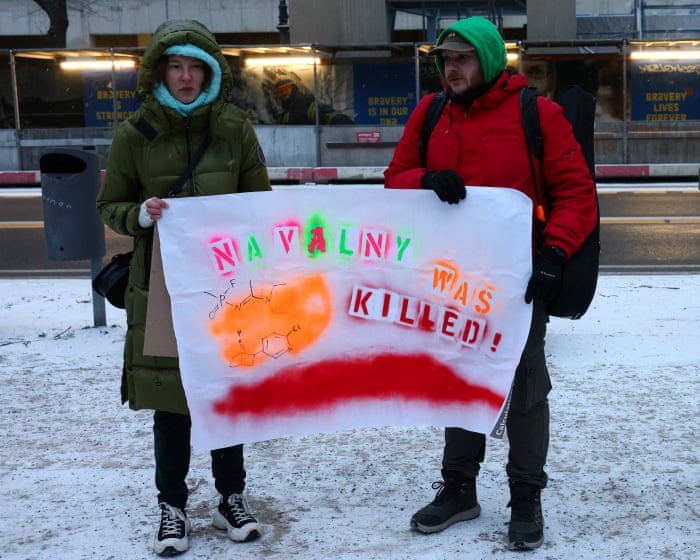
The choice of weapon was highly unusual, but experts say it is unclear whether the dart frog toxin used to kill Russian opposition leader Alexei Navalny was meant to send a message.
The poison, known as epibatidine, is produced by wild dart frogs in parts of South America, meaning Navalny could not have been exposed to it accidentally. The UK government has stated, “Only the Russian state had the means, motive and opportunity to deploy this lethal toxin to target Navalny during his imprisonment in a Russian penal colony in Siberia, and we hold it responsible for his death.”
Epibatidine was certainly effective: it is a powerful painkiller, thought to be hundreds of times stronger than morphine, and can cause muscle paralysis. “Your chest wall doesn’t expand and contract, so essentially you can’t breathe and you suffocate,” explained Alastair Hay, an emeritus professor of environmental toxicology at the University of Leeds.
There is another chilling aspect. “There isn’t an antidote to this poison that I know of,” said Hay.
While epibatidine may seem exotic and its use dramatic, it is not as obscure as it might appear. Hay notes that the chemical has long been studied as a painkiller for lung conditions like pulmonary fibrosis and sarcoidosis, but its high toxicity prevents therapeutic use. As a result, researchers in countries including Russia have been developing chemicals with a similar structure, hoping to harness epibatidine’s pain-relieving properties without its deadly effects.
“Because its structure is known, it can be synthesised in the lab,” said Hay. “It’s a more complicated chemical structure, but competent chemists are not going to have a problem making it.” In fact, epibatidine and its analogues can even be purchased online for research purposes.
Russia has a history of poisoning perceived threats. In 2006, former KGB agent Alexander Litvinenko died after radioactive polonium-210 was placed in his green tea. In 2018, former Russian agent Sergei Skripal and his daughter Yulia survived poisoning by the nerve agent Novichok, though the substance later killed 44-year-old Dawn Sturgess. Russia is known to have a poison facility in Moscow and, as Hay points out, “very, very competent chemists.”
UK Foreign Secretary Yvette Cooper suggested the use of epibatidine in Navalny’s killing was meant to convey a message. “Russia saw Navalny as a threat. By using this form of poison the Russian state demonstrated the despicable tools it has at its disposal and the overwhelming fear it has of political opposition,” she said.
While the poison might appear to be a macabre calling card from the state, signaling an ability to eliminate enemies in a painful manner, some experts believe the situation is less clear. “I think it would be very difficult to detect it, and that would probably be one of the reasons why it was used,” said Hay, adding that the poison’s potency means only a tiny quantity would be present in the body, making it hard to find.
Hay suggests the toxin was identified only due to state-of-the-art instruments and, crucially, because samples from Navalny’s body were obtained. Navalny’s widow, Yulia Navalnaya, has stated such samples were smuggled out of Russia.
However, Dr. Brett Edwards, an expert in biological and chemical weapons at the University of Bath, said that if the goal was to avoid detection or create a more deniable situation, many other poisons or methods could have been used. He argued that deploying such an unusual toxin was a deliberate choice, similar to the Novichok poisonings.
“[Navalny] was in a high-security prison. So, first of all, nothing gets in there unless they wanted it to get in there, particularly for a political prisoner, for obvious reasons,” he said. “If they wanted to do it quietly, they wouldn’t have used a toxin.”
Edwards noted that the Russian state has a pattern of using poisons in high-profile cases, which serves to intimidate others.The authorities did delay releasing Navalny’s body, possibly to hinder others from obtaining and analyzing samples. However, the use of poison has a long history as an instrument of Russian statecraft, which may explain why it was the chosen method to kill Navalny.
According to Dr. Luca Trenta, an associate professor of international relations at Swansea University, this case did not seem to involve overt signaling, unlike the attacks on Litvinenko or the Skripals, which clearly demonstrated reach and capability. “Those cases were impossible to conceal,” he said. “This one might not have been discovered without a prolonged effort to secure samples and conduct testing.”
Trenta suggested that Russia might have been testing the use of epibatidine, aiming to showcase such capabilities if the exotic toxin was detected, or simply employing a particularly gruesome weapon in an act of revenge. “If there is a signal here, it is Russia’s ability to produce and use these weapons, and in a sense, its disregard for international norms and law,” he said. “But again, the signaling aspect is tricky because if that were the intent, it would likely have been more overt.”
Edwards noted that while the use of epibatidine raises questions about what other capabilities Russia might possess, the fundamental reality remains unchanged. “It’s intriguing, but ultimately, it’s just murder—standard political murder. They have always done it, and they will keep doing it,” he said.
Frequently Asked Questions
Of course Here is a list of FAQs about the claim that Alexei Navalny was poisoned with frog toxin as a deliberate warning
BeginnerLevel Questions
1 Was Alexei Navalny really poisoned with frog toxin
No While initial unverified reports speculated about a frog toxin official toxicology reports from labs in Germany France Sweden and the OPCW conclusively identified the poison as a militarygrade Novichok nerve agent
2 What is Novichok and why is it significant
Novichok is a deadly group of chemical weapons developed by the Soviet Union and later Russia Its use is highly significant because it is a weapon only a state actor could produce and deploy pointing to a highlevel assassination attempt
3 Why did people talk about frog toxin
Early in the investigation before official results were released some doctors in Siberia mentioned possible organophosphate poisoning Frog toxin was a misleading simplification or speculation that spread in media reports before the definitive Novichok finding
4 Who is Alexei Navalny
Alexei Navalny is a Russian opposition leader lawyer and anticorruption activist He was a prominent critic of President Vladimir Putin and his government leading nationwide protests and investigations into official corruption
Advanced Contextual Questions
5 If it was Novichok why call it a warning
The use of Novichok itself is seen as a deliberate signature It is a weapon associated with Russian state security Analysts believe its use sends a clear message We can reach you anywhere and we use tools that only we possess The fact that Navalny survived is in this view possibly an intentional outcome to amplify the fear and warning to other dissidents
6 Are there precedents for this kind of poisoning
Yes Novichok was used in the 2018 poisoning of former Russian spy Sergei Skripal and his daughter in the UK It was also implicated in the 2020 poisoning of Russian opposition figure Vladimir KaraMurza These events create a pattern of alleged statesponsored attacks on perceived enemies
7 What was the official Russian response to the poisoning allegations
The Russian government has consistently denied any involvement Officials have offered alternative explanations suggested Navalny poisoned himself or claimed