“Everything already written, everything already said” – these words, spoken by Blixa Bargeld to open Rampen, the latest Einstürzende Neubauten album released in 2024 with relatively little fanfare, felt ominous. Was this the end of a band that has defined German music, at least to the outside world, for nearly five decades?
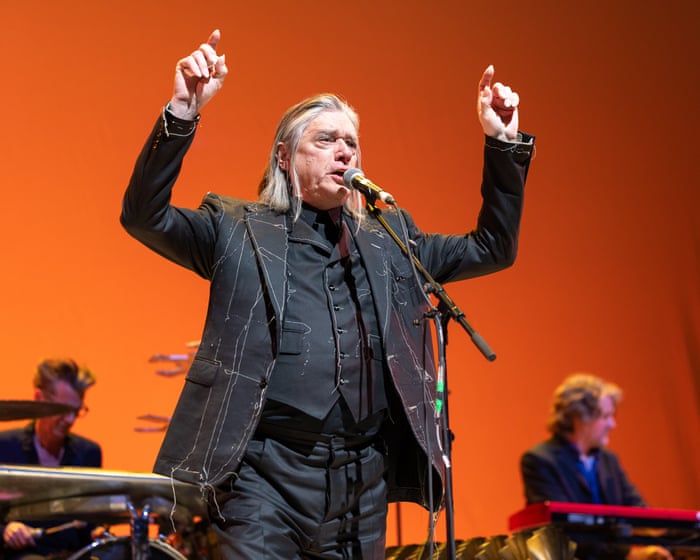
“No!” Bargeld replies, his voice booming across the small dressing room backstage at the National Theatre of the Netherlands in The Hague. “Take it for granted – we’ll make another record.” Later that night, Einstürzende Neubauten (“Collapsing New Buildings”) perform at the Amare concert hall, closing out the 15th edition of the Rewire festival, an anniversary celebration of experimental music and art in the city. It’s the third stop on a short festival tour the band is doing this spring and summer, and as always, they’ve hauled a shopping trolley all the way from Berlin, along with pipes, drills, and metal sheets.
Known for their intense noise sound, created using building materials and scrap metal, Neubauten are seen as pioneers of the industrial genre, influencing later bands like Nine Inch Nails and Swans, even if that abrasive edge softened into something more melodic in the early 2000s.
This time, there’s a new addition to the stage – a new member: bassist Josefine Lukschy, who is now sitting on the sofa next to Bargeld, in the first interview he’s given alongside another band member in years. New chapters bring new routines.
Lukschy, born in 1989, is the first new member since Jochen Arbeit and Rudolph Moser joined in 1997. “When Josefine was born, we had just released Haus der Lüge,” Bargeld says, referring to the band’s fifth studio album. The catalyst for this new chapter was the departure of Alexander Hacke – who joined Einstürzende Neubauten shortly after their founding in 1980 and had been with them ever since – announced last April. The exact reasons remain unclear. In a statement, Hacke cited a divergence of “basic standards, personally and professionally, on every level” and said he was stepping away to uphold his “core value of integrity.”
Bargeld, for his part, points to Hacke’s growing focus on his own projects – including hackedepicciotto, a duo with his wife, artist and Love Parade co-founder Danielle de Picciotto – and the resulting decline in his commitment to Neubauten. “Alexander kept saying he didn’t have the time when we wanted to make a new record,” Bargeld says, explaining why the band turned to improvised passages from their 2022 live shows as the foundation for Rampen. In Bargeld’s telling, the end of the collaboration seemed to happen naturally.
After a discreet search for a replacement – Hacke had served as the band’s musical director during live performances – Neubauten invited four musicians to audition. “We rehearsed with all of them, and our decision was unanimous,” Bargeld says. “With Josefine, it felt as if they’d always been with us. It’s crazy.”
Einstürzende Neubauten announced their new member publicly in late March 2026, roughly a year after the split. Lukschy, who uses they/them pronouns, was unlikely to be a household name even to the band’s devoted fanbase: as an independent musician, they had been involved in several underground projects in Berlin, including the sludge-rock band Crashpad, where they play bass and share vocal duties. Their path into one of Germany’s most influential cultural exports was, by their own account, almost accidental. One day, they got a call from an acquaintance mentioning that Neubauten were looking for a new bassist; a few days later, they were rehearsing songs the band had sent over. “I was really looking forward to finally playing with”I do that by myself, in front of the computer,” says Lukschys, “after rehearsing alone.”
And now here they are, sitting next to Bargeld: a figure of near-mythic status in German culture. He dropped out of school as a teenager in the working-class West Berlin neighborhood of Tempelhof, co-founded Einstürzende Neubauten and Nick Cave’s Bad Seeds (where he stayed until 2003). A sign of how much things have changed: last year, Bargeld received the Order of Merit of the Federal Republic of Germany, the country’s highest honor, recognizing him as a role model for creative people nationwide. That’s an award his younger self—squatting in buildings in the rubble-filled playground of postwar West Berlin—could never have imagined.
How does a musician so much younger than their bandmates find their place in a band that’s been around longer than they have? And as the first non-male member since co-founders Beate Bartel and Gudrun Gut left shortly after the band started, how do they carve out space as a true equal? “That’s a question for Josefine,” Bargeld says—then answers it himself. “They obviously know our work.” “Obviously,” Lukschy adds. “I’m from Berlin, after all. The band is an institution in this city.” As the conversation goes on, Lukschy seems more comfortable in this new role, sitting next to Bargeld and representing a younger generation of Berlin’s music scene—one that’s still deeply connected to the history Einstürzende Neubauten helped create.
The band is a living relic of a near-mythical era in Berlin: one that started with David Bowie and Iggy Pop living in the divided city in the 1970s and ended, in the most cinematic way possible, with David Hasselhoff singing “I’ve Been Looking for Freedom” on the breached Wall in 1989. That era still inspires generations of musicians and shapes the city’s global image as a haven for counterculture, a place where history, DIY art, and hedonism come together.
But that Berlin is said to be dying. A wave of essays and think pieces in German newspapers and magazines over recent months has mourned the city’s perceived decline—the result of harsh budget cuts to culture, social services, and sanitation, and a broader disappointment that Berlin’s dream of becoming a global city like London or New York never fully came true. But maybe the city is just changing, just like its most iconic band is changing too.
It’s not a big stretch to map Einstürzende Neubauten’s journey onto Berlin’s: from broke kids banging on scrap metal from construction sites after selling their instruments to survive, to artistic icons, to reluctant members of the cultural establishment. Bargeld bristles at that last part. “We were the counter-counter culture, the double negation of everything,” he says. “With that, you can never truly become part of the establishment.” Like the city that shaped them, they’ve inspired movements they feel very mixed about: “We’re not blameless for the rise of something as awful as Rammstein,” Bargeld says, only half-joking. And despite their strong international reputation, they’ve largely missed out on commercial success, as Bargeld hints when talking about finding new ways to fund their next album.
But as long as there are stages to play, Einstürzende Neubauten will keep hauling their shopping carts around the world. After the interview, Bargeld and Lukschy walk back to their hotel across the street, and passersby turn to look as they recognize Bargeld. The pipes, the drills, and the metal sheets are already waiting on the other side.The street. After all, there’s still a show to play.
Einstürzende Neubauten will perform at Wave Gotik Treffen in Leipzig from May 22-25, and at Primavera Sounds in Barcelona on June 5. Then they’ll go on tour. This article was updated on May 18, 2026, to clarify that Einstürzende Neubauten’s show at the Rewire festival was held at the Amare concert hall.
Frequently Asked Questions
Here is a list of FAQs about Einstrzende Neubauten based on the article Even after all these years theyre still falling apart Einstrzende Neubauten on their fifth decade as Berlin legends
BeginnerLevel Questions
1 Who are Einstrzende Neubauten
Theyre a German experimental band from Berlin formed in 1980 Theyre famous for using industrial tools scrap metal and construction equipment as musical instruments
2 What does Einstrzende Neubauten mean
It translates to Collapsing New Buildings The name reflects their chaotic industrial sound and themes of decay and urban destruction
3 What kind of music do they make
Its often called industrial music but its more than that They combine noise percussion on metal objects power tools and spokenword vocals Their sound can be harsh rhythmic or strangely beautiful
4 Why are they still important after 40 years
They pioneered the use of nonmusical objects as instruments and influenced countless bands Theyve stayed artistically restless never repeating themselves and remain a legendary live act
5 Do they still perform with jackhammers and drills
Yes thats their signature They use drills hammers sheet metal and even concrete mixers on stage Its part of their identity but their later work also includes more subtle acoustic elements
AdvancedLevel Questions
6 The article says theyre still falling apart What does that mean
Its a double meaning First their music is built on the sound of things breaking and collapsing Second after 40 years the band members themselves are aging dealing with physical wear and tear from decades of violent performances
7 How has their sound changed over five decades
Early albums are pure chaos and noise By the 1990s they introduced more melody and quiet passages In the 2000s they created a supported by fan subscription model which allowed them to experiment freely Now their music mixes raw noise with delicate almost classical arrangements
8 What is the Strategies of Destruction concept
Its an idea they used early