Luxury tourism in the Caribbean promises an escape into timeless paradise—all sun, sea, and sand. But stepping beyond the cruise ship or the all-inclusive resort reveals a more complex reality: a past marked by colonialism and a future threatened by climate change. New research from the Common Wealth thinktank traces how, over the 400 years since English ships first arrived in Barbados, colonial empires built a system of wealth extraction that still shapes the region’s tourism economies today.
Sir Hilary Beckles, a Barbadian historian and chair of the Caricom Reparations Commission, describes Barbados as the birthplace of British slave society. Between 1640 and 1807, Britain transported around 387,000 enslaved West Africans to the island. Their lives were defined by routine brutality—whippings, amputations, and executions. On the Codrington Plantation in the mid-18th century, 43% of the enslaved died within three years of arrival. Life expectancy at birth for an enslaved person on Barbados was just 29 years. This was the immeasurable human cost of the transatlantic slave economy.
This suffering generated enormous wealth for European colonial powers. Historian Joseph E. Inikori estimates that in the 18th century, 80% of the value of export commodities from the Americas came from the labor of enslaved Africans. While some plantation owners in the Caribbean grew rich—like the Drax family, ancestors of former Tory MP Richard Drax, who earned the equivalent of about £600,000 a year from their Barbados plantation in the mid-19th century—British imperial policy ensured most wealth flowed away from the colonies. Two-thirds of the economic value from the sugar industry went to Britain, passing through merchants who shipped unrefined sugar across the Atlantic, insurers like Lloyd’s of London, and refineries that produced the final product.
These patterns of production left a lasting imprint on the Caribbean long after the sugar industry declined. Islands like Barbados now have a “rebranded plantation economy built for leisure instead of sugar,” says Fiona Compton, a St. Lucian artist, historian, and founder of the Know Your Caribbean platform. She points out that most of the region’s hotel chains, cruise lines, airlines, and booking platforms are not locally owned. For every dollar spent in the Caribbean, 80 cents leaves the region, as large foreign companies repatriate their profits.
Hotel developers have been lured with generous tax breaks, while major cruise lines negotiate extremely low port fees—knowing that if a government tries to charge more, they can simply sail to another destination.
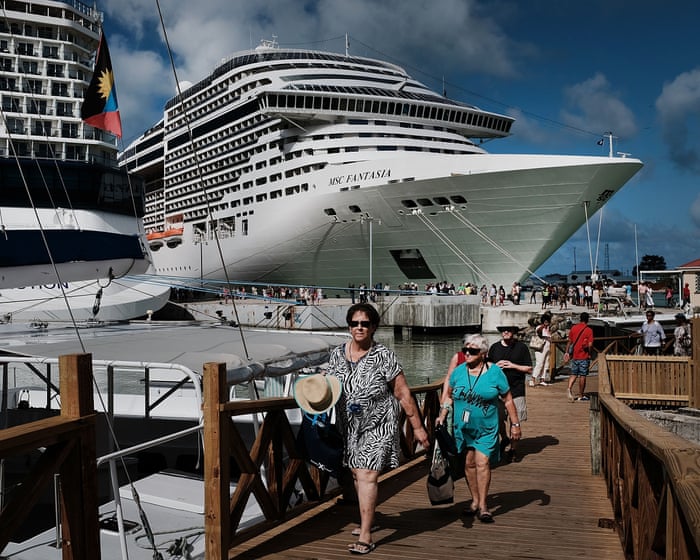
Inside all-inclusive resorts, tourists often have little contact with the local economy. On cruise ships, onboard spas, restaurants, and casinos may discourage passengers from even going ashore. When they do, they typically visit “approved” vendors that pay to be promoted or, increasingly, step onto private beaches and clubs owned or leased by the cruise lines themselves.
Like the plantations before them, tourism takes a heavy toll on local ecosystems. In a single day, a typical cruise ship produces 21,000 gallons of sewage, a ton of garbage, 170,000 gallons of wastewater, more than 25 pounds of batteries, fluorescent lights, and other chemical and medical waste, and up to 6,400 gallons of oily bilge water from its engines. Meanwhile, on land, hotels consume vast amounts of water and energy, polluting scarce water supplies—a serious burden for water-stressed nations in the region. “Their lights are on all night, they’re burning energy 24/7,” says Rodney Grant, a Barbados government adviser. “Governments alone can’t carry the burden of the social and environmental fallout.”
So why, despite these costs, is tour...Why is tourism so prevalent in the region? "This is the only industry, at least in the current global economy, that can generate significant foreign exchange earnings for small Caribbean countries," explains Matthew Bishop from the University of Sheffield, who studies the region's political economy of development. In the 1970s and 1980s, some newly independent Caribbean nations tried more socialist models with government ownership of key industries. These were abandoned or violently overthrown under U.S. pressure, which included a brief invasion of socialist Grenada in 1983. With the only available path being to attract foreign investment and move away from sugar agriculture, tourism became the Caribbean's "last resort."
Although Black resistance—from 19th-century slave rebellions to 20th-century worker uprisings—forced formal concessions from Britain, leading to the abolition of slavery and political independence, the hard truth is that these changes never came with the wealth transfers needed for real economic freedom. Instead, slave owners were compensated in 1837 with an amount equal to 40% of the Treasury's annual income, while Black workers, especially on smaller islands like Barbados, were denied access to land that could have freed them from continuing to work in the sugar industry.
Today, across the region, tourism continues to lock local people out of controlling and accessing land. "It's cultural and economic dispossession happening in real time," says Compton. "So many of our childhood spaces where we enjoyed total freedom have been taken over by beach chairs and security guards, who, if they don't tell you to leave, hover around to make you feel unwelcome." She argues that the same land stolen from Indigenous people and systematically kept from Black people during colonization is now "packaged and sold back to the world as 'paradise.'"
Threatening this "paradise" image is the climate crisis. Despite being responsible for only 0.3% of historic global emissions, the Caribbean is the world's second most hazard-prone region, suffering floods and increasingly devastating hurricanes like Melissa. Between 2000 and 2023, climate events caused over $200 billion in damage. This poses an existential risk not just to tourism, but to the entire fabric of local life.
"You've got this sense that they're suffering twice," says Bishop of the countries battered by extreme weather. "They're suffering from the original historical injustices of slavery and its aftermath, and then they're also suffering from climate shocks today. And they've received no compensation for either." Indeed, rather than money flowing into the region to help with the climate crisis, it flows out to creditors.
Many Caribbean countries are heavily indebted, having borrowed in the 20th century to tackle colonial-era problems like poor public health and education, and to build tourism infrastructure such as airports and deep harbors for massive cruise ships. Recent analysis from the Climate and Community Institute found that the region loses roughly the same amount annually in debt payments as the UN estimates it needs for climate adaptation and resilience. Jamaica, which followed neoliberal rules to reduce its debt-to-GDP ratio from 140% in 2013 to 62% and saved some surplus for future disasters, found that its $500 million in savings could barely make a dent in the over $8 billion in damage caused by Hurricane Melissa.
Rather than continuing to rely on the uncertain and volatile returns of luxury tourism, Caribbean leaders and civil society activists are vocal aboutThe call for reparations goes beyond apologies or symbolic payments; true repair requires rethinking the entire economic system that continues to marginalize the Caribbean. For instance, Compton advocates for a less extractive tourism model built on community-owned hotels, eco-lodges, and heritage tour companies. She created the Caribbean Green Book to help travelers find locally owned businesses. Grant also stresses that Caribbean governments can and should take greater action. “Tourism doesn’t function in a vacuum—it has been supported by legislation we put in place,” he says. He calls for policy changes that encourage companies to pay more taxes and source food and goods locally.
While individual travelers can make more ethical choices and Caribbean governments can steer tourism toward sustainability, deeper structural changes—such as addressing debt, compensating for climate loss and damage, and funding adaptation measures like flood defenses—will require coordinated political efforts.
No matter how much luxury resorts try to sanitize the Caribbean’s past, raking its white sand beaches clean each morning of the sargassum seaweed that now blooms more abundantly due to warming oceans, we all live in a world shaped by empire. The question for everyone is: how do we remake it?
**Häufig gestellte Fragen**
Natürlich. Hier ist eine Liste von FAQs über "Das Erbe der Imperien: Die kolonialen Wurzeln des Luxustourismus in der Karibik" in einem natürlichen, gesprächigen Ton.
**Anfänger – Definitionsfragen**
1. **Was bedeutet "koloniale Wurzeln" in diesem Zusammenhang?**
Es bezieht sich darauf, wie die moderne Luxustourismusindustrie in der Karibik auf den wirtschaftlichen Systemen, sozialen Hierarchien und Landbesitzmustern aufbaut, die während der jahrhundertelangen europäischen Kolonisierung und der Plantagensklaverei etabliert wurden.
2. **Ist Luxustourismus nicht eine gute Sache für diese Inseln heute?**
Er bringt lebenswichtige Einnahmen und Arbeitsplätze, aber es ist ein komplexer Nutzen. Ein großer Teil der Gewinne verlässt oft die Inseln, und die Industrie kann manchmal eine wirtschaftliche Abhängigkeit schaffen, die dem alten Plantagenmodell ähnelt, bei dem die lokale Bevölkerung die Arbeitskraft stellte, aber die wichtigsten Ressourcen nicht besaß oder kontrollierte.
3. **Können Sie ein klares Beispiel für dieses Erbe nennen?**
Ja. Viele der exklusivsten Resorts sind auf ehemaligen Zucker- oder Bananenplantagen erbaut. Die Ästhetik eines abgeschiedenen All-Inclusive-Paradieses spiegelt oft das koloniale Anwesen wider – eine abgeschottete Enklave der Freizeit für Außenstehende, historisch von ausländischen Eigentümern verwaltet, mit lokalen Angestellten in Dienstleistungsrollen.
**Mittelstufe – Fragen zu den Auswirkungen**
4. **Wie beeinflusst diese Geschichte, wem die Resorts gehören?**
Ein bedeutender Teil der hochpreisigen Hotels und Resorts gehört großen internationalen Konzernen oder ausländischen Investoren, nicht lokalen karibischen Unternehmern. Dies setzt ein Muster der externen Kontrolle über die wertvollsten Vermögenswerte der Inseln – ihr Land und ihre Küsten – fort.
5. **Was ist der Zusammenhang zwischen Luxus und kulturellen Stereotypen?**
Das Marketing des Luxustourismus stützt sich oft auf romantisierte, vereinfachende Stereotype – der sorgenfreie Inselbewohner, das unberührte Paradies –, die ursprünglich während der Kolonialzeit geschaffen wurden, um Siedler und Besucher anzulocken, während sie die komplexe Realität und Handlungsfähigkeit der karibischen Menschen und Kulturen ignorierten.
6. **Heißt das, ich sollte nicht in der Karibik Urlaub machen?**
Keineswegs. Der Punkt ist, ein bewussterer Reisender zu sein. Sie können Ihren Urlaub so gestalten, dass er lokale Gemeinschaften direkter unterstützt – z.B. durch Aufenthalt in lokal geführten Gästehäusern, Essen in unabhängigen Restaurants und Buchung von Touren mit lokalen Führern. Dies hilft, das Wirtschaftsmodell umzugestalten.
**Fortgeschritten – Kritische Fragen**
7. **Was ist "wirtschaftliche Abwanderung" (Economic Leakage) und wie funktioniert sie?**
Wirtschaftliche Abwanderung liegt vor, wenn das von Touristen ausgegebene Geld nicht in der lokalen Wirtschaft bleibt. Bei All-Inclusive-Resorts geht Ihre Vorauszahlung oft an ein...