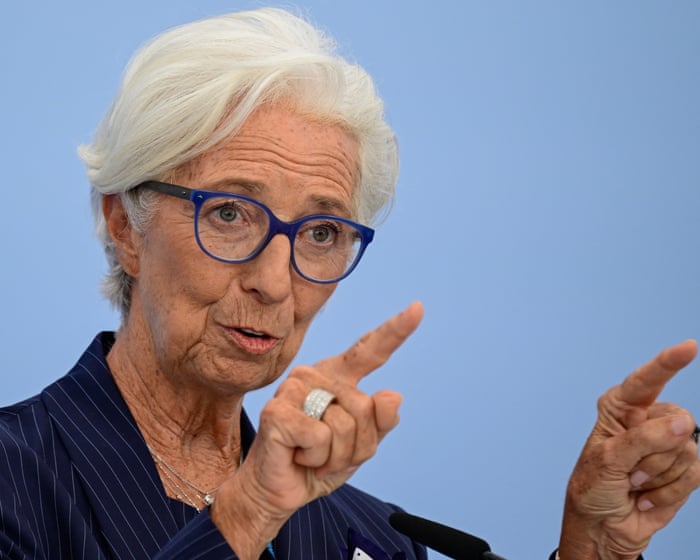
The European Central Bank has raised interest rates to 2.5% and warned that the risk of higher inflation over the next year has increased after renewed fighting in the Middle East. The move came as government bond interest rates soared following a jump in oil and gas prices overnight, triggered by the latest US and Iranian attacks on ships in the Strait of Hormuz. UK government debt rose to a 19-year high on Thursday, and European borrowing costs surged as oil climbed above $105 (£78) a barrel and gas prices also spiked.
Investors had expected the ECB to raise borrowing costs across the eurozone, but were alarmed by the central bank’s hawkish tone, which warned of building inflationary pressures in many sectors of the economy. Raising rates from 2.25%, the central bank increased its forecast for eurozone economic growth in 2026 to 0.9%, up from 0.8% in June, and now expects inflation to average 3% this year.
ECB President Christine Lagarde said: “Headline inflation is expected to return to around target towards the end of 2027, supported by the effects of higher interest rates. We will continue to monitor closely the size and persistence of the energy price increase and how it feeds through to price and wage-setting, inflation expectations and overall economic dynamics.”
David Rees, head of global economics at Schroders, said: “Today’s hike was expected, but the outlook from here is much less certain. Higher energy prices will keep headline inflation up.” He said a measure of core inflation, which strips out volatile elements such as energy and food costs, remained “well behaved so far.” Rees added that the economy was weak and higher borrowing costs were likely to slow growth.
The biggest driver of inflation is energy prices, which jumped again on Thursday following this week’s increase in US and Iranian attacks on ships transiting the Gulf. Brent crude passed $105 a barrel, up more than 4% from the previous day. British gas prices rose above 205p per therm, the highest since December 2022. Continental European gas prices also rose. The Dutch wholesale gas price – the EU standard – passed €80 per megawatt hour (MWh) for the first time since January 2023. The front-month contract is trading 3.4% higher at €82.56/MWh.
This in turn fuelled rising government borrowing costs in leading economies. The interest rate on benchmark 10-year UK government bonds, also known as gilts, hit 5.295%, the highest since August 2007. The rate, or yield, on Germany’s 30-year government bond rose 2.5 basis points to 5.08%, the highest since December 2003. The 10-year yield hit 3.45%, the highest since April 2011. France’s 10-year government bond yield was the highest since October 2008 at 4.344%, up 1 basis point.
Central banks are concerned that high fuel and energy prices will feed into higher transport costs and more expensive heating for commercial and residential properties, leading to a broad-based rise in inflation. Investors are concerned that UK and EU governments have underplayed the risk of running out of gas and the negative effect a subsequent rush for supplies will have on inflation. Recent data shows EU gas stores are only 67% full, well below the five-year average of 84%. Analysts at ING said: “This leaves the market vulnerable as we head closer towards the upcoming heating season.”
UK and continental European gas buyers have delayed filling gas stores in the expectation that the Middle East conflict will be resolved and prices will be lower before winter in the northern hemisphere. As the war drags on, there is the prospect of gas prices rising due to a scramble of buyers looking to replenish stocks in the remaining months before cold weather arrives. Bond markets were also put on alert by the US treasury secretary, ScottBessent said the US would buy back $6bn worth of government debt, known as US treasuries, to ease a sell-off in the US bond market that has pushed up interest rates. But bond buyers considered the package too small, and the yield on 10-year treasuries rose to a three-year high.
Frequently Asked Questions
FAQs ECB Raises Interest Rates to 25 Amid Iran War Inflation Warning
Beginner Questions
1 What just happened with the ECB
The European Central Bank raised its key interest rate to 25 This is the rate that influences borrowing costs across the eurozone
2 What is an interest rate in simple terms
Its the cost of borrowing money When rates go up loans and mortgages get more expensive but savings accounts usually pay more
3 Why did the ECB raise rates
To fight inflation the rising cost of goods and services Higher rates make borrowing more expensive which cools down spending and helps slow price increases
4 What does the war in Iran have to do with inflation in Europe
The conflict can disrupt oil supplies and shipping routes pushing up energy and transport costs Higher energy prices then spread across the economy driving overall inflation
5 How does this affect my monthly budget
If you have a variablerate loan or mortgage your payments may go up If you have savings you might earn more interest Everyday prices may stay high for a while
6 Does this mean prices will start falling
Not immediately The goal is to slow the rate of price increases not necessarily to make prices drop back to old levels
7 What is the eurozone
The group of European Union countries that use the euro as their currency currently 20 countries
Intermediate Questions
8 How does raising rates actually lower inflation
Higher rates make loans pricier so people and businesses borrow and spend less Lower demand takes pressure off prices It also strengthens the euro which makes imports cheaper
9 Whats the difference between the ECBs main rate and my banks rate
The ECB rate sets the baseline for borrowing between banks Your bank adds its own margin so your mortgage or loan rate is always higher than the ECBs rate
10 Why is the ECB worried about an oildriven inflation spike
Energy costs feed into almost everything food delivery manufacturing heating When oil gets expensive inflation can spread fast and become sticky meaning it lasts longer
11 Can the ECB control oil prices
No It can only respond to them Rate hikes reduce overall demand which indirectly eases some price pressure