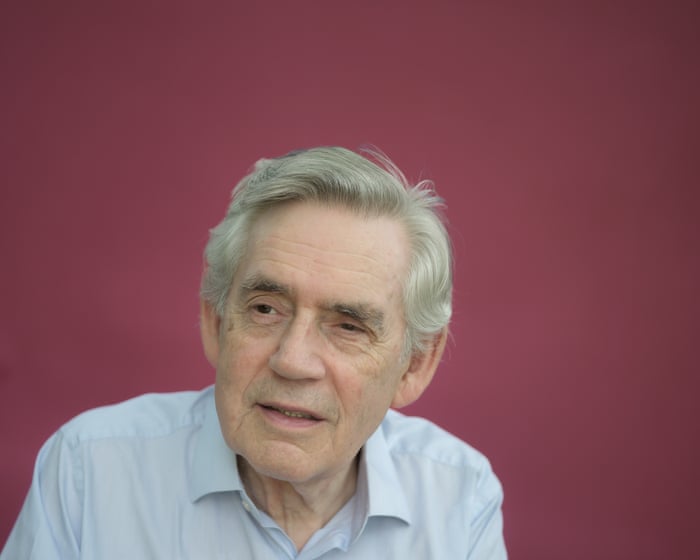
It’s a Monday in August, and while England swelters in dystopian heat, Gordon Brown and I are in his office at the top of his house in North Queensferry, looking out over the moody waters of the Firth of Forth. It’s hard to remember the top of my own sauna-like house in London as we stand here in the cool, wearing wool suits and necessary socks, my coat draped over the back of a chair. “I was watching Raith Rovers – the local football team – on Saturday,” Brown says, “and it was really cold. There was a wind blowing in from the sea.” He asks if I’ve heard the famous joke – “Scotland’s only got two seasons: July and winter” – then chuckles. It’s one of his favourites. (I’ll hear him tell it three times today.)
That’s not to say Fife has been untouched by the multiple heatwaves. They had a few sunny days. One hit 24C – “a shock”, Brown says, since July temperatures are typically 15-17C. He stood in his kitchen and looked at the modest patch of grass at the back of the house. “I never imagined being out in the garden in the summer. I never imagined it because it’s either raining or too cold.” Once out there, he found himself battling a “very dangerous” nest of wasps. One family member was stung, and then there was the whole rigmarole of specialists in thick gloves and protective suits coming to remove it. By the time that was done, the sun had gone in.
Climate is something we’ll discuss today, it being something of a wasps’ nest itself. Also on the agenda: Donald Trump, Europe, Andy Burnham, and the Labour party. The former prime minister (2007-2010) and longest-serving chancellor of the exchequer in modern history (1997-2007) will touch on Iraq, the financial crisis, and Scottish independence. He’ll give his diagnosis of the current state of global politics, which is the focus of his new book, The Future Starts With Us.
What’s telling is how much people still want to hear his views – arguably far more than any of the six broken PMs since (tickets for his upcoming book events in Bath and Edinburgh sold out in minutes). Many feel we didn’t know how lucky we were with Brown and his old-school sense of duty. At the time, we saw him as a brooding toad, a hangdog, grizzled pessimist, instead of valuing his gratitude and prudence. His father’s booming refrain was “Be thankful for what you have; you can cope with a lot less!” so perhaps it’s not surprising Brown didn’t cash in when he left No 10. He didn’t take a fat job in banking, a knighthood, or even the prime ministerial pension he’s entitled to.
He’s aware that, as a political heavyweight, his views on Labour still matter, and that he has a reputation for micromanagement, so initially he’s careful when I ask about Burnham. “I don’t want to be a backseat driver,” he says, settling into a tub chair next to a wall of books (political biographies, political philosophy, a first edition Keynes). But can he help himself? No, he cannot. A second later, he’s saying he “hopes” Burnham will heed a report he did for Keir Starmer recommending abolishing the House of Lords and replacing it with an elected chamber “representative of all the regions and nations of the country, which fits in with Andy’s idea that the regions and the nations are going to have a bigger voice”.
He reminds me the Lords is an unelected chamber of about 800, “the second largest legislature in the world after China”. It’s packed to the Pugin rafters with lobbyists. The problem will be persuading them to vote to cut their own throats. “But something’s got to change.”
View image in fullscreen
As prime minister, with then health secretary Andy Burnham, in March 2010 … Photograph: Stefan Rousseau/AFP/Getty Images
View image in fullscreen
… and with his wife Sarah and their sons after his resignation two months later. Photograph: Ben Stansall/AFP/Getty Images
Brown calls Burnham “Andy”. He has known him a long time.Burnham’s first cabinet role was under Brown, serving as chief secretary to the Treasury (and later as health secretary in Brown’s government). Brown’s official position under Burnham is as an adviser overseeing the G20, which Britain will host next year. Starmer brought him in for this role—remember the photo op of him entering No. 10 with Harriet Harman?—alongside a review of defence spending. Brown doesn’t deny that Burnham sought his advice before appointing John Healey, Brown’s friend and former parliamentary private secretary, as chancellor, but he says, “My advice would’ve been not to take my advice.” (It’s the same line he used when journalists asked if he’d been advising Rachel Reeves.)
Not that he lacks advice to offer: “Look, the British economy was growing about 2.5% a year when I was chancellor, and now it’s growing about 1% a year. So I do believe, as I said to Andy, that focusing on Britain as an innovation nation is a key part of solving this growth deficit.”
Someone brings me a tea and Brown a glass of still water. He’s avoided caffeine since overdoing it during the 2008 financial crisis, and recently gave up sparkling water for “reasons of health.” (No joke, his rider for book events is tap water. An adviser adds, “And maybe a banana.”)
Since leaving office, Brown has spoken out on specific issues: Brexit, antisemitism, universal credit. He’s deeply worried about the far right, which is more popular in Europe now than before fascists seized power in the 1930s. The number of truly liberal democracies has dropped to its lowest level in three decades—29, he writes in his book. “Some fear we are approaching a moment comparable to the run-up to the second world war.”
Part of the problem is that the postwar rules-based order no longer exists. We’ve moved from a “unipolar” to a “multipolar” world where leaders push a kind of zero-fucks nationalism—America First, Italy First, Russia First. “Putin feels he can ignore the rule of law with impunity,” Brown says. “Netanyahu feels the same. In my book, I’ve got quotes from each explicitly saying it’s all about power now. If you’ve got the power, you use it. It doesn’t matter what the morality of what you’re doing is. I’ve got Trump saying, ‘I decide what my morality is. I don’t take moral lectures from anybody.'”
People are angry. And rightly so, because things they took for granted have somehow been undermined.
This posturing is behind Putin and Netanyahu’s indiscriminate bloody slaughters in Ukraine, Gaza, and Lebanon, and behind America’s devastating attacks on Iran (“hospitals and schools should never be subject to bombing in any war”). But also, Brown says, “America was not able to stop the invasion of Ukraine, even though they knew about it in advance. And the Americans are not telling the Israelis actually to respect the idea that Palestine should have sovereignty. When I was prime minister and Israel invaded Gaza in 2009, the Americans told them to get out and they left.”
Brown met Netanyahu a few times when the Israeli leader was finance minister and he was chancellor. “He’s changed dramatically,” Brown says, then corrects himself, because “he’s always been obsessed with Iran. For 20 years it’s been the country that he wanted to neutralise or destabilise. So I’m not surprised that he persuaded Trump to [bomb].”
But weren’t the seeds of these violations sown with the Iraq war, which he supported with Tony Blair in 2003? “To some extent, the interventions in the years from 2000. You can go back to the Vietnam war, to be honest.”
He has long admitted he made a “mistake” with Iraq. He felt “misled” when he learned, through a document he saw after leaving government, that the US knew Saddam Hussein did not have weapons.In 2002, regarding weapons of mass destruction. If he had known, would he have resigned? “Yes. I wouldn’t have been able to support the government.”
Blair now sits on Trump’s Board of Peace. While it’s promoted as an alternative peacekeeping agency, Brown sees it as essentially a corporate exercise. Its founding document, Brown argues, is closer “to an international property developer under the guise of making peace.” I start to ask a question and he cuts me off: “I know what you’re going to ask.” What? “About Tony Blair. I don’t want to talk about Tony Blair.”
View image in fullscreen
With Keir Starmer and Tony Blair in September 2022, when Charles was proclaimed the new king … Photograph: Kirsty O’Connor/AFP/Getty Images
View image in fullscreen
… and with Starmer again, on Brown’s return to Downing Street in May this year. Photograph: Simon Dawson/No 10 Downing Street
In his book, Brown writes that the US “may” have a new president in 2028. Why “may” and not “will,” given the two-term limit? Does he believe there won’t be an election? “No, Trump’s never been against elections. He’s just against results he doesn’t like.” What might this mean for the UK-US relationship? “The thing about that is, no matter what you think of any individual, you’ve got to try and make it work. Keir Starmer, to his credit, tried. Andy Burnham will try. Nobody’s saying they are going to be soulmates. You want to make it work without abandoning any principle.”
Brown’s suggestion for dealing with the spiraling global chaos is to get back to a rules-based world as soon as possible, with an “updated” commitment to “the rule of law, democratic accountability, respect for human rights, freedom of assembly, international cooperation, humanitarian aid, environmental stewardship. People are angry,” he continues. “Rightly so, because things they took for granted have somehow been undermined.”
But he skates over the role played by social media in the darkening of political discourse, except to say it’s a “shouting match without an umpire.” Tech bros are the pied pipers of our children’s attention, I say. He points to a local Facebook group, Love Kirkcaldy! which, to him, exemplifies the positive way people come together online. He stresses – and this is a big theme of his book – one answer to tackling issues in national politics and international geopolitics lies at home. We need to refocus on our local communities: “Stronger communities will give us a stronger resistance to extremism.”
My advice would be not to take my advice
View image in fullscreen
Photograph: Margaret Mitchell/The Guardian
The book is dedicated to the people of Kirkcaldy, where Brown is an active force. We visit the Cottage Family Centre, a charity of which he is patron that helps under-16s and their families. During Covid I visited one of the charity’s two sites. A volunteer said that, on hearing about two children who were sleeping on the floor, Brown had gone home and dismantled his sons’ bunkbed, returning to present it to her along with sheets. (She also said he attempted to make the beds, but botched this so completely that his protection team had to take over.)
Then there’s the local multibank charity he set up: warehouses that take donations of goods from 90 companies, including Amazon, then redistribute them to the poor. I ask if he feels conflicted, given Amazon is a notoriously appalling employer with no unions. It’s the only time he’s a little gruff with me. “My first priority is to see if we can alleviate poverty. If Amazon is prepared to help, we will work with Amazon. If other companies are prepared to help, we will work with them. Poverty has been really severe here.” He says they’ve probably turned over £250m worth of goods to people who really need them. “So for a small charity just starting off …”There’s also his work as a UN special envoy for global education. He tells me about visiting Gianni Infantino, the controversial president of Fifa, four years ago at the organisation’s headquarters in Zurich, with proposals for raising a billion dollars for global education through donations. “And you know the boardroom table is gold. There is a lot of conspicuous consumption on display.”
“My only worry is we are not talking enough about my book,” Brown says when we’re back in his protection team’s Range Rover. We are talking about the book, I stress. In fact, trying to steer the interview back to the book when Brown is talking about it is like trying to take the ball off Lionel Messi when he’s got the goal in sight.
“I always said I’m Scottish through and through. But we did this DNA test and before 1700 we’re from Sweden!”
Brown builds the book’s central argument around the idea of empathy (and there’s a certain irony in that Blair famously accused Brown of lacking emotional intelligence). “Empathy is a term that comes from Adam Smith, from The Theory of Moral Sentiments,” he says. “Smith called it sympathy, but now you’d call it empathy, which is to put yourself in other people’s shoes.” Smith recognises that loyalties to family are strongest, but “unlike JD Vance in his spat with the Pope, Smith would have said, ‘It is possible to have loyalties and feel sympathy towards people in difficult situations in any part of the world.’”
He points out of the window towards the church where his father, the Rev John Brown, was minister. There are more churches in Kirkcaldy than you can shake a stick at. “There was a disruption,” Brown says, “so churches broke away from each other. My father was one of the dissenters.” Gordon and his two brothers, John and Andrew, grew up in the draughty old manse. There was no central heating until they were teenagers. “It was quite cold.” How cold? “You got used to it.”
His mother, Jessie, had a huge influence on him, too, he says. “She always asked whether I really wanted to do the things I was doing. She made you question what you were doing.” The porridge-every-morning Calvinist upbringing was “quite strict”. He pauses. “She was quite appalled one day. She said, ‘I’ve heard a terrible story about you. I’ve heard you sometimes swear.’” (The only exclamation I hear him use is a forceful “gee whizz”.)
When the Beatles came to Kirkcaldy, the Brown boys “didn’t get to go”. Because the Fab Four encouraged loose morals? “We were told we were too young. People in my class were going, but I wasn’t.” He laughs deeply. “Luckily, I have met Paul McCartney since.” He tells me the Beatles had links with the town because John Lennon had “an aunt or someone” who lived here.
View image in fullscreen
‘I don’t get up in the morning wanting to be on the radio or television or in front of a crowd.’ Photograph: Margaret Mitchell/The Guardian
Kirkcaldy was where Brown’s prodigious intelligence was first recognised. He excelled in everything. Academically, he was fast-tracked to the University of Edinburgh at the age of 16. He was the Kirkcaldy boys’ tennis champion, a sprinter, an excellent rugby flanker. It was while playing rugby that he sustained a detached retina, an injury so serious he spent three months lying in a hospital bed, eyes bandaged, unable to move. He lost the sight in his left eye, and nearly in his right eye, too. The disability stopped him doing the thing he really wanted to do – sport – and he was forced to rethink his ambitions. “I think that’s what made me want to do something more active in the community.”
skip past newsletter promotion
Free newsletter | Weekly
Sign up to Inside Saturday
The only way to get a look behind the scenes of the Saturday magazine. Sign up to get the inside story from our top wWriters, along with all the must-read articles and columns, delivered to your inbox every weekend. Enter your email to sign up. After the newsletter promotion.
On the back seat of the car are the extensive notes Brown takes while people talk to him—large letters in black felt tip, tucked into a clear folder. Biographers say he was an introverted child. Even now, before he stands up to give a speech, a voice in his head asks, “Do I really want to do this?” But another voice answers, “Yes, you really have to.” He says, “I don’t wake up in the morning wanting to be on the radio, television, or in front of a crowd. You do things out of a sense of duty.”
When he was young, he says, the social hierarchy expected deference. His generation of students protested, pushing “for greater individual freedom.” Photos of Brown show a serious student with long hair in a strict side-parting—unlike his beer-drinking peers, he’s wearing a tie. He admits he may have been more left-wing back then than during his New Labour years. “But what happened, in a way, was that the balance between individual freedom and social obligation, between self-expression and feeling part of a community, got out of sync. So we threw out the baby with the bathwater. We abandoned the idea that we’re part of a society. And I think that’s why commercialisation, consumerism, the amassing of wealth, and inequality have become so widespread. Because we’ve lost that sense of social obligation to each other, that feeling that we’re part of one community.”
While we’re on the topic of protest (and empathy), I ask about Labour’s treatment of peaceful Palestine Action protesters, who were put into police vans for holding placards in support of activists that raided an Israeli drone manufacturer based in the UK. “I think you’ll find most people in the Labour party did not intend for this to be the outcome,” he says. “And I have always defended the freedom to assemble and protest peacefully.”
We pass a disused linoleum factory, and he points it out as an important part of the town’s industrial history. “They lost out to fitted carpets,” he explains.
Being with Brown is like being with a particularly enthusiastic member of the Scottish tourist board. Did I know there’s an exhibition of Scottish colourists in Perth (even he “hadn’t realised how many there were”)? Did I know the current one-mile world record holder is a Scot named Josh Kerr? Did I hear that Scottish football fans were celebrated in Boston during the World Cup because they were so well-behaved (though “obviously they drank the place dry”)? Do I know about famous Fife emigrants, like Andrew Carnegie? Don’t get him started on the Scottish Enlightenment philosophers. Did I know that three principles of the US Declaration of Independence come from Scotland? Did I know Barack Obama has Scottish ancestry?
But he’s also self-deprecating. He says that when he fought the Scottish National party in the 2014 independence referendum, “I always had this line: ‘I’m Scottish through and through.’ But we did a DNA test, and before 1700, we’re actually from Sweden!”
Given his passion for Scotland and the rise of English nationalism, does he now feel that swooping in on the side of “no” was a mistake? “That’s not in the book,” he says. Pressed further, he acknowledges that the current status quo isn’t satisfactory and that probably half the country wants independence. At the same time, he says, “Scotland’s got to find a way of living in cooperation with other countries, and independence wouldn’t be the right way forward. We’re geographically, economically, socially, and culturally linked to the rest of the United Kingdom, whether it’s Wales, England, or parts of Ireland.”
Surely, that “part” of Ireland is geographically linked with the other part of Ireland, so by this reasoning, should Ireland be united? “Yes. Well, of course, iIn the long run, Ireland will be united.” Wait, what? Brown, who was deeply involved in the peace talks after the Good Friday agreement in 1998, has always supported the union. He says a united Ireland will be “a long process where people have got to come together and find a way of agreeing. Basically, that is the issue: whether people can actually agree.”
The climate debate is intense, we’re facing record temperatures, and phones are buzzing with government wildfire warnings. There’s strong criticism of Burnham for backing drilling in the North Sea. I know Brown supports this too, saying it creates jobs in Scotland – but surely we need to act now? “The debate, Charlotte, seems to be split between those who back North Sea development and those who back renewables. But I don’t think that’s the real conflict.”
Like Burnham, he argues that the same skills and infrastructure used for oil and gas in the North Sea can also support future renewable projects. “So the future of the North Sea isn’t that it dies when oil and gas run out, but it moves gradually to hydrogen, wind, and carbon capture. Thousands of jobs can still be based there, but they’ll slowly shift to renewable-based roles.” Many might see this as classic New Labour balancing act that doesn’t fully grasp how urgent things are. A bit of “after me, the flood”?
‘The country of my birth has lost its heart’: Miriam Margolyes on how to fix broken Britain
Read more
Brown has written a lot about what he got right and wrong in government. (Does this self-reflection help him? “No.”) “One of my faults was that I wasn’t as good at communicating as I should have been,” he says now. He knows it would be tougher in the age of social media, that no politician would “survive” without awkward TikToks and Reels. Would he have managed? “I don’t know how good I would have been. It depends on how willing you are to open yourself up to new things. But Andy would be the first to tell you it’s not just about communication; you need the right policies.”
He accidentally became a TikTok star while waiting in line for the Scotland game at the World Cup (he’d promised his younger son they’d go if Scotland qualified). There he was, smiling among fans in tartan tam o’shanters, looking out of place in a smart blue shirt.
Was he the only fan not in a Scotland jersey? “No, no!” he scoffs. “Not everyone can afford £100 for a jersey, as I told my son. A hundred pounds! Actually, I think they were charging £90. I wasn’t in a kilt either, but I wore a blue shirt, and Scotland plays in blue.” Does he own a kilt? “No, no! The last time I wore one, I was eight or ten.” His parents made him wear one for church on Sundays. “I didn’t like it.”
Football is Brown’s great passion, his “best relaxation” during his time at No 10, and still how he unwinds now – sitting on the edge of an armchair in his living room, shouting and pumping his fist at a wall-sized screen, the green glow maybe visible to passing ships.
View image in fullscreen
As chancellor, visiting the new Wembley Stadium in London in 2007, ahead of England’s bid to host the 2018 World Cup. Photograph: Chris Young/PA
He also saw Scotland in the World Cups of 1982 and 1990. In 1998, as the newly appointed chancellor after New Labour’s landslide in ’97, he watched them play Brazil in Paris, standing behind the Duke of Edinburgh, who was furious when the unofficial anthem, Flower of Scotland, was played, spitting in disbelief, “‘What is that?'” Brown says. “He thought it would be God Save the Queen and was really annoyed. It was hilarious.” (Later, I ask his adviser if Brown is a republican, and she firmly tells meI’m not supposed to ask. “The book…” he urges. Yes! The book. To write it, he’d get up at 5am, head up to this office, and hammer away at his keyboard for four straight hours. Then he has breakfast—scrambled eggs and tomato, or smoked salmon on toast (you can tell when his wife, Sarah isn’t home because the kitchen looks like something out of The Young Ones)—before “getting on” with the day job.
Brown married late, at 49—his single status was once used against him when he was a candidate for high office—to Sarah, who was 36. Their first child, a daughter named Jennifer, was born prematurely in 2001 and died in Brown’s arms just 10 days later. He’s said that after her death, he didn’t want to return to politics, that he wanted to “stay away.”
“For the first few months, I couldn’t really smile or anything. I couldn’t listen to music. It was a very difficult period. But you do decide that something good has got to come out of a tragedy, and that’s what we—Sarah in particular—tried to do.” They founded the Jennifer Brown Research Laboratory to better understand premature births. Sarah also runs the charity Theirworld; among other things, they’ve helped schoolgirls in Afghanistan and set up “pop-up” Sure Start centres in Gaza. Brown has said he can’t bear to think of children suffering, and that the needless deaths of children around the world make him angry.
In the past, he worried that his two sons, John, 22, and Fraser, 20, found him “old”—that the age gap had done them a “disservice.” Today, he’s feeling spry. At the house, Sarah comes in to say hi, holding a small dog that’s wriggling with excitement in her arms. He’s said she was a great sounding board on women’s issues and equality. (Does he have a theory on why there still hasn’t been a female leader of Labour? “Timing.”)
The boys don’t remember much of Downing Street. Brown has joked about how they’d occasionally burst into meetings (memorably, one with US General David Petraeus and Northern Ireland First Minister Ian Paisley, at whom one son shouted, “Teach me how to march!”). All of them were affected by the vicious attacks from the Murdoch press, which he says printed “complete lies” and used “black arts” to snoop into bank accounts and medical records. “I don’t think people understand just how much damage the Murdoch press did,” Brown says, “how much they tried to control British political life for years. They were operating hand in glove with the Conservative party, trying to control British politics—for commercial gain, as well as for political influence. They were only stopped by exposure.” Examples he gives include the Remembrance service where he bowed his head in prayer and the Sun claimed he’d fallen asleep.
“It’s difficult to understand how they can talk about a free press when they actually wanted a press that dictated events regardless of truth,” he says. In 2024, with new information, Brown made a submission to the Metropolitan Police. Have they formally opened an investigation? “I’ll have to come back to you on that.”
Brown speaks in long, winding sentences with multiple clauses, and reads several books at once. Currently, one on the Cambridge spies, which he thinks should be made into a film—”It really makes you very worried about the damage spies can do.” Another, Shattered Dreams, Infinite Hope, is a “reinterpretation” of the civil rights movement. Another is a history of the 1960s by David Kynaston. Plus, he just finished Lyse Doucet’s The Finest Hotel in Kabul. He brings an unfiltered enthusiasm to each review. What will he take on his summer holidays? “Ha! If I could get a summer holiday.”
He listens to podcasts and takes part in philosophical discussions. His jokes are highbrow and niche—there’s one about 1960s Labour party entryism, another about Austrian economists, and one about…I didn’t understand much about 1970s rock bands. As we walk back from the charity, I notice he has a slight sway in his step, but he shows amazing energy, especially since we haven’t had lunch (he quickly ate a Tunnock’s teacake, crumpling the foil and putting it in his pocket). How does he keep going at this pace at 75? “You’ve got to push yourself harder to stay fit.” How? “Lots of walking, a bit of treadmill, a bit of those machines.” Machines? He admits Sarah bought a Pilates reformer years ago that he “maybe” uses too. How often? “Four days a week.” Are there any parts of getting older that he’s found tough? Memory lapses, stiff joints? “You don’t want to go grey,” he says, “and I’m sorry I have. I always had very dark hair. But that’s life.”
When he smiles, it’s like the sun breaking through clouds, so I ask about his famous temper. He says he doesn’t see himself that way. “Look, we all get angry. We all react to certain situations in ways we’d rather not sometimes. But I don’t think of myself as someone who loses their temper regularly.”
Maybe the formidable Brown, once known for his intense stare, deep voice, and impatience with nonsense, has softened? “Look, I’m still working as hard as I did 20 years ago. I don’t think I’ve slowed down.”
The Future Starts With Us by Gordon Brown is published by Simon & Schuster on 1 September at £25. To support the Guardian, order your copy at guardianbookshop.com. Join him in conversation for a special Guardian Live event in London on 10 September; purchase your livestream tickets here. He will also be speaking at the University of Glasgow on 2 September; tickets are available here.
Frequently Asked Questions
Here is a list of FAQs based on the article I dont want to be a backseat driver Gordon Brown on Burnham billionaires and his vision for a better Britain
General Context Questions
1 Who is Gordon Brown and why is he in the news
Gordon Brown is a former UK Prime Minister Hes in the news because he has given a major interview where he talks about his vision for Britains future the current state of the Labour Party and big economic issues like wealth inequality
2 What does backseat driver mean in this context
Normally a backseat driver is someone who gives unwanted advice from the back of a car In politics it means a former leader who tries to control the current leader from behind the scenes Brown is saying he doesnt want to interfere with the current Labour leadership and wants to let them do their job
3 Who is Andy Burnham and what does he have to do with this
Andy Burnham is the Mayor of Greater Manchester and a prominent Labour politician He is often seen as a potential future leader of the party The article discusses how Brown sees him as a strong candidate who could represent a new kind of politics but Brown insists he wont be pulling his strings
4 What is Gordon Browns vision for a better Britain
His vision focuses on tackling extreme inequality He believes that the gap between the superrich and everyone else is damaging society He wants a system where wealth is distributed more fairly and where public services and community needs are prioritized over private profit
5 Why is Gordon Brown talking about billionaires
He is criticizing the massive concentration of wealth among a tiny number of people He argues that this level of wealth is not just unfair but it also gives billionaires too much political power and creates an unhealthy society
Questions About the Political Content
6 What exactly is Gordon Browns problem with billionaires
He believes that extreme wealth is often built on the work of ordinary people and public infrastructure but the profits are hoarded by a few He thinks this leads to a winnertakesall economy that leaves public services underfunded and ordinary workers struggling
7 Does Gordon Brown support Andy Burnham for Prime Minister
He doesnt explicitly