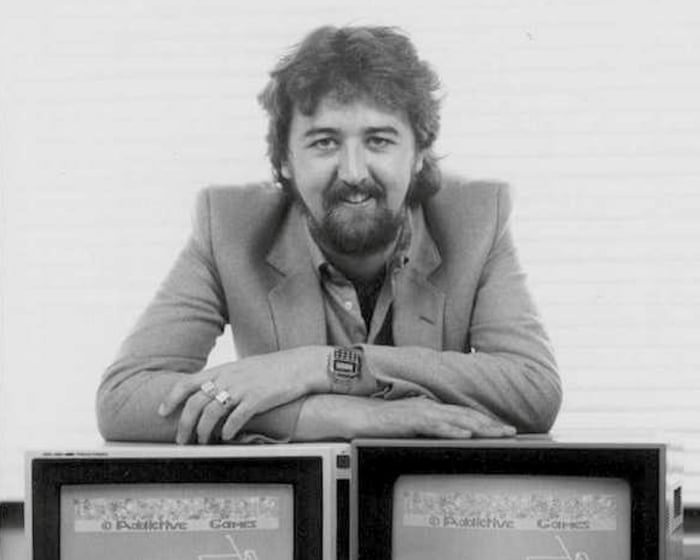
If you were a football fan with a computer in the early 1980s, one game stands out in memory. The box featured an illustration of the FA Cup, with a photo of a smiling, curly-haired man sporting a goatee in the bottom corner. That same image appeared in gaming magazine ads for years—because despite its simple graphics and basic sound, the game was a yearly bestseller. This was Football Manager, the world’s first football tactics simulation. The man on the cover? Kevin Toms, the game’s creator and programmer.
The story behind the game fits right into the era of bedroom coders—talented individuals who crafted hit games for the ZX Spectrum and Commodore 64, often striking it rich in the process. As a kid in the early 1970s, Toms was obsessed with football and loved designing games—though back then, they were board games, since home computers didn’t exist.
“When my parents met with my careers advisor, I told them to ask if becoming a games designer was a real job,” Toms recalls. “The advisor just said, ‘It’s a phase—he’ll grow out of it.'”
He didn’t. Throughout the 1970s, he worked as a programmer on corporate mainframes and even coded for the Open University. “It didn’t take long to realize I could write games on these machines,” he says. “In fact, my first game was on a programmable calculator.”
In 1980, Toms bought a Video Genie computer—a clone of the popular TRS-80. “I realized I could finally turn the football manager board game I’d been dreaming of into a computer game,” he explains. “The big advantages? The computer could calculate league tables for me, and I could program an algorithm to schedule fixtures.”
The Video Genie never took off, so Toms switched to a ZX81 with extra memory and adapted the game for it. “In January 1982, I ran a small ad in Computer and Video Games magazine, and suddenly it took off,” he says. “I’ll never forget the first letter with a cheque inside. Within months, I’d sold 300 copies.”
At first, the game was purely text-based—no graphics. Players picked from 16 teams, acting as manager by buying players, selecting squads, and guiding their team through the season, starting in the old Fourth Division. Toms wrote algorithms to generate fixtures and determine match outcomes based on team stats.
“The tricky part was player attributes,” he admits. “I rated their skill from one to five, but I also needed balance—so you couldn’t just buy the best players and never rotate them. In real football, overused players get injured, so I added an energy rating (out of 20) that dropped with each game, increasing injury risk. That forced you to use weaker players sometimes.”
To add depth, Toms introduced the transfer market—a fan-favorite feature. Early versions offered one random player per week. “If a decent midfielder popped up, but you were holding out for a star, do you spend now or wait?” he says. “That tension made it fun.”
Inspired by Match of the Day, the game captured the drama of football management—and became a legend.Here’s the rewritten text in fluent, natural English while preserving the original meaning:
—
Football Manager match highlights on the Commodore 64. (Photo: Kevin Toms/Moby Games)
The main challenge was memory limitations. The expanded ZX81 had only 16KB, which made certain features difficult—especially team names. “This was long before licensing became an issue,” he explains. “My problem wasn’t whether I needed permission to use Manchester United—it was that the name wouldn’t fit. Every team name had to be eight characters or fewer, so I picked short names like Leeds, though I did include abbreviations like Man U and Man C. Players were mostly famous at the time, but again, with short names—that’s why Keegan made the cut. It’s unbelievable how little memory we had back then.”
Football Manager first launched during gaming’s early days, sold through mail order or at computer fairs. By 1982, mainstream retailers began noticing the growing video game market. “WH Smith contacted me saying they wanted to stock the game and invited me to London. They ordered 2,000 copies—the invoice was more than my annual salary. A month later, my girlfriend called me at work saying, ‘WH Smith ordered another 1,000.’ When I got home, I realized she’d misread it—it was 10,000.”
Toms quit his job at the Open University and founded Addictive Games. Later versions for the ZX Spectrum and Commodore 64 included match highlights—simple graphics showing key moments like goals and near-misses.
“I took inspiration from Match of the Day—they show the most exciting parts,” Toms says. “I deliberately left out a match timer so you never knew when highlights happened or how much time was left. That built tension—it was a key design choice. The slight pause between highlights added to it too. Simple, but effective.”
The game became a phenomenon, topping bestseller lists for years. Fans, including my friends and me, spent hours editing team and player names. “I didn’t grasp its impact for a long time,” Toms admits. “There was no internet then, though I did get letters saying, ‘I played for 22 hours straight,’ or, ‘I failed my mock O-levels because of your game.'” He knew football professionals played too, like Arsenal’s Charlie Nicholas, Spurs manager Bill Nicholson, and Harry Redknapp—who later mentored a Football Manager competition winner in 2010.
Toms created other management games, like Software Star, a simulation of the gaming industry. But as Football Manager updates multiplied, so did the stress. Eventually, he sold the company, left gaming, and returned to business coding while traveling. In 2003, Sports Interactive—developers of Championship Manager—acquired the Football Manager name and rebranded their series, keeping the legacy alive.
(Fullscreen image: ‘I’ve had original players buy it for their kids’ … Football Star Manager. Photo: Kevin Toms)
But the story didn’t end there. A decade ago, Toms reconnected with fans online and asked if they’d want a smartphone version—the same classic Football Manager with its original visuals. The response was enthusiastic, and in 2016, he released Footba…
(Note: The original text cuts off mid-sentence at the end, so the rewrite follows suit.)Star Manager on mobile. He recently upgraded it again and launched a PC version. “People love it because it’s easy to play,” he says. “That’s always been my design approach—it should look simple but have hidden depth, or players won’t stay interested. Some fans tell me they’ve played 500 seasons and have £5 billion in their bank, yet they’re still hooked—that proves the balance is right. Others who played the original are now buying Football Star Manager for their kids.”
Toms has clearly recaptured the magic that created the original Football Manager 40 years ago. He has big plans for Football Star* Manager and possibly Software Star too. “There’s still so much I want to do,” he says. “I have more ideas than time right now. I’m not slowing down—maybe I should, but I won’t.”
FAQS
### **FAQs About “I Had No Idea How Big the Game Would Become for Years”: The Story Behind the Original *Football Manager***
#### **Beginner Questions**
**1. What is *Football Manager*?**
*Football Manager* is a football simulation game where players take on the role of a manager, handling transfers, tactics, and team decisions.
**2. Who created the original *Football Manager*?**
The game was created by brothers Paul and Oliver Collyer, who started developing it as teenagers in the 1980s.
**3. When was the first *Football Manager* released?**
The first version, *Championship Manager*, was released in 1992 by Domark Software.
**4. Why did the name change from *Championship Manager* to *Football Manager*?**
The name changed in 2004 due to a legal split between the Collyer brothers and their publisher, Eidos. The original creators kept the game mechanics under the new name *Football Manager*.
**5. How did the game become so popular?**
Its deep realism, addictive gameplay, and attention to detail made it a hit among football fans who wanted a true management experience.
—
#### **Advanced Questions**
**6. How did the Collyer brothers develop the first game?**
They wrote the original code on a Commodore 64 and later an Amiga, using real-life football data to make it as realistic as possible.
**7. What challenges did the creators face early on?**
They struggled with limited technology, skepticism from publishers, and the difficulty of making a text-based football game engaging.
**8. How has *Football Manager* evolved over the years?**
It went from basic text simulations to 3D match engines, advanced AI, and global scouting networks, becoming one of the most detailed sports games ever.
**9. Did real clubs and scouts start using *Football Manager*?**
Yes! Some clubs and scouts have used its database for player research due to its accuracy.
**10. What’s the most surprising impact of *Football Manager*?**
It inspired real-life managers and even helped some players get discovered.
—
#### **Fun Facts & Tips**