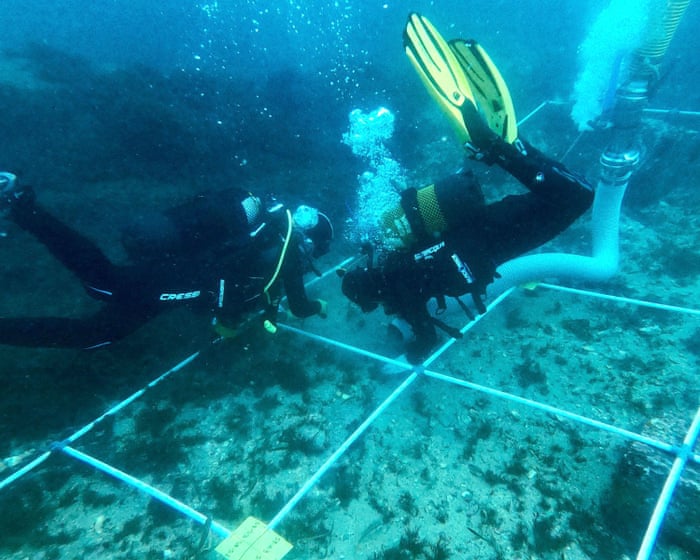
Spanish archaeologists have discovered the remains of more than 30 ships lost over the centuries in the bay between Algeciras and Gibraltar, a key passage at the entrance to the Mediterranean. The finds span from the fifth century BC to World War II.
The bay, at the northern end of the Strait of Gibraltar, has claimed vessels from Phoenician and Roman times to British, Spanish, Venetian, and Dutch ships, along with the occasional aircraft.
A three-year study by the University of Cádiz has identified 151 archaeological sites in the area, including 134 shipwrecks. Researchers from Cádiz and the University of Granada have so far documented 34 of these wrecks.
The oldest is a Punic-era ship from the fifth century BC. Other discoveries include 23 Roman ships, two from the late Roman period, four medieval ships, and 24 from the early modern era.
These underwater artifacts—ranging from an agile 18th-century Spanish gunboat to a 1930s airplane engine—reveal the history of war, trade, and exploration around one of the world’s most strategic waterways.
Felipe Cerezo Andreo, the University of Cádiz archaeologist leading the investigation, known as Project Herakles, described the area as a historic maritime crossroads.
“It’s one of those bottlenecks ships have always had to pass through, whether for trade, exploration, or conflict,” he said. “There are few places in the Mediterranean with such a concentration and variety of archaeological remains from so many different cultures and nations—Dutch, Venetian, Spanish, English, and more—because everyone passed through the strait.”
The team was especially intrigued by three medieval vessels that could provide insights into seafaring during the late period of Islamic rule in southern Spain.
Among the notable finds is the wreck of the Puente Mayorga IV, a small, late 18th-century Spanish gunboat used for swift, stealthy attacks on British ships near Gibraltar. These craft often disguised themselves as fishing boats before revealing their cannon.
Though frequently mentioned in historical records, such boats have rarely been studied by archaeologists.
During an excavation, Cerezo made a curious discovery: what appeared to be a well-preserved book turned out to be a hollow, book-shaped wooden box.
“At first, we thought it might have been used to hide documents, perhaps for espionage,” Cerezo said. “Was the officer mapping an enemy ship?” Further examination revealed the box contained two wooden combs, suggesting its owner was more concerned with personal grooming than spying.
Cerezo and his team hope the Andalusian regional government and Spain’s culture ministry will take steps to preserve and protect these sites.In the Bay of Algeciras—also called the Bay of Gibraltar—archaeological sites face threats from port expansion, dredging, and dock construction. The climate crisis is adding to the danger, with rising sea levels shifting sediment and exposing ancient sites, while an invasive algae spreads over rocks and shipwrecks alike.
To share their discoveries and highlight the need for preservation, the research team has created virtual models and 360-degree videos of the sites. These are shared online and displayed in local museums and town halls.
“We bring virtual reality goggles so people who don’t dive can still experience what it’s like underwater,” said Cerezo. “Sometimes people expect to see a treasure ship like the Unicorn from Tintin, but most wrecks aren’t that well preserved. The reality can be a bit disappointing, but it’s important for the public to know what’s happening. Showing them this creates a demand to protect these sites.”
According to Cerezo, the bay offers a unique window into thousands of years of maritime and cultural history.
“We have a very small area that lets us trace the evolution of maritime history across almost the entire Iberian Peninsula and North Africa. It reminds us of a story we often forget—that coastal communities have lived closely with the sea, depending on it deeply. Studying these archaeological remains in place, not just as objects in a museum, helps us reconstruct and tell the story of these people in their true context.”
Frequently Asked Questions
FAQs Ancient Shipwrecks Discovered in the Bay of Gibraltar
BeginnerLevel Questions
1 What exactly was discovered
Spanish archaeologists have found a collection of ancient shipwrecks on the seafloor in the Bay of Gibraltar These are the remains of ships that sank centuries ago
2 How old are these shipwrecks
The wrecks span a long period with some dating back over 2000 years to the Roman era and others from more recent historical periods
3 Why is the Bay of Gibraltar such a good place to find shipwrecks
The Bay is a narrow strategic chokepoint for maritime traffic For millennia ships from different empires and cultures have passed through its oftentreacherous waters making it a hotspot for maritime accidents and consequently archaeological discoveries
4 What kind of things were found on or near the wrecks
Researchers typically find artifacts like amphorae anchors ship fittings pottery and sometimes personal items belonging to the crew These objects help tell the story of the ships voyage and purpose
5 Will these shipwrecks be raised and put in a museum
Its unlikely the entire ships will be raised Underwater archaeology usually involves carefully documenting mapping and recovering select artifacts in situ Raising a whole wooden wreck is extremely difficult and can damage it Museums may later display recovered artifacts
Advanced Practical Questions
6 What makes this discovery so significant for historians
This hidden trove provides a continuous archaeological record of maritime trade warfare and cultural exchange in one of the worlds most important sea lanes It can reveal changes in shipbuilding technology trade routes and economic patterns over centuries
7 How do archaeologists find and study wrecks deep underwater
They use advanced technology like sidescan sonar and multibeam echosounders to map the seafloor Remotely Operated Vehicles with cameras and robotic arms allow for detailed inspection and delicate recovery of artifacts without divers needing to make risky deep dives every time
8 What are the biggest challenges in underwater archaeology like this
Challenges include depth strong currents preserving waterlogged artifacts once they surface securing funding and protecting sites from l