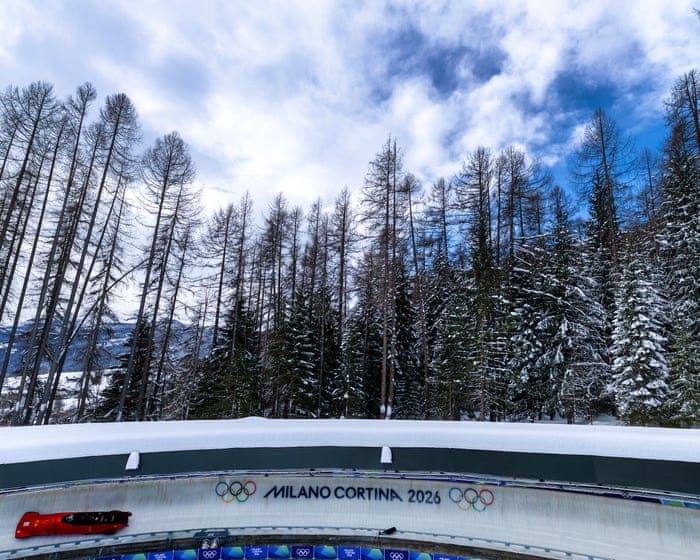
At the foot of the mountains, along the riverbanks in Cortina, there once stood a forest. It was filled with tall larch trees. Arborists estimated the oldest had been there for 150 years, and dendrologists noted its uniqueness—a monocultural forest growing at such a low altitude in the southern Alps was rare.
Locals knew it best as the place with the old wooden bobsleigh run, a spot for summer or autumn walks, or for playing tennis on the small courts built near the bottom. They called it the Bosco di Ronco, and it is no longer there.
Sustainability has been the great lie of these Games. It was woven throughout the bid document, and the International Olympic Committee has stamped it across all kinds of promotional materials. “For the IOC, for sport in general, sustainability is a priority,” said Christophe Dubi, executive director of the Olympic Games. If you ask for details, the IOC will gladly share information about its low-carbon transport plan and its use of recyclable cutlery and linen tablecloths. They’ll repeat that 85% of the venues for these Olympics already existed or are temporary.
What they won’t mention is that most of those existing venues had to be demolished and rebuilt on a much larger scale. They won’t say they carved a new snowpark out of a mountain in Livigno, even though one already existed in Trepalle in the next valley. Or that in Predazzo, the ski jumps were rebuilt from scratch just a few hundred meters from the old ones. Or that to make room for the new bobsleigh track, they cut down the Bosco di Ronco—so now, if you go there, all you see are two kilometers of steel and concrete.
They also won’t tell you that the climate crisis has pushed average February temperatures in Cortina up by 3.6°C since the Olympics were last in Italy 20 years ago, or that average February snow depth has dropped by 15 cm over the past 50 years. They won’t mention the four high-altitude reservoirs built to provide 2.3 million cubic meters of artificial snow, needed to pad the ski runs to a depth of 1.5 meters. Or that most of the water filling those reservoirs is pumped up the mountains after being drawn from local rivers, which are already in drought for much of the year.
They probably won’t bring up that out of the total spending on 98 construction projects, only 13% went toward essentials for staging the Games, while the remaining 87% funded infrastructure like roads, rails, and parking lots—most of which aren’t even scheduled to be built until after the Olympics are over. Or that the Italian government waived Environmental Impact Assessments for 60% of these projects. Or that all of this is taking place in the heart of a UNESCO World Heritage site, one of the most fragile ecosystems on the planet.
“The Milano Cortina 2026 Winter Olympic Games were presented as ‘the Olympics of sustainability,’” says World Wildlife Fund Italia, “but this is not the case.”
It didn’t have to be this way. WWF Italia was part of a group of environmental organizations that met with the Italian Olympic Committee to plan a more sustainable Games. They felt forced to walk away when it became clear the organizers were only using them for appearances. “In reality,” the WWF stated, “there has been no real discussion, prompting the associations themselves to abandon the roundtable a year before the start of the Olympic Games.”
When they cut down the Bosco di Ronco, the Venetian cellist Mario Brunello came and played Camille Saint-Saëns’s “The Swan” among the fallen trees.Luigi Casanova, a former forest ranger turned writer and activist, stood among the fallen trees. “It’s important to remember that in all these cases, the Italian environmental movement has proposed alternative solutions,” he says. “Options that are less harmful to the environment, less expensive, safer, and more beneficial to local communities. The environmental and landscape damage from these Olympics will be a burden for future generations.”
Casanova, author of two key books on the Olympics’ environmental impact, calls the forest destruction “the most glaring example of the violence of these Games.” He lists other concerns: “We have more Olympic sacrileges to account for: the Socrepes cable car in Cortina, built on an active landslide; the Olympic village in Cortina, where 15 hectares of natural land were destroyed for a temporary facility; the village in Predazzo built where two flood-prone streams meet; and the slopes in Bormio and Livigno, upgraded at the cost of thousands of trees.”
Not everyone shares his view. Some local business owners say they don’t miss the forest and welcome the economic activity the new bobsleigh track will bring. Italy has hosted the Winter Olympics twice before, in 1956 and 2006, and both times the bobsleigh tracks built for them were later abandoned. This difference of opinion highlights a local tension: the need for economic infrastructure versus the damage its construction can cause to the community’s long-term well-being.
Providing the vast amounts of artificial snow required for the Games has been a major undertaking. Four new high-altitude reservoirs were built to supply the water needed to create 2.3 million cubic meters of fake snow.
Carmen de Jong, a hydrology professor at the University of Strasbourg, has been leading a multi-year study on the Winter Games’ environmental impact, focusing on water use. It’s easy to forget while watching the broadcasts that these competitions aren’t held on natural snow. The snow is manufactured using water drawn from various sources—springs, streams, rivers, reservoirs, drinking water systems, and even groundwater, which must be pumped uphill and cooled.
“Four new reservoirs ‘had to be built’ to supply huge volumes of snow for just a few days of competition on the ski runs, half-pipe, and snow park,” she explains. “In a rushed effort to make up for construction delays, organizers pumped as much water as they could from alpine rivers already suffering from drought.”
According to De Jong’s analysis, temporary permits allowed them to take three to five times the usual permitted amount of water from the Spöl river in Livigno and the Boite river in Cortina, “nearly drying them up and leading to fish deaths and severe pollution.”
“Water reservoirs for making artificial snow at alpine ski resorts or Olympic venues are a clear sign of water scarcity and a cry for help in an era of climate change,” she adds.
Spreading the Games across such a wide area has multiplied their environmental impact on a region already under great strain. The Olympic drive to make each Games newer, bigger, and better than the last makes the claim that this is a “sustainable Games” feel like an insult to everyone involved.
Frequently Asked Questions
FAQs The Hidden Environmental Cost of the Winter Olympics
BeginnerLevel Questions
1 What do people mean by the hidden environmental cost of the Winter Olympics
It refers to the significant often overlooked damage to the environment caused by hosting the Games This includes the destruction of natural landscapes high energy and water use massive waste generation and increased carbon emissions from construction and travelimpacts that arent always obvious to viewers
2 Isnt snow natural How can a winter sports event be bad for the environment
Modern Winter Olympics require massive infrastructure built in fragile mountain ecosystems They often rely on artificial snow which uses huge amounts of water and energy The transportation of athletes spectators and equipment also creates a large carbon footprint
3 Whats the biggest environmental problem with hosting the Winter Olympics
The most critical issue is location Building in pristine often protected mountain areas leads to deforestation habitat destruction and soil erosion The sites are frequently altered beyond recognition and struggle to recover
4 Do the Games leave anything positive for the environment
Organizers often promise green legacies like improved public transport or renewable energy projects However these benefits are frequently outweighed by the immediate damage and the white elephant problemleaving behind oversized unused venues that continue to consume resources
Advanced Practical Questions
5 How does artificial snow create an environmental cost
Making artificial snow requires vast amounts of water and enormous energy to power snowmaking machines It can deplete local water sources harm aquatic life and ironically relies on fossil fuels in a warming climate thats making natural snow scarcer
6 What is carbon footprint and how do the Winter Olympics contribute to it
A carbon footprint is the total greenhouse gas emissions caused by an event The Olympics contribute through construction travel energy for venues and accommodations and the operation of events themselves
7 Can you give a real example of environmental damage from a past Olympics