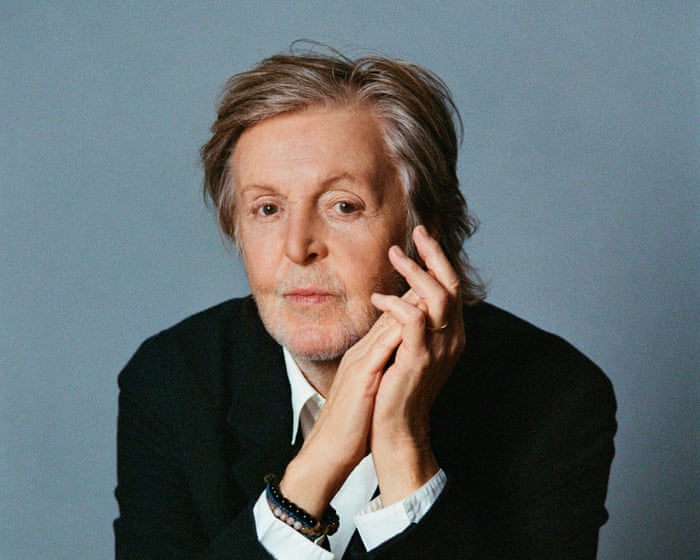
“How far back do you want to go?” In his office overlooking Soho Square in London, Paul McCartney and I sit together on a small sofa, reminiscing. The room smells deep and resinous, with a faint church-like quality. A large green glass candle sits on the windowsill, and beyond it, a view of plane trees bathed in early afternoon sunlight.
McCartney bought this building in 1974, and it has long served as a home for his publishing company and other ventures. On another floor, two members of his team look over prints of his late wife Linda’s photographs, spread out on the boardroom table. An assistant is busy organizing a bagel order, while in the small lift, someone is moving a trolley full of drinking glasses up to the kitchen, a cheerful clinking and clattering echoing through the floors.
McCartney and I are talking about the earliest sounds he can remember—what Seamus Heaney once called “linguistic hardcore.” These are the sounds that unconsciously shape the ear, providing a kind of aural foundation. The Boys of Dungeon Lane, McCartney’s 18th solo album, has been described as “a collection of rare and revealing glimpses into memories never-before shared,” and it’s full of such sonic details: skylarks, train whistles, the sound of a bus braking as it pulls up to a stop. But the record isn’t a syrupy, string-heavy exercise in nostalgia; instead, it’s an adventurous and youthful take on guitar music.
McCartney thinks back. “OK, well, now we’re getting into questionable territory, because I have a feeling I can remember being born,” he says. “Highly questionable, highly questionable, but I can picture the white tiles and chrome instruments and the sounds… It’s probably total nonsense. In fact, it almost certainly is. An imagined memory! And I was a forceps delivery.” He pauses, his face full of warmth and mischief. “I don’t quite understand what that means. I think they had to pull me out with some pliers.”
He returns to the topic of sounds. “There are so many,” he says. “We could be here for a few hours.” At infant school, running indoors with his classmates. At 10 years old, living on Western Avenue in Speke, “hanging out on the grass verge of the dual carriageway, with girls, and listening to them chatting, and one of them said, ‘You’ve got great eyelashes!'” There were the family singalongs of Carolina Moon, Red, Red Robin, Bread and Butterflies; a joke told by some uncle or other, for which he can only remember the punchline: “Repartee.” He can remember the first time he heard the word “ubiquitous.”
“Lots of memories,” he says. “Really deep. They’d be completely meaningless to anyone else, really.”
The curious thing about Paul McCartney’s life is that nothing is considered meaningless. As the foremost songwriter of his generation and beyond, every detail of his 83 years has been examined. Thousands of books about the Beatles have been published; there are now multiple Beatles podcasts, fan forums, and Peter Jackson’s eight-hour documentary Get Back. At the time of writing, there are at least two screen projects in production: Sam Mendes’ ambitious plan for four interconnected films, and Christian Schwochow’s BBC drama series Hamburg Days, which follows the band’s formative time in Germany. And of course, there are the songs themselves—so familiar now that they feel less like music and more like family.
Almost everyone feels they know McCartney, so being in his presence is disorienting. How should one act? Today, he makes it easy—a cheerful figure in a blue plaid shirt and dark jeans, casually filing his nails when I arrive. When I mention how much I like the new album, he responds with a”Folksy: ‘Well, you can come again.'”
McCartney says that when he writes songs, “I don’t really know what’s going to come out.” He doesn’t think there was “anything intentional” about deciding to revisit his past – it was just a chance to tell stories. The Dungeon Lane in the album title was a birdwatching spot near the house on Ardwick Road where the McCartney family moved in 1950. “Rows and rows and rows of council houses,” he says. “But they were great council houses.” The big improvement was having an indoor toilet, but there was also plenty of space that made him proud when relatives came to visit.
With his mother working as a midwife and his father as a salesman for a cotton merchant, they didn’t have many luxuries. But they had an upright piano, a radio, and a carpet where he could lie down and listen to them both. “Radio was a great source of information and music – the BBC was very good for all that. I’m a big BBC fan,” he says firmly. The first single from The Boys of Dungeon Lane was premiered on the BBC’s local station, BBC Merseyside.
He remembers listening to “great little classical pieces, and they stick in your brain.” To this day, he can recall the names from the end credits of the broadcast: “Orchestra conducted by Harry Rabinowitz…” He says the name with a kind of rich enjoyment. “I love radio because it just makes your imagination run wild.”
He liked radio plays and comedy sketches – the vivid possibilities of things you couldn’t see. In the late 1960s, he drove from London to Liverpool in his new Aston Martin. “And I turned on the radio, and it was a play by Alfred Jarry, Ubu Cocu [Ubu Cuckolded],” he says. “I loved it! It’s wild: ‘Hand me my shitter pump!’ I thought, yeah, I can relate to this guy. And he’s just so outrageous.”
Ubu Cocu would later influence much of Maxwell’s Silver Hammer, which appeared on the Beatles’ 1969 album Abbey Road. “The radio just gave me that,” he says. “I don’t think I would have ever come across it otherwise.”
The radio also brought him rock ‘n’ roll: Jack Jackson’s Record Round-up on the BBC Light Programme, and David Jacobs, “who was a very posh BBC announcer, but he was very cool, and he suddenly says: ‘There’s a wonderful American record by Ray Charles called What’d I Say?‘” My god, thought the young McCartney, what is this? He smiles. “So, radio blowing your mind again.”
The first time he heard himself on the radio was in 1963, while driving his Ford Classic. “I remember exactly where I was,” he says, “going past the Grafton in Liverpool, and Love Me Do came on.” He didn’t pull over. “No, I just kept going, thrilled. But it was something.”
A few years ago, McCartney made a book and a podcast series with the poet Paul Muldoon. The singer had once wanted to be a poet, and together they explored the lyrics of over 150 of his songs with a literary focus. One of those was Penny Lane, the 1967 hit where McCartney draws on memories of a street in the Liverpool suburb of Mossley Hill, where he, John Lennon, and George Harrison would change buses at the Smithdown roundabout terminus.
“It was a place that was very important in my life and in John’s life,” he told Muldoon. “And the nice thing about writing it was that John knew exactly what I was talking about.” He described the bus shelter, the roundabout, the striped pole of the barber’s shop. “When we brought it to life in the song, it was a nice thing for John and me to share again.”
Many of the songs on The Boys of Dungeon Lane cover similar ground. How strange it must feel to write about this place, this time, without your great partner. In Ian Leslie’s recent book Joh…In n & Paul: A Love Story in Songs, he writes about how, after hearing Lennon’s song “Strawberry Fields Forever,” McCartney wrote “Penny Lane” as “a kind of answering song about childhood – and not just his own childhood, but the one he shared with John.” The two songs were released as the A-side and B-side of the same single. “We should imagine them facing each other,” Leslie writes, “deep in conversation.”
McCartney’s partnership with Lennon had changed before the Beatles split in the spring of 1970, but when Lennon was killed in late 1980, the conversation ended completely – every song left without a reply. “My collaborator was probably one of the best writers of the century, so, yeah, you’re going to miss him,” McCartney says now. “But when I write about a specific place, I kind of know he would’ve known it.” So wherever McCartney might go with a song, “I can gauge his reaction: that’s good, stick that in.”
View image in fullscreen: The Beatles (pre-Ringo) from left, George Harrison, Lennon and McCartney, outside Paul’s home in Liverpool, circa 1960. Photograph: Keystone/Getty Images
“But that’s life: you lose people,” he adds. The Beatles’ long-time producer George Martin once warned him about the sudden loss that comes with age: “Oh, the terrible thing about it is all your mates start popping off …” McCartney remembers him saying. “Now I’m probably at that age, and I’m very conscious of that, having lost John and George [Harrison] – two big touchstones for anything we’re talking about.”
There’s a song on the album called “Down South” that recalls the days when he, Harrison, and Lennon would go hitchhiking. The three of them would meet on Chester Road, at the spot where all the lorries set off. “George would’ve known exactly what I meant, and where we went, as would John,” McCartney says. “So, yeah, you do miss them. I start to get very sad, and I have to think, ‘Wow, wait a minute, everyone misses them.’ It’s not just me. So that makes me feel a bit better. I think: ‘Well, sod it, it’s life, and it’s what we’ve got.'”
McCartney’s collaborator on The Boys of Dungeon Lane was producer Andrew Watt, a 35-year-old American known for his work with Elton John, Lady Gaga, and Ozzy Osbourne, and for producing the last two albums by the Rolling Stones (McCartney even appears on their latest, out in July).
Watt had never been to Chester Road, but somehow they found common ground. In fact, he encouraged McCartney to be more specific in his lyrics. “I was writing a bit in ‘Days We Left Behind’ where I was saying ‘We met at Forthlin Road …'” McCartney recalls. “And I thought: Should I put that in? I know where Forthlin Road is, but does everyone?” Everyone has a Forthlin Road, Watt assured him. “You don’t have to know or have been to the place, but you get it,” McCartney says.
Watt and McCartney first met over tea at the producer’s studio. The night before, Watt had woken up in a cold sweat. On the phone from Los Angeles, he recalls his thought process: “Shit: I play the guitar right-handed and he plays the guitar left-handed.” He immediately started a frantic online search for the left-handed guitars he knew McCartney played – a Höfner, a Martin D28, an Epiphone Casino. “Just in case he asked for a guitar …”
And he did. “I was talking to him about how you write a song,” McCartney says. “And I said it can happen in all sorts of ways, but one of the things I do lately is just put my fingers on the piano and see if it’s good.” He could try the same approach on a guitar, he suggested. Watt was ready with the left-handed one. McCartney put his fingers on the strings and played. “There you go,” he told Watt, “that’s a wonky chord.” He had no idea what it was, but it would become the basis for the song.The album’s spectacular opener, “As You Lie There,” begins here.
[Image: Paul (left) and his brother Mike with their parents Mary and Jim at their family home in Liverpool in the 1940s. Photograph: © Paul McCartney and Mike McCartney, used with permission]
He claims he still doesn’t know what the chord is. “I’ll tell you what, I would like to know,” he says now, picking up the guitar that has been sitting quietly to his left. “I know quite a few chords like… E!” he plays. “A! B G C F… I know all those. But I’m interested in what this is. Someone will know; someone with some musical knowledge.” He plays the chord for me. I wonder what emotion it brings up for him. “Sort of a little bit of strangeness,” he says. “A little bit of romance. Stranger than fiction.”
Watt describes working with McCartney as “the greatest experience of my life.” He was a lifelong Beatles fan, but the singer made sure he never felt intimidated. “He knows exactly who he is and what he’s done. When he comes into the room, he comes with no ego. It’s as if he invites you to come up a little bit to his level, and he comes down a little bit for you. He makes it very open.”
Watt has plenty of memories from their time in the studio: how he was moved to tears by the vulnerability of “Days We Left Behind,” and how “Home to Us” – a duet with Ringo Starr that started with a Ringo drum track – ended up sounding so strikingly fierce and loud. “We did not have pretty childhoods,” McCartney told Watt; it was important that the song should be just as tough. In the middle of recording the song, McCartney went to see Oasis and was inspired by the enormity of the band’s sound. “Forget about Spinal Tap’s 11,” he told Watt, “the amps are on 12.” He wanted a similar immensity.
As we sit on the sofa, McCartney’s conversation flows on: from the album’s other guest appearances (Chrissie Hynde, Sharleen Spiteri), to midwives’ housing in the 1950s; how Liverpool’s bus network was arguably as transformative as the railroad in Lincoln’s time; how sometimes he thinks about his parents, caring for him as a newborn during the war, and how it becomes impossible not to relate it to the current situation in Ukraine or Gaza, “where any second, bombs could be dropping, and you have to cope with that knowledge.”
[Image: McCartney performs on Saturday Night Live, May 2026. Photograph: NBC/Lloyd Bishop/Getty Images]
Such dark imagery hangs in the shadows of “Dungeon Lane”: a sense of life pressing hard, with rent to be paid and “no food in the larder”; husbands getting high, families who “couldn’t take any more / But they had to.” The album seems to draw a line between those tense days and our own troubled times. McCartney is baffled by much of the current age – its politics, technology, and aggression. “Who would’ve ever thought you’d have an American president like that?” he wonders. “You wouldn’t have thought they could get away with it. Or the secretary of war? That I can’t believe.”
“I still think humanity’s got great resilience and great spirit, and most of the people I meet are cool, good, nice people, family people,” he continues. “And I think we all have reasonably similar values. And often, if I’m writing a love song, I think, ‘Oh, this is not local. They’re doing this kind of thing in China. They’re falling in love and having babies.’ It’s a human thing. So I have every hope that we’ll get through it.”
With a little help from my friend: John, Paul and the ‘romance’ that transformed culture
Read more
He pauses. “My way is to kind of ignore a lot of it,” he admits. “So there’s a lot of things I don’t do.” Such as? He looks animated. “Cookies!” he says – referring not to biscuits, but to the eternEveryone gets annoyed with the internet. “Everyone just accepts cookies, and I’m like, ‘No!’ I’m always looking for the ‘reject all’ button.”
Recently, McCartney performed at a gig for Apple’s 50th anniversary. “Apple 2, as we call them,” he says with a smile, referring to the Beatles’ own record label, the original Apple. He ended up talking to then-CEO Tim Cook and took the chance to complain about how the iPhone constantly needs software updates. “I don’t want updates!” he told him. “I just learned how to use this one! My feeling is: Look, I bought this device, it’s mine. So it should pretty much do what I want.”
He picks up his phone and shows me a photo he took of a vase of hydrangeas in his house. “Mostly, it’s just a camera for me,” he says. Does he use emojis? “Yeah, I like emojis,” he nods. What are his favorites? “Thumbs up is a big one. I use the little cowboy face. And then I get a bit creative—I’ll do strong arm, heart, strong arm,” he smiles, hopefully. “I think it looks a bit like a person.”
The Boys of Dungeon Lane is out now via MPL/Capitol.
Frequently Asked Questions
Here is a list of FAQs based on the quote and context you provided covering the Paul McCartney story and his approach to making his new album
BeginnerLevel Questions
Q What does Paul McCartney mean when he says I can tell what John would think Thats good keep it in
A He means that when hes writing or recording a new song he can imagine what his late Beatles bandmate John Lennon would have said In this case he felt John would have approved of a creative choice encouraging him to keep a certain musical idea in the final track
Q Who is Paul McCartney talking about when he mentions his old bandmates
A Hes primarily talking about his fellow Beatles especially John Lennon and George Harrison He also references the bands producer George Martin and the general collaborative spirit of The Beatles
Q Did Oasis actually play on Paul McCartneys new album
A No Paul says the attitude and sound of Oasis inspired him He was thinking about how Oasis captured a big bold rockandroll feeling that reminded him of The Beatles early energy and that vibe influenced his new songs
Q Is this Paul McCartneys first solo album
A No he has released many solo albums both with Wings and under his own name This is his most recent album and hes talking about how he approached making it in a new way
Intermediate Questions
Q Why would Paul McCartney still care what John Lennon thinks decades after Johns death
A Paul has said that after working so closely with John for over a decade their creative dialogue became an internal voice for him He often asks himself What would John say as a way to test if an idea is too safe too weird or just right Its a form of creative guidance
Q What specific problem does this mental trick solve for Paul