“It’s a natural human instinct, especially as an athlete, that you don’t want to lose,” Peter O’Mahony says on a quiet evening in Dublin as a new rugby season approaches. “But at times it got in my way and caused despair. I honestly don’t know where that deep-down hatred came from, but it used to derail me at times.”
The former captain of Munster, Ireland and the Lions is settling into his second year of retirement. The quiet determination and uncompromising commitment that defined his career have given way to more complex reflections. O’Mahony is a fascinating character, and I ask whether he would have had the same competitive drive if he had been a genius at, say, chess or mathematics.
“Rugby definitely fuelled it for me,” O’Mahony says after a pause. “It’s an aggressive, abrasive contact sport and it brings it out more. The other side was representing the team I grew up in, whether it was Con [Cork Constitution], Munster or Ireland. They each meant a huge amount to me, and maybe my attitude came from wanting to do well for the places I came from and which had given me so much.”
In his revealing and absorbing new book, O’Mahony writes about the philosophy that once prevailed at Munster. Before a European Cup game, the players were made to believe they needed to act selfishly and harshly towards their families at home. They thought it was the only way to convey the magnitude of the game and their seriousness of purpose. It seems a strangely reductive approach for a great rugby institution, because Munster have produced players as intelligent as Keith Wood, Paul O’Connell, Ronan O’Gara, Conor Murray and O’Mahony.
“Rugby is a game of hard men,” O’Mahony says. “These boys were tough men, and whether it’s rugby or not, you don’t let your feelings get in the way. That’s how I carried on for a long time, up to a point where I knew I needed to change. It might have been the way I got the best out of myself, but when you’re in a team environment and you’re a leader, you have to be adaptable to get the best out of others.”
View image in fullscreenPeter O’Mahony in action for Ireland against Italy in the 2022 Six Nations. Photograph: Dan Sheridan/INPHO/REX/Shutterstock
A hard-edged game took its toll on O’Mahony, who won 114 caps for Ireland. He writes movingly of how, just before his third and final World Cup in 2023, his young son Theo was devastated that O’Mahony was going away again: “If you drove past me on the road to Cork, you would see the real Peter O’Mahony sitting alone in his car, crying tears he didn’t know he had.”
O’Mahony still captained Ireland after that tournament, but he changed his pre-game rituals for Munster. On the morning of home games he would happily supervise his three kids at a playground. “Was I missing something by not being [selfish]? I don’t think so.”
The way he changed is best illustrated by his observations of the intriguing coaches he played under. They took the obsessive streak that characterised him to an even greater pitch of intensity. He describes all of them, with the notable exception of Andy Farrell, as being “a little bit cracked”.
O’Mahony says: “I think they’re all a bit mad. You have to be a bit mad to be that obsessed. If you look at the way Andy played, and how aggressive and confrontational he was, there were times when he’d have seemed a bit cracked as well. It just wasn’t something he passed on to us. Andy was able to always get things right, and communicate so well in a hugely pressured environment.”
Farrell, who has had such success as Ireland’s head coach, emerges as a compassionate, empathetic and fully rounded man who wants his players “to be inquisitive and curious”.
Joe Schmidt, for whom Farrell worked as Ireland’s defence coach, transformed O’Mahony and the entire Ireland team asFrom 2013 to 2019, he was the head coach. “Joe brainwashed us in some ways,” O’Mahony says. “A play would be called, and I didn’t have to think about anything.”
View image in fullscreen
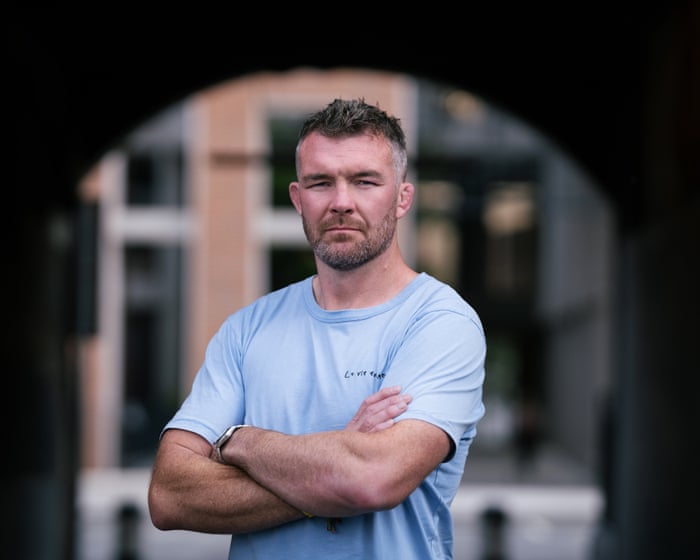
Peter O’Mahony says rugby used to fuel his competitive streak to the point he had to change. Photograph: Patrick Bolger/The Guardian
Ireland won the Six Nations three times during Schmidt’s time in charge, including the grand slam in 2018. They also reached No 1 in the world rankings but failed when it mattered most, at the World Cup, and O’Mahony is refreshingly honest about the coach’s limitations. Beyond handing out heavily scripted game plans, Schmidt never seemed able to communicate easily away from the rugby field. The contrast with Farrell, who is warm and funny, soon became clear.
Did he ever ask Farrell, who always encourages players to feel they can be vulnerable and open, how he coped when working for three years under Schmidt’s rigid regime? “No, but I would have thought it must have been tough for him.”
Farrell also has a skilful and subtle way of communicating that Warren Gatland, his predecessor as British & Irish Lions head coach, never matched. Gatland made O’Mahony Lions captain for the second Test against New Zealand in their drawn series in 2017, but they barely spoke to each other. So is Farrell the best coach he played under?
“Definitely. I was very lucky that, at Munster, I was coached by Rassie Erasmus and Jacques Nienaber [the South African duo who led the Springboks to back-to-back World Cup wins in 2019 and 2023]. They were obviously a world-class team. But I spent a lot more time with Andy and he was the best coach I ever came across.”
Erasmus is the most successful, if controversial, coach in world rugby, and he was at Munster for just over a year before returning to South Africa in 2017. “Rassie had a closed-door policy,” O’Mahony says of Erasmus’s communication style, “but he was very good in other ways. He set up a creche so that partners could come to games. But if you were complaining about getting an extra ticket or two when you weren’t performing, you were getting nothing. I responded well and thought we were on to something good – which is probably the main reason I was upset by the way he left.
“But it’s business. Rassie had a career to look after and when the biggest job in the world comes up for you, of course there’s only one decision to make. He certainly hid it from us, but that’s how business in life is done.”
What does Erasmus do best as a coach? “The way he manages players is superb, and how he frames games and sets up training is really excellent. The way he motivates is up there with the best, and his ability to motivate South Africa is clearly at an even higher level. He is also able to put a bit of fear into you – the fear of losing, the fear of not performing.”
O’Mahony followed Erasmus’s diversionary tactics in the early stages of the Springboks’ recent 3-1 series victory against New Zealand. “Now that I’m out of the game I can say it’s probably good for rugby. It gets people talking. It also takes a lot of pressure off the players because everyone’s talking about Rassie.”
skip past newsletter promotion
Free newsletter | Weekly
Sign up to The Breakdown
The latest rugby union news and analysis, plus all the week’s action reviewed
Enter your email
Sign up
after newsletter promotion
The 37-year-old seems at peace with rugby now, even if the hurt Munster caused him at the end of his career lingers. He was about to be named Ireland’s new captain when, in late 2023, Munster fell strangely silent about his new contract. Graham Rowntree, who coached Munster then, seemed to have doubts about O’Mahony’s ability to play much longer. O’Mahony says he threw a pen on the floor and asked him to pick it up to show his“I’ve spent my adult life at the club,” O’Mahony writes, “and this is what it’s come down to now: Wig [Rowntree] throwing a pen across the floor for me to fetch like a fucking dog … I knew, as every professional knows, that the end will not necessarily be pleasant, but I couldn’t have imagined it would be handled like this. I thought it was bad business.”
How does he feel about Munster now? “It still burns,” he says quietly. “I’d be lying if I told you anything else. I enjoyed 99% of my time at Munster but there were numerous occasions when I was going to announce my retirement and they’d say: ‘No, hang on and let’s see.’ We were getting mixed messages. It’s ruthless but I still felt let down.”
He shrugs. “I love Munster. I still want the club to do well – for the good people there. That will never change.”
Would he return in a different capacity? “I’d be more than happy to help with advice, and offer some of my experience, as to how to do things a bit better. But I don’t think there’s a place for me there at the moment.”
There is even less chance of O’Mahony joining the legion of madmen by becoming a professional coach. But he now helps out his old club, Cork Constitution, one night a week. “I get up there on Thursday nights and help the coaches a bit. It’s so different [to professional rugby]. The guys are coming from work and there’s a huge enjoyment factor. I grew up at Con as a small boy and my two boys are playing there now. So I have a huge amount of thanks to give to Con and it’s nice to give a little bit back.”
Does he ever feel, on those fun Thursdays, that he might like to coach more seriously? “No. It’s a huge commitment and that’s not on the cards for me.”
Peter O’Mahony spent his entire career at Munster, but left under a cloud. Photograph: Dan Sheridan/INPHO/REX/Shutterstock
Instead, O’Mahony explains, “I’ve set up a gardening lifestyle business and I’m doing a bit of rugby work on TV as well.”
We spend the next five minutes talking about O’Mahony’s longstanding passion for gardening and he sounds like the Monty Don of Ireland. “I don’t know about that,” he says with a grin. “I’ve had a couple of suggestions about some TV garden stuff but I don’t know if I have the personality for TV. It matters more that I love my gardening. It’s therapy for me. I like the work and I like seeing things grow and change and mature. It’s very rewarding.”
Will we see a Peter O’Mahony garden at the Chelsea flower show one day? “Our new business has garden planters and we’re coming out with a range of tools. But I don’t have the experience now of setting up a garden like that. That would be a big project. Maybe down the line. There’s a garden show called Bloom here that I did a bit of work for last year. That’s very impressive. But we have to remember how vast Chelsea is, and its history.”
He adds that he has agreed to “do a gardening book – it would be a bit about our own garden, a bit of what to do in each season or each month”.
O’Mahony leans back in his chair, relaxed at last, and he looks briefly amused when I ask which of his coaches most resembles Monty Don? His answer comes with a small smile: “I don’t think any of them were that balanced and calm.”
Peter O’Mahony’s All In is published by Sandycove/Penguin
Frequently Asked Questions
Here is a list of FAQs based on the topic of Peter OMahony discussing his lifestyle changes giving up his hardedged routine and his love of gardening
Beginner Questions
Who is Peter OMahony
He is a professional rugby player from Ireland known for playing for Munster and the Irish national team
What does giving up his hardedged routine mean
It refers to OMahony moving away from a lifestyle that was strictly focused on aggression physical toughness and constant intensity both on and off the pitch
Why did he need to change
He realized that maintaining a constant hard exterior was exhausting and not sustainable for his longterm mental and physical health
What does gardening have to do with rugby
Gardening is the opposite of rugby It is quiet slow and nurturing For OMahony it became a way to balance the violence of his sport with peace in his personal life
Is gardening a common hobby for athletes
Yes Many athletes use gardening to relax reconnect with nature and take their minds off the pressure of competition
Advanced Questions
How does gardening help with the mental side of professional sports
Gardening requires patience and care It forces athletes to slow down their breathing and focus on the present moment which helps reduce anxiety and burnout
Does changing your routine affect your performance on the field
No it often helps By finding peace off the field players can conserve their aggression for the game rather than using it up in daily life
What is the biggest challenge when trying to change a hardedged persona
The biggest challenge is social pressure Teammates and fans may expect you to always be tough Learning to be vulnerable or gentle in private takes courage
Can gardening teach lessons that apply to rugby
Yes Gardening teaches that growth takes time You cannot force a plant to grow faster by yelling at it Similarly in rugby you must trust the process and put in consistent work
What are practical tips for someone who wants to soften their routine
Start small Set aside 20 minutes a day for a quiet activity like gardening reading or walking Do not check your phone during this time Focus on the task in front of you not the next competition
Common Problems Examples