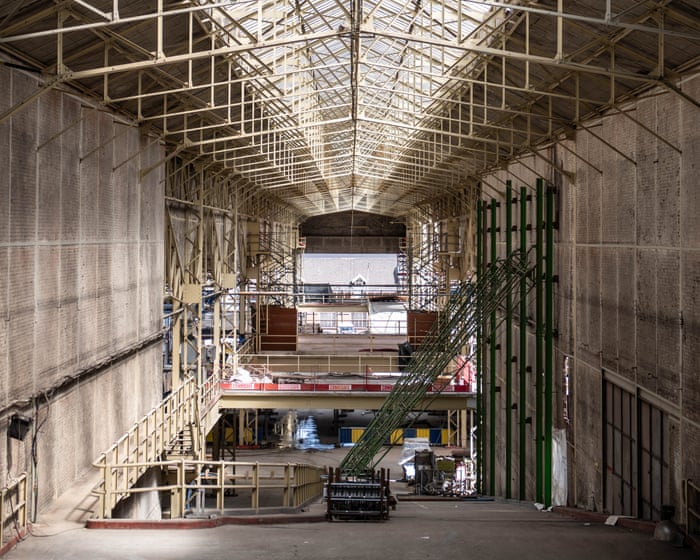
With one year to go until its planned opening on November 28, 2026, construction of Kanal—a new contemporary art museum in Brussels—is on schedule. The museum, located in a renovated former Citroën garage on the northwestern edge of the city center, is 95% complete. Curators are adding the final touches to the opening exhibition, which will feature works by Matisse, Picasso, and Giacometti on loan from the Centre Pompidou in Paris. Trilingual wall texts in English, Dutch, and French have already been approved.
Spanning five floors and offering 12,500 square meters of exhibition space, along with an architecture center, restaurants, and live performance venues, Kanal will be larger than the original Tate Modern in London, the Palais de Tokyo in Paris, and the Guggenheim Bilbao. This investment reflects a desire to transform Europe’s administrative capital into a cultural destination in its own right.
But in recent weeks, the conversation around Kanal’s opening has shifted from “when” to “if.” A year and a half after Belgian regional elections, there is still no functioning government for the semi-autonomous Brussels-Capital region. The only certainty appears to be anticipated austerity measures and proposals to cut Kanal’s budget by more than half.
“We never anticipated that 12 months before opening, and 18 months after the election, there would be no government,” said the museum’s director, Kasia Redzisz. “If there isn’t a decision on the budget, we risk having to stop construction, threatening the entire project’s future.”
Plans to give the Belgian capital a museum that not only displays but also collects contemporary art date back at least 25 years. Neither Brussels’ modern art gallery Wiels nor the more classical Bozar Centre for Fine Arts has its own collection. Without such an institution, works by major Belgian artists like Marcel Broodthaers have been purchased by New York’s MoMA and sent to the US.
In 2001, American curator Michael Tarantino was hired to lead an arts center, but the project was stalled by political infighting and shelved after his death in 2003.
Thirteen years later, under the governing socialist PS party, a compromise was reached to convert the 1934-built former Citroën garage on Place de l’Yser into Kanal.
The ambitious scale of the project drew criticism from the start.
The formal partnership with the Centre Pompidou in Paris, limited to five years after Kanal’s opening, will cost Brussels €2 million a year.
“It’s a nation state-sized project undertaken by a regional government—a technocratic decision that has been blown out of proportion by consultants and advisers,” said Dirk Snauwaert, director of Wiels, which does not receive structural funding from the Brussels region. “Who thinks this is doable?”
The partnership with the Pompidou has been met with skepticism by some Flemish speakers, who make up 60% of Belgium’s population but are a minority in the capital, fueling suspicions of French colonial attitudes.
“Kanal is a really significant project, but the relationship with the Pompidou was complicated and confusing from the outset,” said Chris Dercon, the Belgian former director of Tate Modern who now runs the Fondation Cartier in Paris. “Why do we need the Pompidou collection in Brussels when we have some of the best private collections in Europe right here in Belgium?”
Supporters of Kanal argue that such controversies are inevitable for a project with global ambitions and point out that similar objections were raised against arts centers now considered essential to their cities, such as Tate Modern and the Centre Pompidou itself.
Redzisz stated that Kanal, under her leadership,The new museum, Kanal, will focus on championing contemporary artists who were born in or live in Belgium. It is expected to create 780 direct and indirect jobs and contribute €144.4 million annually to the Brussels economy.
The arts complex includes 20,000 square meters of public space and a playground designed by the Turner Prize-winning collective Assemble. Kanal has also organized workshops to prepare children from 27 nearby schools for the opening.
Supporters of Kanal say controversies are inevitable for a project with such global ambitions. Ann Demeester, a Belgian art historian and director of the Kunsthaus Zürich in Switzerland, stated, “It’s absolutely essential for Brussels to have this space. This is the symbolic heart of Europe, a city full of artists that is as edgy as Berlin used to be.”
However, the Brussels-Capital region has been in a political deadlock for 537 days, which could break the previous record. A spokesperson for the Francophone centrist party Les Engagés, one of six parties in negotiations, said, “We must find €1 billion in savings out of a total budget of €7 billion. All departments and projects will have to contribute, and the Kanal project will not be exempt.”
A spokesperson for the Flemish Green party added, “The current ambitions of Kanal, a project outside the core competencies of the Brussels regional government, will have to be severely curtailed. We will have to see what is possible with a smaller budget.”
According to reports in the newspaper L’Echo, the liberal party MR has proposed cutting Kanal’s €35 million annual operating budget by 60%, though this has not been made official.
Meanwhile, Dirk Snauwaert of Wiels is urging officials to find savings by reconsidering the costly partnership with the Pompidou. “We all hope our money won’t be wasted,” he said. “But the wise decision would be to cut ties with the Pompidou and invest the money in culture instead.”
Katarzyna Redzisz of Kanal responded, “There is a new fiscal reality, which we understand, and we are prepared to take a cut like everyone else. I still believe that politicians will realize the huge potential of this project as a destination and landmark for Brussels. Abandoning Kanal now would amount to cultural suicide.”
This article was amended on 28 November 2025. An earlier version stated that Kanal would be bigger than the Tate Modern; in fact, it will be larger than the original Tate Modern before its extension in 2016.
Frequently Asked Questions
Of course Here is a list of helpful FAQs about the political gridlock affecting Brussels arts center with clear and direct answers
General Beginner Questions
1 What is the ambitious arts center in Brussels
Its a major highprofile project to build a new largescale cultural hub in Brussels intended to be a landmark for the arts hosting exhibitions performances and events
2 What does political gridlock mean in this context
It means that the different political parties and government bodies responsible for approving and funding the project cant agree on key issues This disagreement has stalled all progress
3 Why is the arts center at risk
Without political agreement the project cant get the final approvals guaranteed funding or legal permissions it needs to move forward The longer the delay the higher the costs and the greater the chance it will be canceled entirely
4 What are the main things the politicians are disagreeing about
Common points of conflict include the final cost and budget the specific location of the center its architectural design and which community or government level has the final say
Impact Consequences
5 What are the benefits of building this arts center
It would boost the local economy by attracting tourists create new jobs enhance Brussels international reputation as a cultural capital and provide a worldclass space for artists and the public
6 What happens if the project is canceled
Brussels would miss out on all the potential benefits The time and money already spent on planning would be wasted and it could discourage future largescale cultural investments in the city
7 How does this gridlock affect local artists and residents
It denies them a new potentially vibrant cultural venue It also creates uncertainty for artists who were hoping to perform or exhibit there and for local businesses that would have benefited from the increased foot traffic
Advanced Detailed Questions
8 Are there any legal or procedural ways to break the gridlock
Possibly A higher level of government could intervene to force a decision or a referendum could be held However these options are complex timeconsuming and can themselves become politically contentious
9 Have other major European cities faced similar problems with cultural projects
Yes this is a common challenge For example the Elbphilharmonie concert hall in Hamburg Germany faced