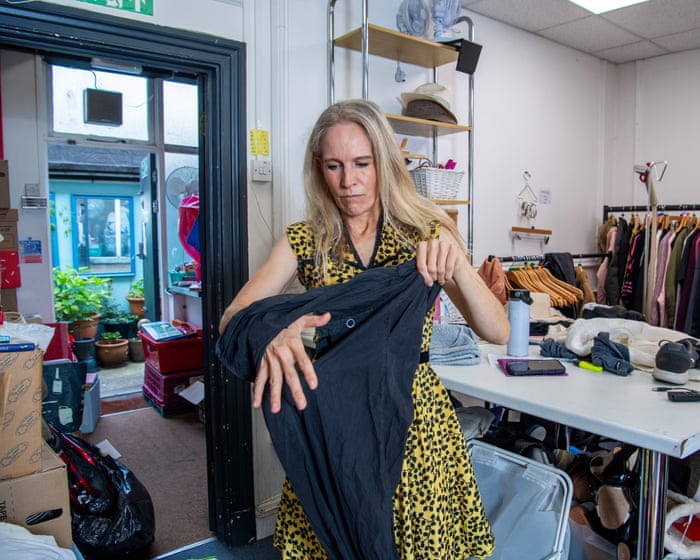
The small stockroom at the St Raphael’s Hospice charity shop in Cheam, south London, is packed with donations. “On average, we get 30 to 50 bags a day,” says Caroline Worley, the commercial manager, “but it’s not unusual to receive over 100.” This might sound like a good problem to have, but the sheer volume of stuff is the shop’s biggest challenge. “Sometimes, there’s only enough floor space to tiptoe,” says 48-year-old store manager Colin French.
Rummaging through the donations, it’s clear that much is unsaleable: a smelly, soiled bathrobe, tatty trainers, heavily bobbled jumpers, old socks, an empty Swarovski jewellery case. “Absolutely typical,” says Worley. They’re also overwhelmed with floods of low-quality fashion – a shift in donation habits that sped up during Covid, because, says Worley, all that time at home enabled people to sell their best stuff on Vinted.
The experience here echoes that of author Tansy Hoskins, whose latest book, Charity Shop World, paints a picture of a charity retail sector in crisis. She spent 16 months working in a London charity shop, sorting through “daily avalanches” of clothing, which swamped “all the other categories put together”.
View image in fullscreenSt Raphael’s Hospice charity shop in Cheam, Sutton gets rammed with donations. Photograph: Jill Mead/The Guardian
Everyone Hoskins interviewed said similar: “quality is the big change marker – it’s gone through the floor. You’re just fighting against the waste.” The problem is nationwide. Since the book came out, she’s “been contacted by managers of charity shops around the country – for example, Nottingham, Accrington, Newcastle – all saying that most of what they’re getting is waste.”
It is, of course, our waste. According to Jose Baladron of Traid, which has 12 shops across London, shopping for new clothes is “through the roof – the UK is the highest consumer of clothing in Europe by far”. “That obviously translates to more donations, which is far too much to process in small shops.” Hoskins routinely found that ultra-fast-fashion donations would “still have tags on – it was clear people had received their online purchases and gone, ‘What the hell is this?’ It wasn’t even wearable so they’d just donate it.”
On average, charity shops only manage to sell about 25% of clothing donations, according to Baladron (a figure replicated by a University of Southampton study). “So they rely heavily on the ragman” to shift the rest. Yet the price of rag has “plummeted”, according to Merryn Haines-Gadd of the environmental action charity Wrap, “due to the saturation of low-quality fast fashion”. Ten years ago, a charity might have been paid 50-60p per kilo. “Now you’re lucky to get 10p,” says Baladron. Plus there’s only so much the ragman can take.
View image in fullscreenBritten sorts through donations. Photograph: Jill Mead/The Guardian
For anything they can’t take, charity shops have to pay to have it collected as waste. At St Raphael’s, some of that has included, according to Worley, saucepans with food still in the bottom, babies’ soiled sleep-suits and used sanitary products. “[Staff] can get a bit worn down when people are donating stuff that isn’t saleable,” says Libby Gordon, CEO of Fara, which has 39 charity shops in London. “Plus there’s a time cost for us to process it all.”
Factor in rising utility costs and national insurance payments, and “charity shops are in a perfect storm”, says Hoskins. In June, the British Heart Foundation announced plans to close 150 of its 651 stores; its latest accounts indicate that its retail arm lost £3.3m last year. Cancer Research is part-way through a 190-shop closure programme, and rumours are swirling that up to 100 Oxfam shops might close (which the charity has denied).
Some are fiFara’s new in-store poster campaign tells potential donors: “If you’d be happy to give it to a friend, we’d be delighted to receive it.” Their online guide states that items should be “clean, complete, and in good condition.”
But just as people “wish cycle” by throwing unrecyclable items into the recycling bin, people also “wish give.” I struggle to accept that something with life left in it, no matter how worn, can’t be useful to someone. But this mindset creates unpleasant work and costs for charities—especially when people leave donations outside a closed charity shop. Technically, this is fly-tipping, and charity shops often check CCTV, record number plates, and report these crimes. These bags are often soiled by foxes or dogs, ripped open, or rained on. At St Raphael’s, staff have found soiled mattresses, ripped sofas, and even an old toilet dumped outside. “It leaves us with a big problem,” says Worley.
Disposing of unwanted items at scale is expensive. St Raphael’s, a charity that costs around £7 million a year to run and supports over 1,000 patients a year with free end-of-life care, ends up paying £30,000 a year to dispose of unusable donations. That could fund a month of round-the-clock specialist care for an inpatient; their 13-bed inpatient unit can currently only afford to keep 10 spots open. Other charities face similar problems. “The public’s generosity is how we support our work in Romania,” says Gordon. “It’s how the British Heart Foundation funds their research; it’s how Mind supports their mental-health work.”
French knows firsthand the difference money earned by charity shops can make. Last year his sister died, and in her final three weeks, she received incredible care from Princess Alice Hospice in Esher, Surrey—as did the whole family. “My parents still go back every single week for bereavement support and don’t have to pay anything,” says French. “It’s not until those moments that you truly realise that this is vital for our communities,” he says.
The work a charity does can often feel far away when you’re faced with a wardrobe that needs clearing out. But, says Hoskins, try to “connect with why you like a charity, why it’s important—whether it’s the Red Cross or Cancer Research or an animal charity—and donate responsibly to them. It would be a complete tragedy if our charity shops vanished.”
How can you make your good intentions go further?
Resist virgin fast fashion
The fast-fashion business model is about making clothes quickly and cheaply to churn out trends. It’s bad news for our wardrobes, our purses, and the charity shops we pass them on to.
‘Donate like you’re being reviewed’
“Wash your clothes first, do simple mending tasks, or get it fixed at a free Repair Cafe,” says Hoskins. There’s a perception, she adds, that “charity shops have laundries—they don’t. The number one reason we’d chuck something in the rag bag was because it was dirty.”
Reframe how you view charity shops
Think of them not as convenient dumping grounds, but as places that deserve a little more thought. Plus, Hoskins says, “if you can afford it, donate your best bits instead of selling them on Vinted.”
Research what to do with rags
Don’t bin those odd socks, greyed bras, or stained items, as many of us do—according to Wrap, almost half of all used textiles end up in the bin. There are specialist recycling programmes for…Underwear: For new pants and “gently worn, laundered” bras, try Smalls for All, which distributes them to people in need. Bravissimo accepts bras of any brand and condition, plus swimwear, for redistribution or downcycling (in-store only). For odd or holey socks, the London Sock Company runs a “sock amnesty,” recycling them into fingerless gloves for the charity Give Your Best (free UK postage).
Cotton: Remill recycles 100% cotton items (excluding bed linen, denim, and underwear) into new clothing, or when necessary, downcycles them into cloths and insulation (free UK postage). You’ll also get a voucher for its recycled-cotton clothing.
Cashmere: The Cashmere Centre recycles your used, pure cashmere into knits and gives you a £10 voucher.
Sports shoes: JogOn, on a mission to save 1 million sports shoes from landfill, accepts trainers, football boots, and similar items in any condition. It redistributes the usable ones to people in need (its “save” rate is 90%) and sustainably disposes of truly end-of-life ones (postage costs £2 for up to 30 pairs).
General rags: Ease the processing burden on charity shops by taking end-of-life textiles to your local textile recycling bank (check Recycle Now’s bin locator – you can also search which bins accept specific items; some take shoes). Ideally, put your rags in a labelled bag to make sorting easier, tie pairs of shoes together, and if the bank is full, don’t dump your stuff – it will most likely be binned.
Frequently Asked Questions
FAQs People Sell Their Best Stuff on Vinted How Charity Shops Became a Dumping Ground for Clothes No One Wants
Beginner Questions
What does people sell their best stuff on Vinted mean
It means that when people clear out their wardrobes the goodquality desirable items get sold on resale apps like Vinted for cash while the wornout or unfashionable items get donated to charity shops instead
What is Vinted
Vinted is an online marketplace where people buy and sell secondhand clothes shoes and accessories Sellers keep the money so theres a strong incentive to list items that will actually sell
Why are charity shops called a dumping ground for clothes
Because they increasingly receive the items nobody else wants stained torn faded or badly outofstyle clothing rather than goodquality pieces that could be resold for a decent price
How is this different from how charity shops used to work
Historically charity shops received a mix of quality donations including good brands and vintage pieces Now the best items are often creamed off and sold online first leaving shops with the leftovers
Do charity shops still make money from donations
Yes but less than before They sell what they can but a growing share of donations cant be sold and must be recycled exported or disposed of which costs money rather than raising it
What happens to clothes that charity shops cant sell
Theyre often sold in bulk to textile recyclers shipped to markets in developing countries turned into rags or insulation or in the worst cases sent to landfill or incineration
Why would someone donate bad clothes instead of throwing them away
People feel guilty binning clothes so donating feels like the ethical choice even when the item is unwearable Many assume charities can do something with anything
Intermediate Questions
Is it actually a problem that people sell on Vinted instead of donating
Not inherently resale keeps clothes in use and reduces waste The problem is the imbalance charity shops are left handling lowvalue unsellable items while bearing the cost of sorting and disposal
How much of whats donated to charity shops actually gets sold
Estimates vary but many large UK charity retailers report that only around 1030