When I was younger, I wanted to be the captain of my football team because back then, I thought the armband was given to the best player. It was a goal of mine for so long that, even as my youth teams won tournaments and trophies, and I won top scorer and best player awards, I still felt unsatisfied because someone else always had the armband. Whenever I saw another teammate running around with the armband on, I took it as a criticism.
I had forgotten this childish way of thinking until France v Belgium in the Uefa Nations League last week. Ousmane Dembélé, who was wearing the armband for France, was particularly active. Had it not been for his teammates wasting chances, he would have had several assists during his time on the field.
That time came to an end in the 60th minute, when France manager Zinedine Zidane decided to make changes to energize his team. Dembélé was doing well, but Belgium were neutralizing the threat he posed. They would double or triple team him, knowing that he wasn’t the best passer and that he would often linger on the ball. Those extra touches and extra dribbles allowed the Belgium defenders time to close in, or to recover before the pass made it to a teammate.
Why we’re stuck with a Premier League in the clutches of the global mega-rich | Jonathan WilsonRead more
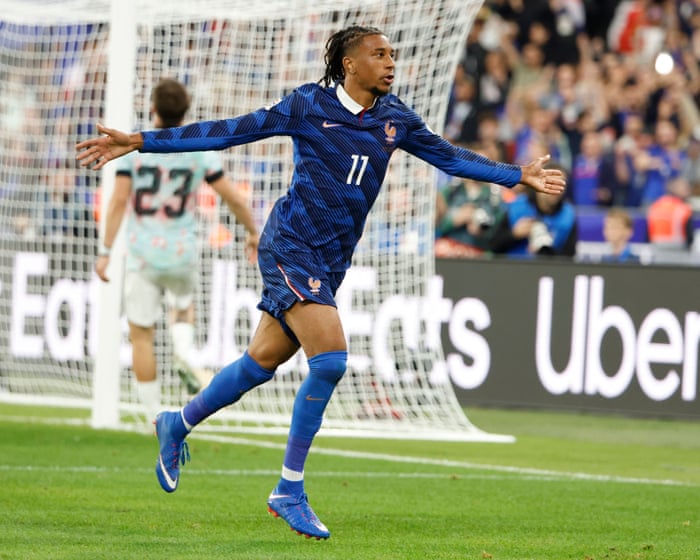
On came Michael Olise as Dembélé’s direct replacement, with Dembélé handing Olise the captain’s armband. There’s a clip online of the moment zoomed in, which shows what the broadcast cameras seemed to miss. When Dembélé gave Olise the armband, Olise accepted it with a look of confusion, seemingly not understanding why he was being given the honor, since he is not usually the captain or vice-captain. Seeing this, I remembered that I used to believe that the best player on the team is – and should be – the one who wears the armband, and in that moment, the exchange made perfect sense.
You can always tell the quality of a player by how the crowd reacts to them. When Olise came on, the crowd roared, behaving as if victory was inevitable, even though France were down when he made his entrance. Whenever he touched the ball, they rose and took a deep breath in anticipation. He had wowed them throughout the World Cup, where he provided seven assists and countless moments of magic, and he had already scored a late goal to beat Belgium at the end of September. The French crowd expected great things, because he had delivered for them over and over again.
The first goal would actually come not from Olise but from Désiré Doué, who had subbed on for Bradley Barcola before Olise came on. But once things were back level, Olise took over and ended the game as a contest. In the 80th minute, he beat his man with ease down the line and cut the ball back for Rayan Cherki to slot past the keeper. Seven minutes later, he got the ball on the right side of the box from Doué. Surrounded by several defenders who were grabbing him all over, he managed a weak shot with his right foot that took the goalkeeper by surprise and went in the bottom left corner. Then three minutes after that, in the 90th minute, he made a run through the middle where Doué once again found him with the ball. With one touch Olise slotted the ball home through the keeper’s legs. His fourth goal in the last four matches. He didn’t just win the game, he turned a tough match between two of the best teams in the world into a rout in the span of 10 minutes.
Olise is often accused of performing nonchalance. Maybe that’s true, and maybe it’s a case of social anxiety and shyness being so unusual in the professional football ranks that fans have to see it as something insincere. Regardless, if you watch Olise play closely, beyond the YouTube highlights of isolated moments, it’s impossible to accuse him of nonchalance. His playing style is one of ease and grace, but that is not a consequence of pretending not to try. His style is so similar to that of Zidane, in the sense tThe grace comes from both an instinct to entertain the crowd and an economy of movement. View image in fullscreen. Michael Olise looked confused after being given the armband. Photograph: Catherine Steenkeste/Getty Images. If Dembélé’s danger comes from the countless ways he can beat you—options so numerous they sometimes weigh him down when he tries to do too much—Olise beats defenders and teams by doing the simple things extremely well. When he controls the ball, he sets it up for his next move. When he runs with the ball, he pushes it with just the right amount of force to either get past the defender or set up a pass. And when he has several options in front of goal or for finding a teammate on the run, he usually picks the best one. That doesn’t mean everything he does ends in success—his failure to score during the World Cup eventually made it seem like he was under a curse—but he usually makes the right choices with the ball at his feet. Armbands don’t actually signify the best player on the field or in the world. These days, that conversation centers on the Ballon d’Or. Players and their teams openly campaign to win it, and fans of each player attack the other side, each belittling the opposing side’s favorite in order to boost their own candidate. This obsession with the award has completely withered how we understand and appreciate players, replacing it with a destructive kind of comparison where great players are torn down as bad if they haven’t won enough, or scored enough goals, or had more assists than their rivals. skip past newsletter promotion. Free newsletter | Twice weekly. Sign up to Soccer Desk. Jonathan Wilson and Guardian journalists bring expert analysis and reporting on the biggest stories in soccer. Enter your email. Sign up. after newsletter promotion. This kind of engagement is intellectually silly and insincere, and leaves us no room for one of the best parts of watching football: the sense of wonder that players give us. And in the effort to boost one over the others, whether through tribalism or idol worship, we miss the beauty of such a diverse group of players at the top of their game doing the ridiculous, match after match. The joy I get from watching Olise and Dembélé (or Lamine Yamal, Kylian Mbappé, Raphinha, Harry Kane, Rodri, and others) doesn’t come from the possibility that they might win the Ballon d’Or. What is wonderful to me is seeing how each player solves the same questions presented to them on the football field. How each one interprets the game, its constraints, and faces it with their own strengths and weaknesses. What matters is how each of them makes magic from a collection of rules and the chaos of 22 people on the field. When Olise steps onto the field after checking the length of the grass and looking in bemusement at the armband, my thoughts aren’t about whether he can prove he’s the best player in the world. No, like everyone else who stands and gasps whenever he tries the spectacular, what I’m looking and hoping for is to be impressed by a player expanding what is possible on the field. And more often than not, he delivers.
Frequently Asked Questions
Here is a list of FAQs based on the article The Ballon dOr doesnt capture footballs wonder Michael Olise is proof by Zito Madu
Beginner Questions
Q What is the main point of this article
A The author argues that the Ballon dOr award is too focused on stats and trophies It misses the true wonder of football which is the joy and creativity players like Michael Olise bring to the game
Q Who is Michael Olise
A He is a young talented winger who plays for Bayern Munich and the French national team He is known for his elegant creative style of play
Q Why does the author use Olise as an example
A Olise is not a top contender for the Ballon dOr The author uses him to show that a player can be one of the most exciting and wondrous to watch without winning major individual awards
Q What is the Ballon dOr
A The Ballon dOr is an annual award given to the best football player in the world voted on by journalists It is one of the most prestigious individual prizes in the sport
Q What does the author mean by wonder in football
A Wonder refers to the beauty artistry and pure joy of playing and watching the game Its about a players unique skill flair and the emotion they create not just goals or assists
Advanced Questions
Q What is the authors main criticism of the Ballon dOr
A The author criticizes the award for being a statistical and trophybased metric It rewards players on dominant teams who win major titles often overlooking players whose brilliance is more aesthetic or who play for less successful clubs
Q How does the article define the difference between greatness and wonder
A Greatness in football is often measured by tangible achievements like trophies and goal records Wonder is intangibleits the feeling of awe you get from watching a players unique skill creativity and style which may not lead to a major trophy
Q Why does the author mention other players like JayJay Okocha and Ronaldinho