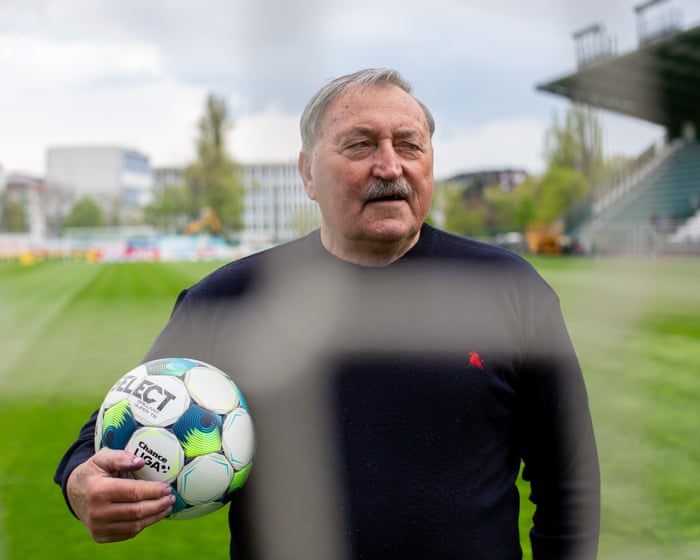
Antonín Panenka laughs like a bear might—a low rumble that hints at mischief buried in the memories. He’s sitting in an office at Bohemians football club in Prague, telling the story of his cheeky, game-changing penalty. That kick not only won the 1976 European Championship for Czechoslovakia against West Germany but also soured his relationship with the goalkeeper he embarrassed, Sepp Maier. “He didn’t say a single word to me for 35 years,” Panenka says with a smile.
But the feud ran deeper. “I read articles saying he even had a shooting target in his garage with my face on it, and he used to throw darts at it. We get along fine now, though.”
Saturday marks 50 years since that moment in Belgrade’s Red Star Stadium became part of football legend. The final was tied 2-2 after extra time, and Czechoslovakia faced the reigning world champions in uncharted territory: the first penalty shootout to decide a major international tournament.
It almost didn’t happen at all. The plan was for a replay, but a request from the German FA pushed organizers toward penalties. Panenka believes that decision was influenced by the fact that the German team had already booked their holidays.
By the time Bayern Munich’s Uli Hoeness blasted Germany’s fourth penalty over the bar, the stage was set. Panenka stepped up with the chance to win it. Then it happened. A quick run-up, a brief pause, and the softest of chip shots. The ball floated right down the middle as Maier threw himself to the side. For a split second, it seemed to hang in the Belgrade air before dropping into the net. The Panenka was born.
In the decades since, many have tried it and succeeded. Zinedine Zidane chipped his off the crossbar and in during the 2006 World Cup final, while Andrea Pirlo embarrassed a grimacing Joe Hart at Euro 2012. Others haven’t been as lucky.
In 1992, Gary Lineker—just one goal away from matching Bobby Charlton’s record of 49 for England—messed up his attempt against Brazil at Wembley. More recently, Morocco’s Brahim Díaz chipped his penalty straight into the arms of Senegal’s goalkeeper Édouard Mendy in the Africa Cup of Nations final.
Panenka watches them all with pride and amusement. “It’s pure joy to see these players using my penalty,” he says. “The only downside is that I don’t get any royalties from it.”
It’s not for lack of trying. “I used to think that every time someone takes one, they should have to pay me. Back in the Communist days in Czechoslovakia, I talked to some friends who worked at a patent office and tried to register it, but they said it wasn’t possible. That was a shame.”
Panenka’s penalty in the final wasn’t the first time he tried it. Two years before Belgrade, Panenka—a creative midfielder for Bohemians 1905—started a friendly penalty competition with the club’s goalkeeper, Zdenek Hruska.
Every day, the two would stay after training to practice penalties. Always competitive, Panenka suggested a bet. He would take penalties, and if he scored all five, Hruska would have to buy him beers or chocolate. If the keeper saved just one, Panenka would owe him. But Panenka kept losing and was running out of pocket money.
Then came his brainwave. “I started thinking about how goalkeepers always dive to one side or the other, and I came up with the idea of just chipping the ball straight down the middle. It worked right away,” he recalls.The competition with Hruska was tipping in Panenka’s favor. “I started winning our bets all the time, so I got all the beer and chocolate. But that also meant I started getting fat.”
Although Panenka occasionally tried his penalty in friendlies and domestic games, it was still unknown outside Czechoslovakia as they headed to the European Championship in Yugoslavia. That convinced him to bring it to the international stage.
“I always knew there was only one way I was ever going to take it, simply because nobody had done it before and nobody would ever think I would do it, especially in a final,” he says. “But I wasn’t 100% sure I would score – I was 1,000% sure.”
For Panenka, his penalty is more than just another chance to score. On one hand, he says, you need the personality to come up with the original idea itself, but you also need energy and a strong work ethic to make sure you have the right technique when it’s time to take the penalty. “You can’t have one without the other,” he says.
Watch footage of Panenka’s penalty now, and it’s unlike many of the versions you might see today. There’s no dramatic, winding run-up and no staring down the goalkeeper. It’s just a straight, aggressive run-up that convinces Maier that a fast, powerful shot is coming. Only at the last moment does Panenka slow down, lifting the ball into the air and leaving Maier diving helplessly to his left as the ball takes an eternity to drift and drop into the net.
It is, says Panenka, a thing of rare beauty. “I’ve seen it described as the ‘falling leaf’ penalty, and I like that,” he reflects. “It works so beautifully.”
After the final, Panenka and his Czech teammates returned home to anything but a heroes’ welcome. “We expected at least some celebration or recognition, but there was very little,” he recalls. “We said, ‘We are European champions!’ And they said, ‘So what? The league starts again tomorrow, so get back to work.'”
As Panenka returned to domestic football with Bohemians, his pioneering penalty had now become a weapon to use sparingly. After Belgrade, he estimates he took about 15 more penalties in his playing career but used the Panenka only three more times, most notably in a European Championship qualifying win over France in Bratislava in April 1979.
“The only time I ever missed was in a friendly against a small club in southern Bohemia. There had been a lot of heavy rain, and the goalie was just standing in a big puddle, so I don’t think he actually wanted to dive anyway,” he recalls. “He just stood there and caught it.”
Today, the 77-year-old Panenka and his penalty are known around the world. He believes this is because parents pass on this unique piece of football vocabulary – both a noun and a verb – through YouTube and social media. But his popularity still surprises him.
Recently, he was on a plane in Madrid waiting to take off when another passenger recognized him. “Suddenly there was this long line of people all wanting a selfie with me,” he smiles. “Our flight was even delayed.”
You can count on one hand the players whose names have become shorthand for invention, for a moment that bends the logic of the game itself. Some labels flatter, others fade, but the Panenka endures alongside the Cruyff Turn as something both daring and definitive.
Panenka shrugs at the idea of an ordinary alternative. Yes, a more conventional penalty might still have won the European title for Czechoslovakia, but it wouldn’t have changed his life or carved his name into football history.
Half a century later, what remains isn’t just his medal or the trophy, but that choice.A split-second act of courage turned a risk into a lasting legacy, and turned a footballer into a legend.
“The penalty I took really changed my life, and the fact that I’m still here 50 years later talking about it is absolutely amazing,” he adds. “I’m so glad I did it.”
Frequently Asked Questions
Here is a list of FAQs about the article That penalty changed my life Panenkas pride 50 years after his famous spotkick
BeginnerLevel Questions
1 What is a Panenka penalty
Its a soccer penalty kick where the player gently chips the ball straight down the middle of the goal instead of blasting it to the side The trick is to wait for the goalkeeper to dive then softly lift the ball over them
2 Who invented the Panenka penalty
Czechoslovakian midfielder Antonín Panenka invented it He used it to win the 1976 European Championship final for his team
3 Why is this article called That penalty changed my life
Because Antonín Panenka became a legend overnight Before that kick he was a good but not famous player After it his name became synonymous with one of the most famous moves in soccer history
4 Did the goalkeeper get in trouble for diving the wrong way
No it wasnt his fault The Panenka is designed to trick the keeper The keeper was one of the best in the world but Panenka waited until Maier committed to his dive before chipping it in
5 Is it risky to try a Panenka
Yes its very risky If the goalkeeper doesnt dive or if you dont chip it high enough they can easily catch the ball It looks amazing when it works but it looks silly when it fails
AdvancedLevel Questions
6 Why did Panenka choose that moment to try it for the first time
He had practiced it for years in training In the 1976 final he noticed the German goalkeeper Sepp Maier always dived early on penalties Panenka decided the highpressure moment was the perfect time to use his secret weapon
7 How did this one penalty change the way penalty kicks are taken today
Before Panenka almost all penalties were struck with power to a corner After his success players began using delayed or chipped penalties more often It introduced the idea of psychological trickery and precision over pure power
8