Death and taxes are often considered the only certainties in life. But in 2025, American entrepreneur Ben Lamm convinced much of the world that death might not have to be permanent after all.
That year, his genetics startup, Colossal Biosciences, announced it had resurrected the dire wolf—an animal that vanished at the end of the last ice age—by modifying the DNA of grey wolves. The company also claimed to be closer to reviving the woolly mammoth, having created genetically engineered “woolly mice.”
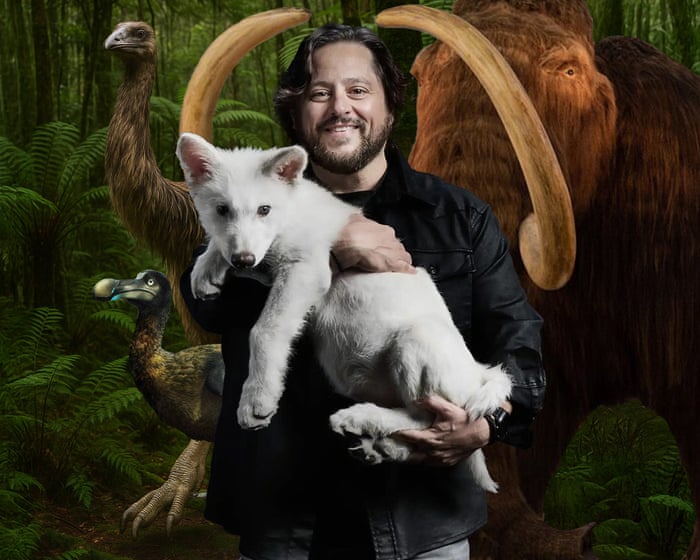
In a series of high-profile announcements, Colossal launched projects to bring back the Tasmanian tiger (also called the thylacine), the dodo, and the moa—a 3-meter-tall bird extinct for 600 years.
“We’ve made a lot of big promises to the world,” Lamm told the Guardian. “I think we’ve started to deliver.”
Lamm, a 44-year-old veteran of gaming and AI startups, has brought bold Silicon Valley showmanship and entrepreneurial drive to genetic conservation—and his approach has proven highly lucrative.
He quickly realized that de-extinction announcements generated excitement and publicity. When the company revealed its “woolly mouse,” he recalls, “people were losing their minds.”
Watching the response, Lamm thought, “Oh my gosh, they’re going to go crazy about the dire wolf stuff.”
He was right. When Colossal unveiled its version of the dire wolf in April, the news made international headlines. Enthusiastic profiles in Time and the New Yorker declared “the dire wolf is back.”
Colossal invited the public to listen to “the first dire wolf howls in over 10,000 years” on YouTube. “Obviously the dire wolves were a massive hit and fan favorite,” Lamm said.
Money flowed into Colossal from Hollywood and venture capital firms. The Texas-based startup, co-founded by Lamm and Harvard geneticist George Church, was valued at over $10 billion in its latest funding round. Investors include socialite Paris Hilton, filmmaker Peter Jackson, and former NFL star Tom Brady. The company now funds more than 100 scientists working to revive extinct species.
Colossal’s approach has also drawn attention from political leaders. The Trump administration cited the “resurrection” of the dire wolf while pushing to cut the U.S. endangered species list.
“It’s time to fundamentally change how we think about species conservation,” said U.S. Interior Secretary Doug Burgum. “We need to continue improving recovery efforts, and the marvel of ‘de-extinction’ technology can help forge a future where populations are never at risk. In the future, ‘de-extinction’ can serve as a bedrock for modern species conservation.”
But scientists have been far less enthusiastic. Shortly after the dire wolf announcement, a group of leading canid experts quietly concluded that the company had not truly resurrected the species.
Instead, they said, Colossal had made 20 edits to grey wolf DNA, and the resulting animals were not substantially different from those already roaming North America.
Amid the scientific skepticism, Colossal’s chief scien…Beth Shapiro, a leading expert on ancient DNA, told New Scientist: “It’s not possible to bring back something identical to a species that once lived. Our animals are grey wolves with 20 genetic edits that are cloned.”
Many independent researchers in the field have been far more critical of the company’s claims. Nic Rawlence, director of the palaeogenetics laboratory at the University of Otago in New Zealand and an expert on the moa—a bird Colossal is attempting to resurrect—says bringing it back from extinction is impossible.
“Extinction is still forever. Charles Darwin put it well when he said, ‘when a group has once wholly disappeared, it does not reappear; for the link of generation has been broken.'”
“Rather than true de-extinction, Colossal’s attempts are, at best, genetically engineered poor copies being passed off as the real thing,” he says. “Colossal is preying on people’s desire to undo the sins of the past. But to do this, they are spreading misinformation and undermining trust in science by attacking critics.”
The company’s announcements have been met with deep skepticism in several academic journals and by scientists. Geneticist Adam Rutherford called the mammoth plans “elephantine fantasies” that would only be possible with time travel.
Others argue that overhyped claims of reviving lost species weaken public trust in science. “I don’t think they’ve de-extincted anything,” stem-cell biologist Jeanne Loring told Nature.
These concerns haven’t slowed the company’s progress. In the next few years, Colossal’s team plans to unveil its version of the woolly mammoth. According to Colossal’s Ben Lamm, it will be a genetically modified Asian elephant adapted to live at -40°C, with long hair, small ears, and other mammoth traits interpreted from frozen DNA. Lamm bristles at the suggestion this creature may not truly be a mammoth.
“We believe in free speech, so if people want to call our mammoth a mammoth, or a genetically modified, cold-tolerant Asian elephant with inserted mammoth gene variants, we’re cool with that. Whatever,” he says.
“If a child cares more about biodiversity loss and climate change because they saw a Colossal mammoth, who cares? That’s our view,” Lamm adds. “Modern conservation doesn’t work at the speed at which we are eradicating species and changing the planet.”
For some scientists, publicly criticizing the company has come at a cost. In July, New Scientist reported that several critics of Colossal had been targeted by seemingly AI-generated articles in a mysterious smear campaign attacking their credentials.
Lamm says the company has nothing to do with those stories. “We have a lot of public support from a wide range of communities, from scientists to crypto enthusiasts. People argue about things all the time. So if you’re going to be a critic, you should be comfortable that you may also be criticized.”
The criticism has frustrated Lamm. He points to Colossal’s efforts in elephant conservation and attempts to save the northern white rhino as evidence that his company can change how the sector operates. The company’s website presents its work as part of the fight against biodiversity collapse, which some scientists call the sixth mass extinction.Colossal is working to bring back extinct New Zealand birds. “The worst part of conservation is conservationists,” he says. “Many current models aren’t working, and we need new ones. The reality is that modern conservation—while effective—can’t keep up with the speed at which we’re losing species and altering the planet.
“We need to get more of these brilliant scientists out of the lab and into the field, actively saving animals. They have to share their work in a way that’s accessible, not locked behind paywalled journals, so that it inspires a child to think, ‘I want to go to Africa and save elephants,’ or ‘I have to protect the dugong. Wait, drug cartels are killing the vaquita? How can I help?'”
Even Colossal’s strongest critics acknowledge the potential of gene editing to rescue species facing genetic bottlenecks. As wildlife populations shrink, many become dangerously inbred. Colossal is working to restore genetic diversity to critically endangered species, like the North American red wolf, by reintroducing lost genes from museum specimens.
Despite the excitement and funding surrounding Colossal, conservationists emphasize that its work cannot replace traditional efforts to prevent extinction: the slow, demanding tasks of controlling predators, safeguarding ecosystems, and restoring habitats.
“De-extinction technology could be a useful tool for living species,” says Rawlence, “but it won’t replace the unglamorous, hard work on the ground.”
For more coverage on the age of extinction, follow biodiversity reporters Phoebe Weston and Patrick Greenfield in the Guardian app.
Frequently Asked Questions
FAQs Colossals DeExtinction The Real Thing
Beginner Questions
1 What does they havent brought anything back from extinction mean
It means that as of now no extinct species has been fully recreated and reintroduced into the wild Projects like Colossals are in the research and development phase
2 What is Colossal Biosciences trying to do
Colossal is using genetic engineering to create hybrid animals that closely resemble extinct species like the woolly mammoth by editing the genes of their closest living relatives
3 Can they make an exact copy of a woolly mammoth
No They cannot clone a mammoth because viable intact mammoth DNA doesnt exist They are engineering an Asian elephant to have mammothlike traits such as cold tolerance and shaggy hair
4 So is it a mammoth or an elephant
Genetically it would be a modified Asian elephant with some mammoth DNA sequences It would be a new hybrid creature designed to look and function like a mammoth in its ecosystem
5 Whats the main goal if its not a perfect copy
The stated goals are to help restore degraded Arctic ecosystems and to advance genetic technologies that could aid in conserving currently endangered species
Advanced Ethical Questions
6 If its not genetically identical can it ever be truly the species
This is a core debate Biologically noit would not be the original species Ecologically and functionally maybe if it fills the same niche and behaves identically Much depends on how you define real
7 What are the biggest scientific hurdles
Key challenges include the complexity of editing not just physical traits but also behavior and immunity ensuring the health and welfare of the surrogate elephant mothers and the immense difficulty of successfully rewilding a created animal into a modern ecosystem
8 What about the original animals behavior and instincts
This is a major unknown Genes influence but dont fully determine complex behaviors learned from a herd A genetically engineered mammoth would have no mammoth parents to teach it