A new wave of escalating strikes between Iran and the US has continued, further weakening the fragile interim peace agreement between the two countries. This has prompted Donald Trump to threaten violence that would ensure Iran “will no longer exist.”
On Sunday, Tehran launched drone and missile attacks against Bahrain and Kuwait, following new US strikes on sites in southern Iran. Iran also threatened a “complete halt” to negotiations aimed at ending the war. Trump said a moment might soon come when he would abandon talks, and the US would “militarily finish the job.”
The US president posted on social media: “If that happens, the Islamic Republic of Iran will no longer exist!”
Kuwait, which hosts a major US army base, said it had intercepted two ballistic missiles and reported no injuries or damage. Meanwhile, Bahrain’s interior ministry said the Iranian strikes had damaged a residential building near the international airport, but no one was killed.
The latest violence was triggered by efforts to reopen the Strait of Hormuz to all shipping without Iran’s direct oversight. This strategically critical waterway, which carried a fifth of the world’s oil and liquid gas supplies before the war, has long been considered an international passage.
US Central Command said in a statement that its strikes were “in direct response to continued Iranian aggression against commercial shipping” and targeted Iranian military surveillance, communications, air defense, drone storage, and mine-laying facilities.
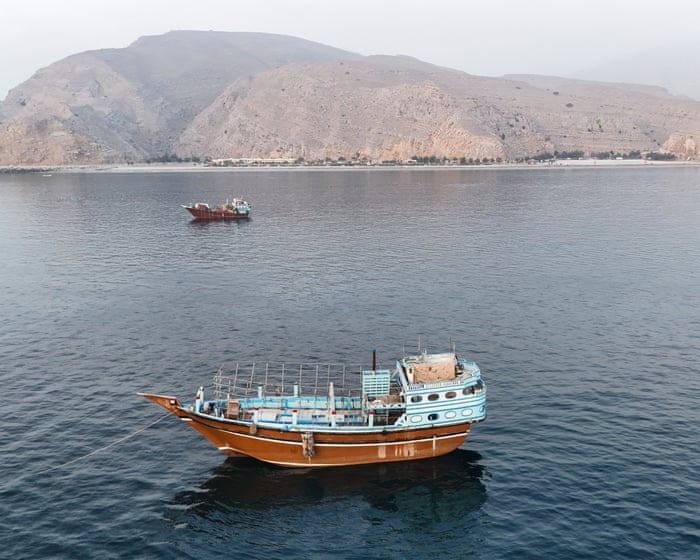
Washington has been promoting a southern shipping lane along the coast of Oman, while Tehran—which ultimately aims to charge fees for using the strait—wants ships to use a northern route through its waters and under its control.
Hundreds of vessels, including oil-laden tankers, have been blockaded inside the Gulf since the strait closed when war broke out. Over the past two weeks, some ships have risked the passage, causing oil prices to drop close to prewar levels and bringing relief to economies around the world.
The US military accused Iran of violating the ceasefire on Saturday by attacking the Panama-flagged tanker Kiku, which was carrying crude oil for Qatar’s state-run energy company. According to ship-tracking websites, the Kiku appeared to be trying to use the southern corridor near the coast of Oman. A Singapore-flagged container ship was struck by an Iranian drone while traveling the same route last week.
Iran’s foreign minister, Abbas Araghchi, restated Tehran’s claim to sole control of the waterway during a state visit to Iraq on Sunday. He said in Baghdad: “Any interference in this matter, any attempt to establish new or separate arrangements from those currently being carried out by the Islamic Republic of Iran, will only lead to further complications, delay the reopening of the Strait of Hormuz, and increase the level of tension.”
Observers say Iran is using its ability to threaten shipping in the strait not just as leverage in negotiations with the US, but also to intimidate neighboring countries and establish a more dominant role in the region.
Araghchi also called for a security framework with Gulf countries that would exclude the US. He said: “We should reach a new framework that includes all countries in the region and without the presence or interference of any country from outside the region.”
Mediators from Qatar and Pakistan successfully brought representatives from Washington and Tehran together in Switzerland earlier this month, but they have been unable to bridge wide gaps on contentious issues such as the future of the Strait of Hormuz, sanctions relief for Tehran, and the future of Iran’s nuclear program.Under a memorandum of understanding signed earlier this month, the two countries have 60 days to finalize the details before signing a final agreement.
Leaders in Tehran and Washington are under domestic political pressure to avoid a return to conflict and appear committed to a ceasefire for now, despite frequent aggressive rhetoric.
The Islamic Revolutionary Guard Corps claimed responsibility for both new attacks on Sunday. It stated: “Let the enemy know that violating the ceasefire … will lead to a complete halt of ongoing processes.”
Oil tankers sailing off the coast of Kuwait on Saturday. Photograph: Yasser Al-Zayyat/AFP/Getty Images
The IRGC, which controls Iran’s ballistic missile arsenal, has gained influence in Iran in recent months. Its navy command said American bases in the region would “experience hell in the coming days.”
Bahrain’s foreign ministry condemned the attacks, calling them “a dangerous escalation that reveals that what Tehran is doing is not a passing act, nor an isolated incident, but rather a deliberate approach and a systematic pattern of repeated aggression against the sovereignty of the kingdom, and the security of its citizens and residents.”
Bahrain hosts the US Navy’s 5th Fleet, whose base there came under repeated attack during the war.
Shadow war: how use of proxy forces by Iran, Israel and US is driving Middle East instability
Read more
Violence has also continued in Lebanon, further threatening the agreement between Iran and the US to end their own conflict.
An Israeli military vehicle traveling past destroyed buildings in southern Lebanon on Sunday. Photograph: Ohad Zwigenberg/AP
Israeli military officials said a soldier was killed on Sunday when soldiers encountered a “Hezbollah terrorist after entering a suspicious structure in the area of Deir Seryan in southern Lebanon.”
The Lebanese state news agency reported a new Israeli attack targeting the outskirts of the towns of Deir Seryan and Taybeh in southern Lebanon.
These fresh clashes in Lebanon come two days after Israel and Lebanon signed an agreement aimed at ending hostilities. The deal calls for Israeli forces to begin an initial withdrawal from the south of the country and their replacement by the Lebanese armed forces, who will take over local security and dismantle Hezbollah’s military infrastructure.
They will also further undermine prospects for any lasting peace agreement between Iran and the US, which Tehran has insisted depends on a ceasefire in Lebanon.
Israel, which is not part of the US deal with Iran, invaded southern Lebanon in March in a new offensive against Hezbollah, which is backed by Iran.
Israel and Lebanon have repeatedly agreed to US-brokered ceasefires, the latest on Friday, but these have had only limited effect. Israel insists it will not withdraw from Lebanese territory it has seized, and Hezbollah repeatedly rejects calls to give up its arms as long as Israeli troops remain in place.
With reporting by Reuters and Associated Press
Frequently Asked Questions
Here is a list of FAQs about the increasing strikes between the US and Iran putting the temporary peace deal at risk
BeginnerLevel Questions
1 What is the temporary peace deal everyone is talking about
Its a shortterm agreement likely informal where both the US and Iran agreed to pause direct military attacks and avoid escalating tensions It wasnt a formal treaty but more of a mutual understanding to reduce conflict
2 Why are the US and Iran striking each other again
The recent strikes are usually in response to specific incidentslike an attack on a US ally blamed on Iran or an Iranian proxy group attacking US troops Each side accuses the other of breaking the spirit of the deal first
3 Is a fullblown war going to start now
Not necessarily Both sides have avoided direct allout war for years However these strikes increase the risk of a miscalculationa single mistake or unintended escalation could trigger a much larger conflict
4 Who is winning right now
Neither side is clearly winning The US is demonstrating military power while Iran is showing it can disrupt the region through its proxies The peace deal was a win for stability and both sides are now losing that stability
5 How does this affect gas prices
Yes it can The Middle East is a major oilproducing region When conflict escalates markets fear supply disruptions which often drives up global oil and gas prices
AdvancedLevel Questions
6 Was the temporary peace deal ever officially acknowledged
No It was an unspoken deescalatory understanding often reported by news agencies citing anonymous officials Neither the US nor Iran formally signed or announced it which makes it fragile and easy to break
7 What are the specific red lines that each side is violating
For the US a red line is Iran attacking US personnel or major commercial shipping For Iran a red line is the US killing senior Iranian commanders or directly striking Iranian soil The recent strikes often target Iranian proxies rather than Iran itself but still cross a line
8