Social media arrived right as I, a younger millennial, was about to become a teenager. My friends and I signed up for accounts on Facebook, Myspace, and Twitter, along with lesser-known sites like the now-defunct Bebo. We had no idea what we were doing—nobody did. We posted careless messages and photos on public feeds that we wouldn’t want any future employer, or really anyone, to see. Over time, we, along with our parents and grandparents, gradually learned what it means to live with this world-changing phenomenon we call social media. We started finding different ways to adapt, and that process is still ongoing.
But what is it like for Gen Z, the first generation of “digital natives,” who grew up speaking the language of the internet as their mother tongue? That’s the question that led Italian photographer Niccolò Rastrelli to start the project IRL—the online acronym, of course, for a phrase that describes our offline lives: in real life.
Rastrelli has long been interested in how people build their identities through self-presentation. “In the last few years, I’ve also worked a lot with younger people. I’m older and don’t have children, so I want to understand their point of view,” says the photographer, born in 1977, which makes him a member of Generation X. His past work includes a project exploring the growing global popularity of the youth subculture of cosplay. Now, he felt it was time to widen his focus to a more common experience: being on social media.
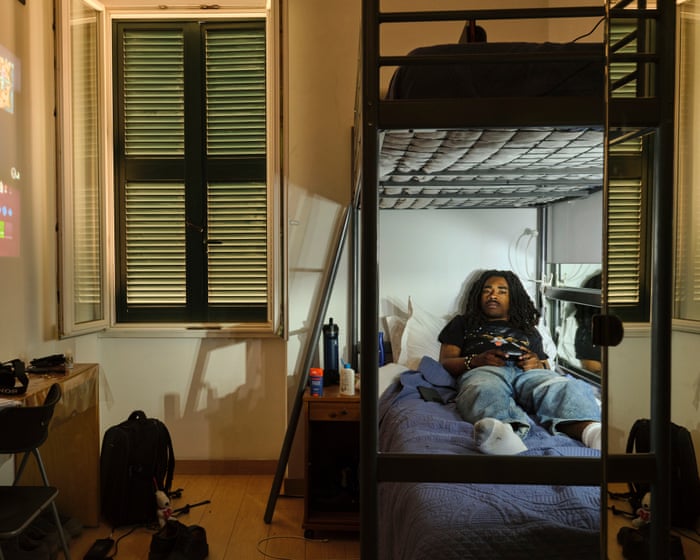
“I wanted to show the diversity within Gen Z,” Rastrelli says. He recruited subjects across the whole generation, from 14-year-olds to adults in their late 20s. Most were in Italy, but he also visited the UK, Morocco, and France. Each portrait has two paired parts. On one side, the subject is photographed in their bedroom, whether in their family home, a shared flat, or university housing. They are deliberately posed, almost always making eye contact with the camera. Some hold their phones or sit by a computer. Often, you see the familiar sight of a tangle of cords and plugs in an extension cable by the bed.
“When you’re young, your bedroom is such an important place. It’s really your first solo home,” Rastrelli explains. “Before social media, it was also the main place where you could build your identity.” Your room and the things in it—posters, paintings, books, an electric guitar, a barbell, a giant stuffed unicorn—tell a story about who you are and who you want to become.
Nowadays, the same applies to social media. So, alongside those portraits, Rastrelli asked each subject to pick screenshots of their phone screens that showed their usual activity. Nearly everything comes from Instagram, one of Gen Z’s main apps of choice—and many images are from temporary “stories” rather than permanent feed posts. There are selfies with silly filters, casual snaps of friends and food, and black-and-white portraits taken with film cameras. It was important to Rastrelli that the young people “co-curated” the selection, just as they had arranged and posed in their bedrooms.
Rastrelli also gave his subjects a questionnaire about their relationship with social media. Many responses surprised him—for example, that they often keep more than one account on a single platform. Lana, who is 16, has multiple Instagram profiles with different levels of privacy. “Only on my most private account do I feel free to really be myself,” she told him. He was also struck by how many young people see social media less as a place for personal expression and more as a work tool. The clearest example was 23-year-old web developer and social media manager Francesco, who doesn’t post on hisHe says that in his own experience, it’s like what chefs often say: they don’t cook at home because they spend all day cooking at work.
Recently, there’s been a lot of discussion about how social media might be harmful to young people. In the UK, a ban for under-16s is planned to start next spring. (Italy has no such plans.) But from talking to Gen Z-ers, Rastrelli doesn’t think they’re more affected than older generations: “Many of them use social media less than people from my generation.” The main difference is which platforms they use. For example, Facebook—now seen as something for baby boomers—hardly came up in conversations. This has made Rastrelli think about doing a similar project focused on older people instead: “We’re all involved with social media.”
Stevie, 20, Rome (main picture top)
A student from Pennsylvania, Stevie is currently studying abroad in Rome. He says he has two Instagram accounts: one public and one private, and he shifts his tone and identity depending on which one he’s using. He hopes to become a media personality.
Lana, 16, Florence
Lana got her first smartphone at age 11, after long negotiations with her parents. It opened up a new world for her, from group chats to sharing photos. Social media is a big part of her daily life: TikTok is more for fun, while Instagram feels like a diary. She says her bedroom is where she feels most like herself. She reads a lot, from young adult novels to heavier authors like Dostoevsky and Freud, who help her understand herself and the world better.
Sofia, 14, Arezzo
Sofia goes to an art school where she studies animation, a passion she discovered thanks to a digital creator who makes content about cartoon history. Her online life is limited: her parents have blocked Instagram and TikTok, so she uses WhatsApp to share drawings, homework, and memes with friends.
Roberto, 27, London
Born in Italy to a Ghanaian family, Roberto has lived in London for the past eight years and works as a personal trainer and bartender. He didn’t get his first smartphone until he was about 15 or 16—before that, he had a basic phone so his parents could keep track of him. He’s careful about what he shares and looks at, mainly sticking to fashion and fitness content.
Mark, 28, Florence
Mark was born in Nigeria and raised in Italy. He paid for his first smartphone himself at age 12 by doing odd jobs and reselling customized clothes. He used to edit his photos, removing features like his nose to avoid being labeled. Now, as a freelance creative, he mainly uses Instagram as a research tool and rarely posts.
Melina, 24, Arles
Melina studied 3D animation and relies on Instagram for tutorials and finding other artists. She also follows friends and funny accounts. She doesn’t post often, mostly sharing drawings rather than photos of herself, and rarely edits them beyond an occasional filter. She keeps a second account with no followers, where she saves images to remember moments from her life.
Anna, 23, Glasgow
What excited Anna most when she got her first phone at age 11 was being able to take photos and videos of the world around her. Now she dreams of working in film, and she says social media will be a useful way to share her work and find opportunities. For now, she uses Instagram mostly as a source of creative inspiration.When she posts, she likes to avoid making herself the main focus of the image.
Andrea, 22, Florence
View image in fullscreen
View image in fullscreen
Andrea runs two separate Instagram accounts—one personal and one professional—and also performs with a local theatre group, where he does solo drag acts. He says his approach is the same on both accounts: he shows himself without filters, whether he looks beautiful or deliberately strange, and only uses Photoshop to make a scene look more “editorial.”
Ali, 28, Rabat
View image in fullscreen
View image in fullscreen
Ali’s first proper smartphone, after years of using broken old ones, changed everything for him. It let him take and share photos for the first time. Now he works in social media marketing, helping companies and projects grow and get noticed. He says he sees his bedroom as a place to rest and think, while online is where he can express his personality and find inspiration from others.
Silvia, 23, Rome
View image in fullscreen
View image in fullscreen
Silvia says she feels like herself both offline and online, but in different ways. At home, she’s quieter; on social media, she’s more outgoing. She says her family hasn’t always liked how unfiltered she is on the internet, but she keeps doing it anyway. Music is a big part of her life—she’s in a techno collective and performs as a DJ. To see more images from Niccolò Rastrelli’s project, visit instituteartist.com.
Frequently Asked Questions
Here is a list of FAQs about the visual contrast between Gen Zs public profiles and their private lives
General Definitions
Q What does the people behind the posts actually mean
A It refers to the idea that the person you see on Instagram TikTok or Snapchat is often very different from the person in real life Its about the gap between the highlight reel and the behindthescenes reality
Q Why is this photo essay specifically about Gen Z
A Gen Z is the first generation to grow up entirely with smartphones and social media They are digital natives so the pressure to curate a perfect online image is deeply ingrained in their daily lives making the contrast between online and offline more pronounced
Q What is a public profile versus a private life in this context
A A public profile is the persona you present to your followersthe photos you choose to post the captions you write and the aesthetic you create Your private life is what happens when the phone is down your messy room your unfiltered emotions your interactions with close friends and your downtime
Q Is this article judging Gen Z for having a curated online presence
A No The photo essay is meant to be observational and empathetic It aims to highlight the reality of living in a digital age showing the effort and anxiety that goes into maintaining a profile rather than criticizing it
The Photo Essay Content
Q What kind of photos are typically in this photo essay
A Usually it features diptychs One side shows a perfectly posed welllit Instagramstyle photo of the person The other side shows the same person in a candid unglamorous or mundane momentlike waiting for the bus eating takeout alone or sitting in a messy bedroom
Q Does the essay include interviews or just photos
A Most versions of this concept include short captions or quotes from the subjects They often explain why they post what they do how they choose their content and how they feel when they log off
Q Are these photos staged or candid