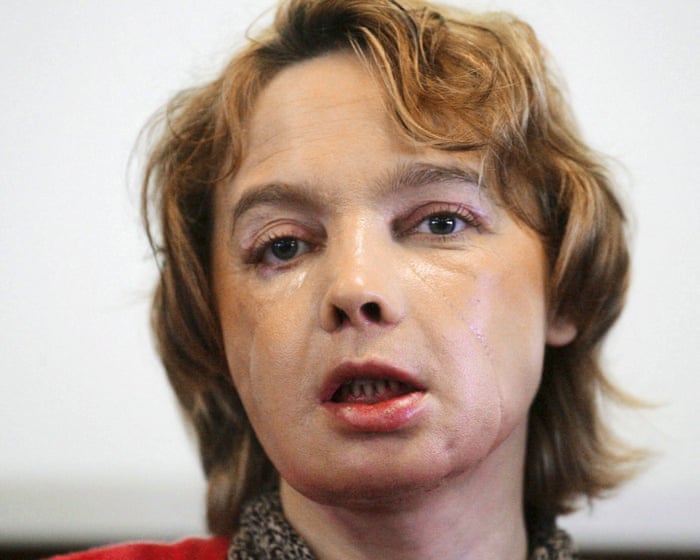
On the morning of May 28, 2005, Isabelle Dinoire woke to find herself lying in a pool of blood. After a family argument the night before, she had taken sleeping pills and alcohol to numb the pain, as she later explained. When she instinctively reached for a cigarette, she discovered she couldn’t grip it with her lips. Something was clearly wrong.
She made her way to the bedroom mirror and was horrified by what she saw: her nose, lips, and parts of her cheeks were gone, replaced by a raw, gaping wound. While Isabelle had been unconscious, her dog Tania—a Labrador-Beauceron mix—had chewed off her facial features.
“I saw the blood around me,” Isabelle recalled to the BBC, “and the dog was licking it. But I never imagined it was my blood or my face.”
On November 27, 2005, Isabelle underwent the world’s first face transplant at University Hospital in Amiens, France. The procedure, part of a new medical field called vascularized composite allotransplantation (VCA), involved transplanting multiple tissues—skin, muscle, bone, and nerves—as a single unit. Led by surgeons Bernard Devauchelle, Sylvie Testelin, and Jean-Michel Dubernard, two teams carefully attached a donor’s nose, lips, and chin to Isabelle’s face. The donor was a 46-year-old woman who had died by suicide. The complex surgery reconnected sensory and motor nerves, arteries, and veins, and took more than 15 hours with a team of 50 people.
The following February, Isabelle appeared before the press, astonishing the world by speaking and drinking water through her new mouth. “I now have a face like everyone else,” she said. “A door to the future is opening.”
Her case seemed to prove the value of face transplants, sparking a race among medical teams to perform their country’s first. The U.S. followed with a partial transplant in 2008, then a full one in 2011. Other milestones included the first African American recipient in 2019, the first combined face and double hand transplant in 2020, and the first to include an eye in 2023. To date, about 50 face transplants have been performed, each bringing new funding, donations, and prestige to the doctors and hospitals involved.
Meanwhile, the patients continue with their lives as best they can. Some, like Isabelle, have endured great suffering. Others, such as Joe DiMeo—who received the world’s first double hand and face transplant at NYU Langone in 2020—have found ways to build careers, including sharing their stories online. But Joe and his wife Jessica, a nurse, face constant online harassment, and the risk of organ rejection remains a lifelong threat.
For the past six years, I have researched the history of face transplants, interviewing surgeons and patients across the U.S., France, China, Spain, Italy, Mexico, and Canada. I’ve contributed to surgical papers and conferences, advocated for patient perspectives, and advised on a key Department of Defense-funded study to regulate VCA procedures.
What I’ve learned is troubling. The field is marked by competition for funding and prestige, and negative outcomes are often hidden from view. In some clinics, publicity is treated as marketing, and patients may be exposed to intrusive media attention. Support systems for patients are inconsistent, and few are prepared for the lifelong burden of immunosuppressant drugs. Ethically, face transplants transform otherwise healthy individuals with facial disfigurements into permanent medical patients.
Public memory often focuses on dramatic before-and-after images, but the reality is far more complex.
Take Dallas Wiens, who in 2011 became the first American to receive a full face transplant. The 25-year-old electrician had been electrocuted while painting a church, losing his face and his eyesight. He worried his daughter Scarlette would be teased because of his appearance and hoped to give back to veterans. He viewed the transplant as a medical miracle.Dallas wanted to be able to hail a cab. Like Isabelle, he was grateful to his donor and surgeons. He attended medical conferences so doctors could see the outcome of his transplant and met with prospective patients. The global media sought him out as living proof that face transplants could work.
For a few years, this story held up, but then reality set in. The anti-rejection drugs that preserved his new face damaged his kidneys. Dallas suffered repeated rejection episodes, each requiring stronger immunosuppressants. He lived in poverty in Texas with his beloved wife, Annalyn, who was blind. His main medication alone cost $120 a month—a heavy burden on their disability income.
“It’s one thing to be told about the risks,” Dallas told me as his kidneys began to fail. “It’s another to live through them.”
In the U.S., now the global leader in face transplants, the Department of Defense funds most procedures, viewing them as pioneering care for wounded veterans. Private insurers, however, refuse to cover the costs.
Because insurance won’t pay until the field proves itself, surgeons have been eager to demonstrate results. A 2024 study in JAMA Surgery reported 85% graft survival at five years and 74% at ten years, concluding that face transplantation is “an effective reconstructive option for patients with severe facial defects.”
But patients like Dallas tell a different story. The study measured survival but didn’t account for psychological well-being, effects on intimacy, social life, family dynamics, or comparisons with traditional reconstruction.
Most surgeons care deeply for their patients, though they also have personal ambitions. Worldwide, there are only about 20 specialized surgeons—mostly men—capable of performing face transplants. No one reaches that elite level without ambition, both for themselves and for the field. Surgeons ask: what can they do if the system doesn’t support them?
It’s a catch-22. Without proof of success, face transplants remain experimental. And because they’re experimental, grants don’t cover long-term patient needs, leaving individuals to bear the burden.
“I don’t have $100 for Ubers to the hospital and back,” Dallas explained. Public transportation exposed his weakened immune system to infections, which could trigger facial rejection. “But if I miss appointments, it’s seen as non-compliance. Is that fair?”
On September 27, 2024, Dallas died suddenly at his home in Fort Worth. His death certificate listed complications from electrocution—the same accident that injured him in 2008. His wife Annalyn still doesn’t know exactly what happened. “His body gave up,” she said. “He was constantly tested and made to feel like a lab animal. I just wanted his body to be left in peace.”
Annalyn had Dallas cremated quickly, fearing the Department of Defense or Yale might want his body for research. Neither did, but her fear highlights the gap between surgical intentions and patient experience.
This same fear was shared privately with me by a member of Isabelle’s immediate family, who wishes to remain anonymous. From their perspective, Isabelle’s transplant was not a success, even though it launched the entire field.
In fact, few expected France to perform the first face transplant. Insiders assumed it would happen at the Cleveland Clinic, where Maria Siemionow had spent years refining both the technique and the ethics.
By contrast, Devauchelle’s first request for ethical approval was rejected. In the early 2000s, French ethicists—like those in the UK—were concerned about the risks of immunosuppressants and the psychological impact. How could someone cope with seeing another person’s face in the mirror?
For his next, successful attempt, Devauchelle partnered with Dubernard, an influential member of the French National Assembly and the surgeon who made history in 1998 with the world’s first hand transplant. Making history has a momentum of its own.Face transplants have often brought glory, especially to the surgeons performing them. But what about Isabelle? Three months before her operation, she signed a contract with British documentary maker Michael Hughes, agreeing to let cameras film her transformation in exchange for payment. The Times of London exposed this deal, revealing how a vulnerable, suicidal woman without a face had effectively been “sold” even before the surgery. Isabelle was drawn in by the promise of a better future, a promise that was never fulfilled.
During the surgery, Dubernard described watching blood flow into Isabelle’s lips and compared himself to the prince who awakened Sleeping Beauty, saying, “I still see her image among the stars in my dreams.” But Isabelle felt more like a circus animal than a princess. After the transplant, she spoke of her torment: “Everyone would say, ‘Have you seen her? It’s her. It’s her…’ So I stopped going out completely.”
Living with a stranger’s face proved as psychologically challenging as ethicists had feared. Two years later, she described the oddness of having “someone else’s” mouth: “It felt strange to touch it with my tongue. It was soft. It was horrible.” One day, she found a new hair on her chin and thought, “It’s odd. I’d never had one. I thought, ‘It’s me that has given it life, but the hair is hers.'”
Surgeons and ethicists noted that Isabelle wasn’t offered proper alternatives and wasn’t in a sound state of mind. The French team’s only admission was that she wasn’t an “ideal patient.” She might have had a better experience in a country like Finland, where transplants are anonymous, patients and families aren’t hounded by journalists, and clinics don’t use patients for media exposure.
Instead, Isabelle never returned to a normal life, work, or good mental health. From 2013, she experienced regular episodes of rejection. In 2010, she was diagnosed with cervical cancer, followed by lung cancer. She died in 2016, though her surgeons deny any link to her immunosuppressant use. In fact, her transplanted face died before she did; after it became necrotic, it was removed and replaced with a graft from her thigh. As she told her family, she “didn’t want to die without a face.”
A close family member shared that Isabelle’s well-being declined sharply after the transplant and that she was in “psychological distress” when she consented to the procedure. “They took her away from us, so we couldn’t dissuade or advise her.” After each psychiatric appointment, she would return home “at her lowest, full of guilt and suicidal thoughts.” She attempted suicide more than once after the transplant, though this isn’t part of the official record.
Robert Chelsea, the first African American to receive a face transplant, wanted to kiss his daughter’s cheek. Now he can, but she can’t look at him the same way. “Only when he opens his mouth, I know it’s him,” she says; otherwise, he seems like a stranger. Today, Robert is frequently hospitalized and unable to earn an income.
Robert is aware that race plays a role—the troubling history of medical experimentation on Black people means African Americans are less likely to donate organs. Scientific medicine has also favored whiteness; before Robert’s surgery, the hospital hadn’t considered the need for donors with diverse skin tones.
Once a successful businessman, Robert now relies on GoFundMe campaigns. His car has been repossessed, and he can’t get to church. He suffers from rejections and infections and can’t afford caregivers. Sometimes he becomes so weak he can’t even call an ambulance, and if he did, it would be an extra expense he can’t manage. Aftercare is the biggest challenge for U.S. face transplant recipients, yet the JAMA study only measured outcomes by graft survival, not by patients’ quality of life.Face transplants allowed people to work, afford medication, and maintain relationships. However, the data didn’t track financial hardship, mental health, or quality of life. It recorded 10 deaths but not the circumstances of their deaths or what their final years were like. No one monitored Dallas’s failing kidneys or Robert’s repossessed car.
These patients are pioneers. During World War II, plastic surgeon Archibald McIndoe treated severely burned pilots. His patients formed the Guinea Pig Club, a brotherhood that openly acknowledged their experimental role. They received lifelong care, peer support, and recognition for their contributions to surgical advances. The same cannot be said for face transplant recipients.
A key question remains: How can science and medicine innovate ethically without learning from past experiences?
Most innovations follow a similar path: an idea emerges, ethical debates ensue, someone takes the lead, and others rush to follow. These innovations typically end in one of three ways: they fade into obscurity, collapse in scandal, or mature into a stable, standardized practice.
Now, face transplants are confronting this reality. About 20% of patients have died from rejection, kidney failure, or heart failure. This is an unacceptably high death rate for an elective procedure meant to enhance life, especially when there’s no consensus on who is an ideal candidate, how to measure success, or what long-term support should entail.
We’ve seen this before with lobotomy, a field that eventually faded away. Portuguese physician Egas Moniz won the Nobel Prize for developing lobotomy in 1949, and 3,500 brutal procedures were performed.
A similar pattern occurred with vaginal meshes in the 1990s. Initially hailed as a breakthrough, they caused chronic pain and organ damage, led to millions in lawsuits, and became a symbol of prioritizing profits over patient safety. Unlike face transplant patients, vaginal mesh victims found strength in numbers—100,000 in the U.S. alone took legal action.
A more successful innovation is IVF, which transitioned from controversial “test-tube baby” experiments to mainstream medicine through rigorous patient selection, improved safety standards, and proper regulation—all driven by surgeons.
Which path will face transplants take? The numbers are already declining, with fewer procedures since the 2010s as outcomes worsen and budgets tighten. Unless the field raises its standards, enforces rigorous follow-up, and commits to transparent, systematic data sharing that includes patients and their families, it cannot demonstrate real success. Without these changes, face transplants are not headed for evolution or stability; they’re on track to become a footnote in medical history.
Isabelle’s loved one is watching closely. It’s not easy for her to speak out, even now, for fear of harassment by journalists. But she says, “I must find the strength.”
Isabelle did not want the transplants to continue. She gathered documents to highlight various problems and told me that after her death, I could speak openly because during her life, she feared the medical team and the overwhelming pressure.
She felt compelled to stay positive and represent the success of the innovation, no matter the cost—an unbearable burden for someone already vulnerable.
“You only hear from the complainers,” one delegate told me earlier this year after I spoke at a conference for face transplant surgeons in Helsinki. “The happy patients are quietly living their lives.”
Such claims are meaningless without accurate data. Patients are often afraid to tell surgeons the truth; even without the power imbalances in healthcare, they feel ungrateful or worry about being seen as a “bad patient.”
Yet they are the only ones who truly know if face transplants are successful. They live with the reality long after the media attention has faded.
Is change happening? Not fast enough. The same pattern repeats with each new case.Innovation in medicine often follows a familiar pattern: surgeons lead the way, patients endure hardships, research gets published, and the field advances.
I recently saw Robert in an online meeting about a Department of Defense grant focused on raising standards. He had just been discharged from the hospital after another episode of organ rejection and was one of three patients sharing their stories.
He appeared weary and unenthused.
“Everyone here is earning money,” he remarked. “Except for us. Who’s taking care of our families while we’re helping to make history?”
Fay Bound-Alberti is a professor of Modern History at King’s College London. Her upcoming book, The Face: A Cultural History, will be released by Penguin in February 2026.
Frequently Asked Questions
Of course Here is a list of FAQs about face transplants framed around the theme of hope and significant challenges with clear and direct answers
Understanding Face Transplants
What is a face transplant
Its a complex surgery where a severely damaged or disfigured face is replaced with a donors face
Why would someone need one
People seek it after severe trauma burns disease or birth defects that traditional surgery cant fix to restore basic functions like eating and breathing and to improve their appearance
Is it a common procedure
No its extremely rare Its considered only when all other options are exhausted because of the immense risks and challenges involved
The Hope The Benefits
What are the biggest success stories
Successful transplants have allowed patients to smell smile eat solid food and feel the touch of a loved one again for the first time in years They can often go out in public without being stared at
Does it actually look like the donor
No the final appearance is a blend of the donors tissue and the recipients underlying bone structure so the patient doesnt look like their old self or the donor but rather a new person
Can patients feel their new face
Yes sensation typically returns over months or years which is a major success Patients can feel touch temperature and pain
The Unimaginable Challenges Risks
Whats the biggest risk
The body rejecting the new face This is a lifelong risk and patients must take powerful antirejection drugs forever to prevent it
What are the side effects of the medications
The drugs weaken the immune system making patients highly vulnerable to infections cancer diabetes and kidney damage
Are there psychological challenges
Yes immensely Patients struggle with identity issuesgetting used to a new face in the mirror They also often feel a heavy sense of guilt and responsibility toward their donor
What happens if the transplant fails
This is the worstcase scenario The body can reject the tissue irreversibly and if it cant be controlled the transplanted face would have to be removed In some tragic cases patients have lost their transplants or even their lives
Is the surgery itself dangerous
Yes its one of the most complex surgeries in the world taking many hours