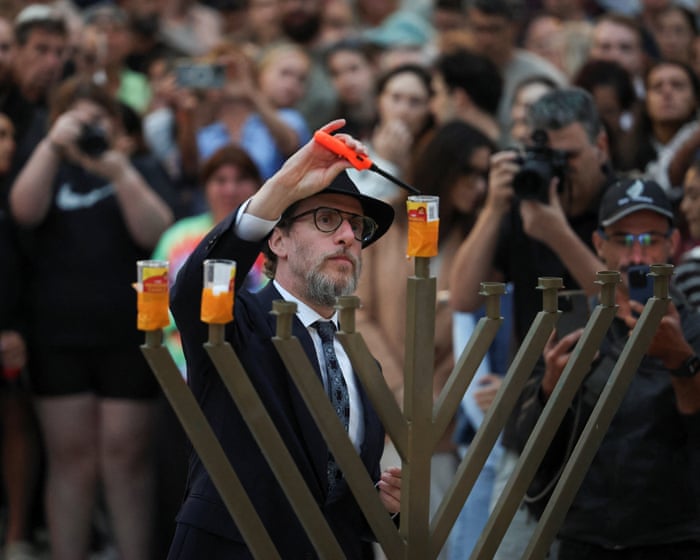
As daylight faded, people returned to Bondi to light candles, sing, and stand together in solidarity and defiance against the terror that had struck their beach and their world.
Across Bondi, Sydney, and Australia, candles were lit in support of the Jewish community, which suffered the country’s worst antisemitic attack when two gunmen allegedly opened fire on a Hanukkah celebration at Bondi Beach shortly after 6:40 p.m. on Sunday. Among the fifteen killed were a 10-year-old girl, a London-born rabbi whose fifth child was born just two months ago, and an 87-year-old Holocaust survivor.
The “Chanukah by the Sea” event had promised faith and fellowship. A promotional flyer encouraged the community to “come celebrate the light of Chanukah together,” inviting friends and family to “fill Bondi with joy and light.” Instead, the gathering brought darkness and terror. Now, candles are lit in memory, and songs of mourning are sung.
Prime Minister Anthony Albanese urged Australians to light a candle and place it in their front window, “to show that light will indeed defeat darkness—part of what Hanukah celebrates.” He added, “We are stronger than the cowards who did this.”
The two alleged attackers, father and son Sajid Akram, 50, and Naveed Akram, 24, were from Bonnyrigg in western Sydney. Sajid, licensed to own six firearms, is believed to have used those weapons in the attack. He was shot and killed by police, while Naveed was critically injured and remains hospitalized under police guard.
In response to the attack—the worst mass shooting since the 1996 Port Arthur massacre—Albanese reached an agreement with state leaders on Monday to introduce stricter gun control laws. Proposed reforms include limiting the number of firearms one person can own and conducting regular license audits. “People’s circumstances can change. People can be radicalized over time. Licenses should not be in perpetuity,” the Prime Minister said.
Much of the attack was captured on phone footage circulating on social media and WhatsApp groups. One 10-minute video shows the attackers taking positions on a stone footbridge overlooking the beachside park where the celebration was held. From an elevated vantage point about 50 meters away, they fired into the crowd of families, pausing periodically to reload. At one point, Sajid descended from the bridge and walked into the park, shooting at hundreds of people who were lying on the ground, hiding behind trees, or trying to flee.
In an extraordinary act of bravery, Sydney fruit-store owner Ahmad al Ahmad crept up to Sajid, who was still firing into the screaming crowd. Ahmad lunged at the gunman, wrenching the weapon from his hands and turning it toward him before placing it by a tree. Sajid stumbled backward and retreated to the bridge.
The assault ended after at least seven minutes of gunfire when police bullets struck first Sajid and then Naveed. Police and civilians then stormed the footbridge.
That Sunday evening, Bondi had been filled with crowds. The water was calm, and the fading light…The sun was still warm. Without warning, panic swept the beach—frenzied, chaotic moments as round after round was fired into the terrified crowd.
Footage from within the crowd, lying in fear on the park grass, shows people on phones pleading for help. Others can be heard listening to their inaccessible phones ringing—loved ones calling in panic, desperate to know they were safe.
Other videos capture the terror of thousands fleeing the gunfire: some running up the beach, others down the sand into the water, stumbling over one another to escape the gunmen.
They fled in panic. On the quiet Monday that followed, the everyday possessions they left behind—shoes and hats, umbrellas and balls—had been quietly lined up at the edge of the sand, waiting to be reunited with their owners.
Mass shootings are rare in Australia. In the wake of this attack, in a place known to so many across the country and around the world, Australia is wrestling not only with questions of gun control, but also with social harmony and antisemitism.
Since October 2023, Australia has seen a rise in antisemitic attacks targeting synagogues and Jewish businesses. Some have been domestic in origin, but according to the Australian Security Intelligence Organisation, a number have been planned and financed by Iran’s Revolutionary Guard Corps.
In response to those earlier attacks, Rabbi Eli Schlanger said: “In the fight against antisemitism, the way forward is to be more Jewish, act more Jewish, and appear more Jewish.”
Schlanger, a father of five, was killed on Sunday evening.
More has also emerged about the alleged attackers, particularly the younger one, Naveed. He came to the attention of intelligence agencies in 2019 due to his “associations,” but was deemed not to be a threat.
Sheikh Adam Ismail, head of the Al-Murad Institute in Sydney’s west, said he had briefly taught Naveed Akram the Qur’an and Arabic language, “as I’ve done with thousands of students.”
Ismail said he was deeply saddened by the senseless, brutal violence carried out by his former pupil.
“I condemn these acts of violence without any hesitation. I’m deeply saddened by what occurred and extend my sincere condolences to the victims, their families, and the affected Jewish community.
“What I find deeply ironic is that the very Qur’an he was learning to recite clearly states that taking one innocent life is like killing all of humanity.
“This makes it clear that what unfolded yesterday at Bondi is completely forbidden in Islam. Not everyone who recites the Qur’an understands it or lives by its teachings.”
Frequently Asked Questions
Of course Here is a list of FAQs about the symbolic act of lighting candles across Australia
General Understanding
Q What does candles are being lit across Australia refer to
A Its a symbolic act of unity hope and remembrance People light candles to show solidarity during a difficult time to honor someone or something lost or to collectively wish for a brighter future
Q Is this for a specific event or a general tradition
A It can be both Australians often light candles for specific national tragedies anniversaries or vigils It can also be a more general response to periods of collective hardship or uncertainty
Q What does light overcoming darkness mean in this context
A Its a metaphor The darkness represents grief challenge disaster or fear The light from the candles symbolizes hope resilience community spirit and the belief that better times will come
Participation Meaning
Q How can I participate
A You can light a candle in your own home at a designated time join a community vigil or simply take a moment of quiet reflection while others do the same
Q Do I need a special type of candle
A No Any candlea tea light a pillar candle or even an electricbatteryoperated one for safetyis perfectly fine The intention is what matters most
Q Im not religious Is this still appropriate for me
A Absolutely While lighting candles has roots in many religious and spiritual practices in this national context it is primarily a secular humanist symbol of community memory and hope that transcends any single belief system
Context Examples
Q When has Australia done this before
A Australians have held candlelight vigils after natural disasters like bushfires and floods following national tragedies on ANZAC Day for fallen soldiers and during events like National Sorry Day to remember the Stolen Generations
Q Is this similar to things done in other countries
A Yes Lighting candles is a nearuniversal gesture Examples include vigils after terrorist attacks the global Wave of Light for Pregnancy and Infant Loss Remembrance Day or Holocaust remembrance ceremonies