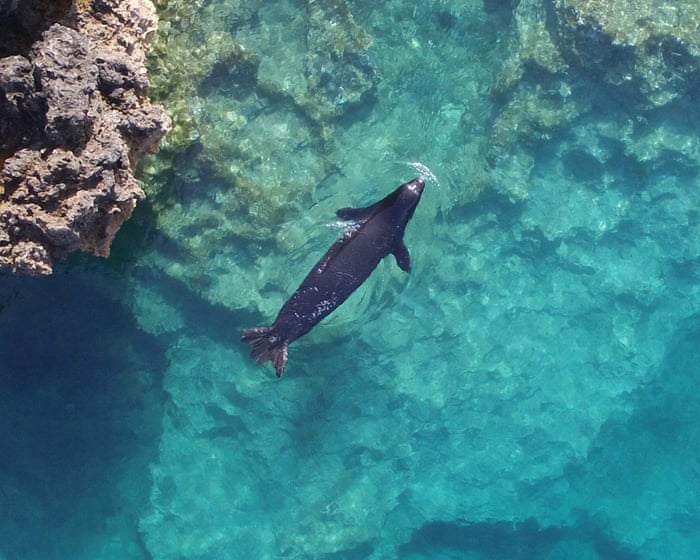
Deep in a sea cave among Greece’s northern Sporades islands, a large, shadowy figure stirs in the dim light. On a boat drifting quietly nearby, someone passes around binoculars. There it is—a massive Mediterranean monk seal, one of the rarest marine mammals on Earth. Reaching up to 2.8 meters and over 300 kilograms, it is also one of the largest seal species.
The seal has come ashore on Piperi, a strictly guarded island within the National Marine Park of Alonissos and Northern Sporades. This area is Greece’s largest marine protected zone and a vital breeding ground for the seals. Only researchers with government permission are allowed within three miles of its coast.
With a global population under 1,000, the Mediterranean monk seal is listed as vulnerable on the IUCN Red List, having been reclassified from endangered in 2023 after decades of conservation efforts helped numbers slowly recover. According to the Hellenic Society for the Protection of the Monk Seal, Greece is now home to about 500 monk seals—half of the world’s total—up from around 250 in the 1990s. This gives Greece a uniquely important role in the species’ survival. It’s a fitting responsibility, given that seals were once believed to be under the protection of the gods Poseidon and Apollo and hold a special place in Greek culture.
Monk seals have been hunted since prehistoric times for their skins, meat, and blubber. While hunting has declined in Greece, other threats remain: entanglement in fishing gear, food shortages, pollution, and habitat loss. Now, conservationists warn that a very modern danger is growing rapidly and threatening the seal’s fragile recovery: Greece’s booming marine leisure industry. Unregulated tourism, they say, is harming a species highly sensitive to human disturbance.
This summer, several initiatives were launched to address the problem, including Seal Greece, a national education campaign. Around the same time, the islet of Formicula—a key seal habitat in the Ionian Sea—was protected with a strict 200-meter no-entry zone ahead of the busy tourist season. In October, Greek Prime Minister Kyriakos Mitsotakis confirmed plans for two large new marine protected areas. If well managed, these could offer a lifeline to the species.
Back near Piperi, freelance warden and marine biologist Angelos Argiriou points toward a beach monitored by camera as the boat glides past. “We often see seals resting here,” he says. “The fact that they feel safe enough to come ashore in the open is a really good sign that protection measures are working.”
Seals first gained protection in Greece in the late 1980s, thanks in large part to the Hellenic Society for the Protection of the Monk Seal. The organization has rescued more than 40 orphaned or injured seals to date. “Our rehabilitation center has really helped the species recover,” says the society’s president, Panos Dendrinos. “Last year, we observed a rehabilitated female with a new pup. Saving one female can mean 20 pups in her lifetime.”
Monk seals once commonly gathered on open beaches, but many retreated to caves in recent decades due to human pressure. While caves offer shelter from people, they can be dangerous nurseries—rough surf can dash pups against rocks, drown them, or sweep them out to sea. And even caves are no longer safe havens. Once-remote coastlines are now accessible to day-trippers on rented boats and private yachts anchoring in seal habitats.
“About a week after giving birth, monk seal mothers leave their pups alone to go fishing.”For hours,” says Dendrinos. “If someone enters the cave, the pup is likely to panic and flee, and its mother probably won’t be able to find it.”
An adult female seal with her pup on the island of Piperi, which lies within a marine park established to protect seals and encourage them to return to using beaches.
After 40 years of monitoring the Alonissos Marine Protected Area (MPA), Dendrinos notes that his team now regularly observes seals using open beaches.
Formicula, another crucial seal habitat, will be included in the new Ionian MPA. This small island sits in one of the world’s busiest sailing areas. Unlike its more famous neighbors, Meganisi and Cephalonia, it remained relatively unknown to tourists until recently.
Marine biologist Joan Gonzalvo from the Tethys Research Institute describes how tourism has impacted the area. “Six, seven, eight years ago, we had encounters almost every day,” he recalls. “We would see five or six seals in the water at once, socializing and chasing each other.”
But as sightings increased, so did tourist interest. “What was exciting at first quickly turned into a nightmare,” he says.
Crowds arrived seeking “seal experiences.” Instead of studying the animals, Gonzalvo found himself documenting people chasing seals. On two occasions, individuals entered breeding caves, causing mothers to be separated from their pups. Both pups disappeared. One day in August 2024, he counted over 50 boats around the islet’s small shoreline. “Nowadays,” he says, “we are lucky if we see even one or two seals.”
In Greek culture, seals hold a special place, once believed to be under the protection of the gods Poseidon and Apollo.
During our conversation, Gonzalvo spots a seal and reaches for his camera. He recognizes her immediately. “Mm17003,” he says, referring to the identification number of one of the more than 40 seals he has cataloged online. As the seal swims, boats anchor in newly established no-entry zones, and tourists swim near the protected caves.
Unlike the Alonissos MPA, there are no wardens patrolling Formicula. It falls to Gonzalvo to politely inform boat skippers that they are in a restricted area.
“It’s early days,” he says. “But the seals’ inactivity worries me. We need serious investment in law enforcement.”
In Greece, NGOs have repeatedly raised concerns about “paper parks”—protected areas with inadequate enforcement. A study published last year by nine environmental organizations highlighted that “only 12 out of 174 marine Natura 2000 sites [EU protected areas] have a protective regime,” and even those measures were fragmented or temporary.
The hope is that the new MPAs will include patrols. “The Natural Environment and Climate Change Agency needs more boats and more people,” says Dendrinos, adding that current wardens must report to port police, “a process that is time-consuming and ineffective.”
At Formicula, Gonzalvo fears time is running out. “If we cannot protect this vital habitat—a tiny drop in the middle of the Ionian Sea, home to one of the most charismatic and endangered marine mammals on the planet—then there is very little hope for protecting anything else in our oceans.”
The sight of seals playing in the water once attracted crowds of tourists looking for “seal experiences.”
Frequently Asked Questions
Of course Here is a list of FAQs about Greek tragedy designed to be helpful for both beginners and those with more advanced interest
Beginner Questions
1 What exactly is a Greek tragedy
Its a specific type of play from ancient Greece that explores serious themes like fate justice and human suffering It typically features a noble hero who makes a critical mistake leading to their downfall and aims to evoke pity and fear in the audience
2 What are the most famous Greek tragedies
The three most famous tragedians are Aeschylus Sophocles and Euripides Mustknow plays include Sophocles Oedipus Rex and Antigone Euripides Medea and Aeschylus The Oresteia trilogy
3 Why did the Greeks watch such depressing plays
They werent just for entertainment Tragedies were part of a religious festival and served as a form of civic education They helped the community explore difficult moral questions and experience a collective emotional release known as catharsis
4 What is a tragic flaw
Its a translation of the Greek term hamartia which means a critical error in judgment or a character trait that leads to the heros downfall Its not necessarily a moral failing but a mistake anyone could make
5 Did actors wear masks
Yes All actors wore large masks to portray different characters and help project their voices A few actors played multiple roles by switching masks
Advanced Practical Questions
6 Whats the difference between the plays of Aeschylus Sophocles and Euripides
Aeschylus focused on grand themes of gods fate and justice often in connected trilogies He used two actors
Sophocles introduced a third actor focusing on the individual heros struggle against fate His plots are often seen as the most perfectly structured
Euripides was skeptical of the gods and focused on the psychology of his characters especially women and the marginalized His plays can feel surprisingly contemporary
7 What was the role of the Chorus
The Chorus