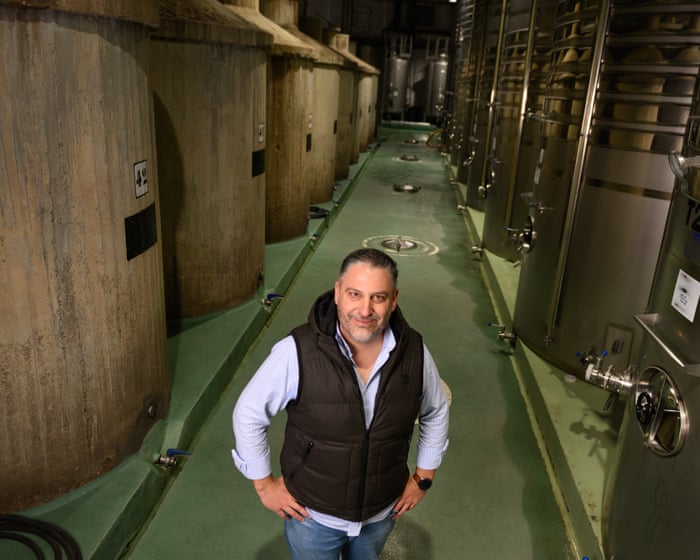
The massive concrete vats that have held countless liters of verdejo white wine over the 90 years since the Cuatro Rayas cooperative winery was founded are now overshadowed by the stainless steel tanks opposite them—a clear sign that even in a tradition as old as winemaking, times are changing.
Outside, a cold but refreshing rain falls on the surrounding vines, which have turned autumn-brown after another scorching summer in Valladolid, northern Spain. But shifting technologies and the unpredictable effects of climate change aren’t the only challenges facing Spain’s €22.4 billion wine industry.
A recent report warns that the sector urgently needs new blood and must recruit 22,600 younger workers in the coming years as the current generation of growers reaches—and passes—retirement age. The study, commissioned by the Spanish Wine Interprofessional Organisation (OIVE), found that 38.9% of winegrowers are between 51 and 65, and 35% are over 65. Those aged 41 to 50 make up 16.9% of the sector, while people under 40 account for just 9.3%.
The organization’s president, Fernando Ezquerro, is frank about the situation. “If we don’t get that generational replacement, the sector will obviously wither,” he says. “If you don’t have grapes, you don’t have wine.”
Winemakers across the border in France have also raised the alarm, though for different reasons. They warn that a bitter mix of Donald Trump’s tariffs, falling sales, and some of the worst harvests in 70 years is pushing producers to the brink.
Much of Spain’s problem stems from the ongoing phenomenon of la España vaciada—the emptying of rural areas as young people leave the countryside to study, work, and live in cities. The numbers tell the story: although rural areas make up 84% of Spain’s territory, they are home to just 15.9% of the population. Moreover, the number of young people in rural municipalities is a third lower than in urban ones.
“There’s a problem of generational replacement across the primary sector, and that’s because people want to live in cities and the rural world is less attractive for a thousand reasons,” says Ezquerro. “We all need to work together to make this sector more appealing so that young people make what is often a difficult choice.”
Ezquerro and his colleagues believe the key to securing the future of the industry—which accounts for 2% of jobs in Spain and 1.6% of its GDP—lies in attracting young people, modernizing vineyards, and ensuring those who run them are knowledgeable about sustainability and digital tools.
Óscar de Íscar, a partner and board member at the Cuatro Rayas cooperative, is part of the much-needed younger generation of winemakers. At 36, with a degree in chemical engineering and a master’s in winery management, he isn’t your typical grower. But his family has been making wine for at least four generations, and he never doubted that he and his brother would take over its 60 hectares when his father retired. As he puts it: “To be honest, there’s as much wine in me as there is blood.”
Although De Íscar describes wine as his passion, he also acknowledges that he’s fortunate to earn enough from it to make it a career, not just a hobby. Part of the recruitment challenge, he says, is that many young people don’t see its entrepreneurial potential. De Íscar, who also leads the youth working group in Spain’s Association of Agro-Alimentary Cooperatives, recalls coming across a newspaper article tA survey found that 40% of young people aged 18 to 25 aspire to become civil servants. “So we’re starting from a point where there may not be a strong culture of entrepreneurship,” he says. “But ultimately, winemakers are businesspeople, and the profession needs to be recognized and valued for what it is.”
While he acknowledges that the wine industry, like any other, faces challenges—not least the weather—De Íscar adds, “Right now, we’re the best-prepared generation in history, and we have the best technical resources in history. That’s where we should begin when we outline this entrepreneurial vision and try to encourage people to sustain the sector.”
A quick tour of the Cuatro Rayas winery in La Seca, Valladolid, shows that the days of dusty cellar-door sales and labor-filled barrels are long gone. Its sleek shop shelves are stocked with panettone alongside wine, and like many wineries, it has a PR team and is a popular stop for wine tourists.
Yet all this may simply be the latest chapter in a centuries-old tradition. “My father always says, ‘When you visit a town with a winemaking tradition, look at the houses and the churches,'” says De Íscar. “The wine sector has likely been one of the economic engines of many regions.”
Ezquerro agrees. “There are so many small towns and villages that depend on wine—they would disappear, along with much of the countryside,” he says.
He also notes that vineyards and wineries help store carbon and sustain local populations. “This is too important not to fight for,” he says. “One of our challenges as a sector is explaining the whole story behind each bottle, each vineyard, and each winery. We need to get better at telling that story because I believe society—and young people—would understand it.”
Frequently Asked Questions
Of course Here is a list of FAQs about the topic Too important not to fight for Spains wine industry looks to attract new talent designed to cover a range of perspectives
Beginner General Questions
1 What does too important not to fight for mean in this context
It means that the Spanish wine industry is a vital part of the countrys culture economy and heritage and its worth making a significant effort to ensure its future by bringing in a new generation of skilled workers
2 Why does Spains wine industry need to attract new talent Isnt it doing fine
While Spain is a worldleading wine producer many experienced winemakers and vineyard workers are nearing retirement Theres a real risk of a skills gap if young people dont enter the field threatening future innovation and sustainability
3 What kind of jobs are available in the wine industry besides being a winemaker
There are tons Careers include viticulturist marketing and sales specialist wine tourism guide lab technician sustainability expert sommelier logistics manager and digital content creator for wineries
4 Is working in wine just about farming and manual labor
Not at all While handson vineyard work is crucial the modern industry is highly technical It combines science technology business tourism and creative arts like branding and storytelling
Benefits Opportunities
5 What are the main benefits of pursuing a career in Spanish wine
You get to work in a dynamic internationally respected field that blends tradition with innovation Careers can be deeply connected to a specific region offer opportunities for travel and involve creating a product enjoyed globally
6 How is the industry trying to make itself more appealing to young people
Initiatives include modernizing its image through social media offering more formal apprenticeships and training programs emphasizing technology and sustainability roles and promoting better worklife balance and career progression
7 Are there opportunities in cities or is it only in rural areas
There are opportunities in both While production is rural many headquarters marketing firms export departments and wine bars are located in major cities like Madrid Barcelona and Bilbao
Common Problems Challenges