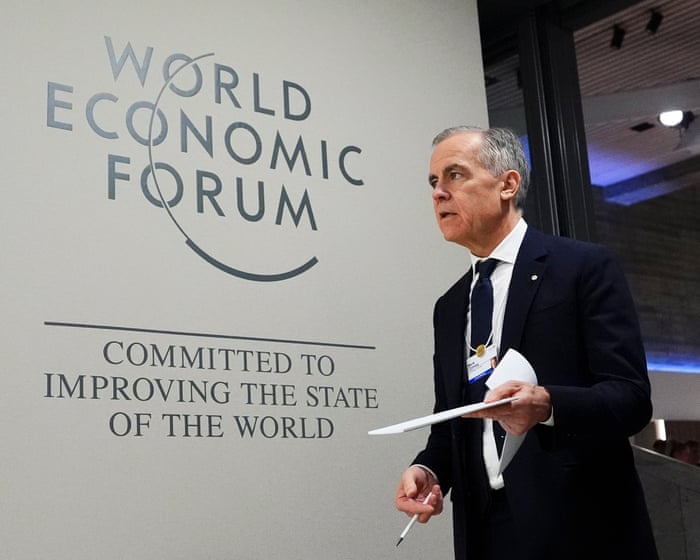
When exactly did the rules-based order die? Mark Carney’s speech last week at Davos was the first time a Western leader has openly stated what has been looming over politics for some time: the rules-based order is “fading,” in the midst of a “rupture,” and there is no turning back. But beyond Davos, the G7, and NATO, this is old news—many believe the order died long ago, depending on which moment you see as the turning point.
The order had several layers, each complex. First, there was the structural component: an agreement among powerful, prosperous nations to establish mechanisms and protocols aimed at maintaining political stability, preventing wars, and advancing shared economic interests. Institutions like the EU, NATO, the UN, the WTO, and the IMF formed this top layer of global governance.
Second were the more abstract norms these countries upheld in both action and rhetoric. They agreed not to pursue aggressive protectionist policies against one another, not to covet each other’s territory, and not to interfere in domestic affairs.
Third was the ideological glue that held it all together—the notion that these arrangements were not merely transactional, but rooted in liberal ideals: promoting universal human rights, self-determination, and the sanctity of individual freedoms.
In many ways, this final layer was the most important, what Carney called a “pleasant fiction”: the pretense that the system wasn’t fundamentally about American hegemony. The U.S. and its allies frequently violated or overlooked international law, but they generally worked to make those actions appear consistent with the order. Sometimes they had to break the rules to save them, acting not simply because they could, but as self-appointed guardians of moral standards and global security.
The “war on terror” was the first major challenge to that narrative. Any belief that powerful nations would not abuse their power to invade others, carry out illegal renditions, or imprison people without due process ended then. For the victims—whose lands became battlegrounds for foreign troops—there was no part in this “pleasant fiction.” Their countries endured years of war and fragmentation, leading to disastrous outcomes like sectarian violence in Iraq and Afghanistan, and ultimately the return of the Taliban once the post-9/11 fervor faded. Yet the architects of the war could still console themselves and their publics by framing it as a necessary fight against Islamic terrorism, blaming the catastrophic results on “unknown unknowns.”
That consolation has become nearly impossible in Gaza, where another part of the order has died and the decay has spread. Every aspect of the genocide there has shattered the pretense that the order was grounded in ideals—or that those ideals applied to anyone but those at the top. The sheer scale of killing, along with violations of every established rule—from the mass killing of civilians to depriving them of food and medicine—has obliterated the fiction.
But it wasn’t just the atrocities themselves. It was that Israel was both armed and diplomatically shielded by its allies, making them not mere bystanders but partners in the crime. This was not a genocide in a distant African country, allowing for hand-wringing and condemnation from afar. It was a joint venture, sustained only because Israel is a close ally, laying bare that the rules have always been applied selectively.The conflict in Gaza also revealed deeper fractures, creating a tension between the parts of the international order that have decayed and those that still function. In backing Israel, some Western nations, including the US, clashed with their own institutions—ignoring rulings from the International Criminal Court regarding Benjamin Netanyahu, with the US even imposing sanctions on the court itself. Gaza laid bare that these institutions often operate like an exclusive club where insiders are shielded from consequences.
Then came a more recent shift, where the very components of that order became targets of American power rather than its partners. This includes Trump’s overtures toward Greenland, his disdain for European allies and NATO, and his tariff wars. These allies are now grappling with how to coexist on terms abruptly and aggressively rewritten by a US that has abandoned even the pretense of discreet dominance.
Carney’s remarks, while welcome, frustrated many who saw them as stating the obvious. He only spoke out once the decay affected him directly, and his admission made it worse—acknowledging that the order’s foundations were always flawed and unjust, yet had until now been upheld by a functional “bargain.”
In truth, this realization is more difficult for close US allies like Canada than for nations that always knew they were expendable and less entangled with America. For those deeply integrated into US security, economic, and ideological networks, this new hostility represents a fundamental breach of trust, not just routine politics.
As the guardians of the rules-based order consider its decline and what comes next, they will find that much of it is still alive. Moving on won’t simply mean shifting foreign policy away from the US, but unraveling an entire system—both practical elements like global capital, trade deals, and dollar dominance, and intangible ones like shared values, norms, and a persistent disregard for those outside the club. Notably, even as Carney outlined the old order’s hypocrisies, there was no recognition of the people who have always borne its costs.
Proposed solutions so far—like greater coordination among middle powers, increased defense spending, and reducing trade barriers to compensate for US isolationism—largely perpetuate the old order’s security and economic supremacy. Those seeking to break free remain trapped by the very structures they built and still believe in. The challenge now is not just what can be built from the ruins—that would imply a clean break—but rather how much of the old order still lives on within them.
Frequently Asked Questions
Of course Here is a list of FAQs about the statement Even the elites at Davos have finally taken notice but mere speeches wont be enough to see them through the collapse of the old order
BeginnerLevel Questions
1 What does the elites at Davos mean
It refers to the powerful and influential peoplelike CEOs politicians billionaires and thought leaderswho attend the annual World Economic Forum meeting in Davos Switzerland They are often seen as representing the current global economic and political system
2 What is the old order thats collapsing
Its the established global system that has dominated for decades This includes assumptions about steady economic growth stable international relations predictable climate patterns and the idea that existing institutions can easily manage global problems
3 What have they finally taken notice of
They are acknowledging major interconnected crises that threaten the current system such as severe climate change extreme inequality geopolitical fractures and the disruptive impact of technologies like AI
4 Why are mere speeches not enough
Because giving talks and making pledges at conferences doesnt create the deep systemic changes needed Real actionlike overhauling economic models enforcing strict climate policies and redistributing power and wealthis much harder and often conflicts with their shortterm interests
Advanced Implication Questions
5 What specific crises are driving this collapse
A combination of factors the climate and biodiversity emergency a crisis of legitimacy in democratic institutions unsustainable debt levels the shift from a unipolar to a multipolar world and the social fragmentation caused by technology and inequality
6 If speeches arent enough what would enough actually look like
It would require transformative action binding international agreements with real penalties taxing extreme wealth phasing out fossil fuels with a just transition reforming global trade and financial rules and genuinely empowering new voices in decisionmaking
7 Whats the main obstacle preventing the elites from taking real action
Their power wealth and status are often tied to preserving the current system Radical change could undermine their own positions shareholder returns or national advantages in the short term creating a powerful incentive for delay and incrementalism
8 What does see them through imply
It suggests