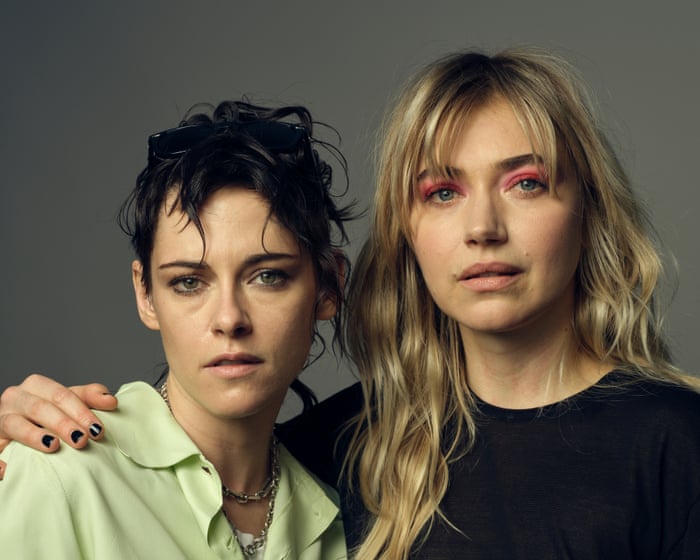
“The movie is meant to be consumed, digested, and transformed by each viewer in their own way,” says Kristen Stewart with refreshing candor. Her directorial debut, The Chronology of Water, has been making its way through film festivals, and when we meet in London, reviews are starting to arrive. Stewart understands that this impressionistic, arthouse collage—adapted from an experimental memoir exploring a woman’s pain and loss, the elusive nature of memory, and the reclaiming of desire—won’t appeal to everyone. “My favorite Letterboxd review says: ‘The Chronology of what the hell did I just watch?'” But it matters deeply to her that people engage with it. “Whether it’s your least favorite movie or your absolute favorite, it’s honest. And I’m incredibly proud of that.”
Stewart is seated beside the film’s star, Imogen Poots, who appears a bit more composed. Watching Stewart speak—her leg bouncing, her vocabulary intense—feels a bit like being swept up in a whirlwind. It’s energizing and oddly motivating, but you don’t enter a conversation with her unprepared. The same could be said for the film itself. “Language is a metaphor for experience,” writes author Lidia Yuknavitch at the start of the book it’s based on. “It’s as arbitrary as this chaotic collection of images we call memory.”
Stewart first read the book in 2018 while filming JT LeRoy. She recognized the visual potential in its chaotic imagery and quickly decided it would be her first feature-length film as a director. “Forty pages in, I was completely fired up and fiercely determined that no one else could make this movie but me,” she says. “It felt so physical. So urgent. Like a profound secret. There’s an uncovering quality to how Yuknavitch writes about trespass, and how our desires are etched into our bodies. As women, our power resides in our openings, but it’s also where we can be taken advantage of.” At this point, barely two minutes into our conversation, it’s clear this isn’t your typical movie-star promotional interview. “We’re all so restrained,” Stewart adds. “And this felt like breaking free. That’s the exciting part. It’s bold. Unapologetically loud.”
So she emailed Yuknavitch.
“It was a wildly exciting email,” the author recalls from her home in Portland, Oregon. “She explained why this book could never be a conventional biopic and why she had to turn it into a piece of art. Her language resonated with me instantly—it wasn’t ordinary.” Yuknavitch, a lifelong film enthusiast, was already familiar with Stewart’s work. “I even wrote a novel with her in mind years ago. She was younger then, just moving beyond the Twilight phase and into independent art films. I pictured her as I wrote.” That novel is titled Dora: A Headcase. Does she see this as a spooky coincidence? Artists, Yuknavitch responds, often find each other. “They cross paths, and these threads or currents we don’t fully understand connect. I think that’s what happened here.”
Securing funding for the film wasn’t easy. Poots and Stewart, both avid readers, delve into a thoughtful discussion about how confessional writing is often taken seriously when men write it but “constantly belittled,” Stewart notes, when it comes from women.from women. “There are so many examples in modern literature of men laying everything bare, but when a woman does something overtly personal, it’s seen as less serious,” Stewart continues. “We’ve been completely erased from modernism in the literary canon. It’s like we don’t exist in it at all. And it’s such a fucking crock of shit. You have to be Virginia Woolf to be considered a good writer.” This is not Reese’s Book Club.
Did they encounter those attitudes when making the film? “Yes, because I think when people read the script, it was reduced to how to sell it,” says Stewart. “Okay, so what’s it about—incest and rape? Fun!” It was not an easy pitch, she admits. “It’s about the gouging out of desire, and reframing that, and how empowering that is. In a logline, it’s a really tough sell.” It took eight years of development before they finally got to work, mostly on location in Latvia. In the meantime, Stewart continued to act and directed smaller projects: a couple of short films and a music video for the band Boygenius. Time passed in the background, sometimes unpromisingly, until eventually it all came together. Even Stewart’s longtime producer, Charles Gillibert (On the Road, Personal Shopper), had told her he couldn’t finish the script. “And he’s not the only one. He really encouraged me not to make this movie,” she smiles. “I was like: we’re going to stop being friends if you keep saying this to me.”
Poots plays the adult Lidia with physical gusto. The film is a collection of fluids and fragments. Poots read Stewart’s screenplay, then the book, and then sent Stewart “a really pretentious email, which she lapped up,” she teases. Was she nervous about taking on a role that is so stark and exposing? It pulses with sex, drugs, and violence. Bleeding, sobbing, and grief wash over it. “Any actress I know would have wanted to play this part,” says Poots. In fact, she explains, casting her as the lead made the film harder to make. “If Kristen had hired a huge movie star, it would have made getting the money a hell of a lot easier,” she says.
Poots is a best-kept-secret kind of actor, and her performance here is immense, but I ask Stewart why she felt so loyal to her. “She’s my favorite actor, and everyone else sucked,” she shrugs. “There was literally no one else, and she’s been a favorite of mine forever.”
“And we have the same teeth,” says Poots, showing them off.
Stewart flashes hers in unison. “Because we have the same teeth, I thought: this is my girl. Bucktooth!”
The film also stars Kim Gordon, Thora Birch, and Jim Belushi, who plays the late One Flew Over the Cuckoo’s Nest author Ken Kesey. It is a merry band of misfits. “What’s really cool, and you wouldn’t have been aware of it, is that these people, who have all been at the center of incredibly creative community movements, wanted in on what you were doing,” says Poots to Stewart.
Did she pull in any favors to get them involved? “Nobody did me any favors, trust me,” Stewart says gravely. “In fact, we got fucked. In the face. Over and over.” She pauses. “Like a real woman!” she jokes. To be honest, she says, Belushi came on board after a couple of other actors dropped out. “I don’t think it was an easy yes. But the feeling of him supporting you, a nice pat on the back from Jim Belushi, could make you cry. He’s kind of a radical, and he’s a hippie, and he was perfect to play thImogen is a powerhouse actress straight out of the British academy—a real knock-down, one-two-punch performer if I’ve ever seen one.
Since the film deals with memories, it avoids a conventional narrative structure. Men drift in and out of Lidia’s life, which meant actors would come to set briefly and then leave—”sort of like a conveyor belt,” says Poots.
“Or chapters,” suggests Stewart.
“These insanely brilliant, talented actors,” adds Poots.
“And they serviced you,” Stewart grins. “It was fucking incredible to watch male actors come in and have it not be about them. I’d be like, ‘Sorry, but we’re actually not going to shoot you. We’re just going to shoot her. But talk to her. You’re here, kind of, but this is about her.'”
Poots cackles. I’m guessing this isn’t a typical experience?
“Mmmm,” says Poots. “For so many reasons.” Both say they plan to make “a lot more movies” together.
A few weeks later, Birch video calls from her home in Los Angeles, her dog lounging happily in the background. “You cannot enter a conversation with Kristen Stewart without coming locked, loaded, and ready to go,” she laughs. “It’s intimidating!” Birch plays Lidia’s older sister, Claudia, in a brief but powerful role. In one of the film’s earliest scenes, she holds a sobbing, grief-stricken Poots in the bath after the death of Lidia’s stillborn baby girl. “Imogen is just a knock-down, one-two-punch, hazelnut-popping actress out of the Brit academy if I ever saw it,” Birch says brilliantly.
Birch and Stewart had met at an event where they did some “mutual fangirling.” A few months later, Stewart called and said she was making a movie. Birch signed on right away—and then she read the script. “I’m not going to lie, it was a little bit of a daunting process,” she says. “But I just trusted her already.” Partly, she thinks, that’s because they share some experiences. Both became famous as children. Stewart was 12 when she starred in Panic Room, while Birch’s run of ’90s and early 2000s films—from Hocus Pocus to Now and Then to Ghost World—defined adolescence for a whole generation of girls.
“Maybe I related to her because we’re both performers who started out very, very young, and so we had a common language. I say she’s my spirit animal. She does a lot of things that I do, but just way better,” Birch says. She had followed Stewart’s career from afar. “Different times, different generations, but the way she handled [getting famous young], I was just like: dude, that’s with aplomb. You knocked it out of the park, because you held on to your individuality and your point of view, which can really be difficult to hold on to.” She waves a hand. “But let’s not get too far into that.”
In its boldness and experimental form, The Chronology of Water may well surprise those more familiar with Stewart the movie star, who might not expect a film like this from her. “I sort of did,” counters Birch. “This is a very Kristen Stewart movie.”
She’s glad, she says, that this is the story Stewart chose to tell. “She will hate me for saying it, but I’m sorry, this is emblematic of a female experience that not a lot of people are ready, willing, or even able to dissect and talk about.” The movie covers some “heavy shit,” Birch says. “We’re talking about period blood and stillborns and familial sexual abuse. Nobody wants to talk about this stuff, and yet she presents it in such a way that it marries fantasy and poeticism with the human experience. It’s a punk rock arthouse movie that’s like a non-psychedelic ayahuasca trip.”It makes sense, then, that Birch had no idea how it would turn out. She just had to have faith in what they were doing. “When I finally saw it, I thought: oh, that’s what she’s doing. One reviewer said: homegirl can direct. And coming from LA, I thought: yeah, that’s it. Homegirl can direct. She knows what she’s doing.” The Chronology of Water is released in UK cinemas on 6 February.
Frequently Asked Questions
Of course Here is a list of FAQs about Kristen Stewarts directorial debut and her statement Women hold power in our orifices
FAQs Women hold power in our orifices Kristen Stewarts Directorial Debut
Beginner Definition Questions
1 What is Kristen Stewarts directorial debut
Its a short film titled Come Swim which she wrote and directed It premiered at the 2017 Sundance Film Festival and is a poetic visual exploration of heartbreak and healing from a mans perspective
2 What did Kristen Stewart mean by women hold power in our orifices
She was using vivid metaphorical language to describe the creative process She meant that true raw artistic expression comes from deep within the body and selffrom internal often vulnerable placesrather than from an intellectual or calculated space
3 Was she talking about something literal or biological
No not literally She was speaking metaphorically about the source of creativity and emotional power The quote is about art originating from visceral internal experience
Advanced Contextual Questions
4 Why did that specific quote get so much attention
The phrasing was intentionally bold and unconventional It challenged typical sanitized Hollywood discourse and sparked discussion about how female artists describe their creative process using embodied sometimes shocking language to make a point
5 How does the film Come Swim reflect this idea
The film is highly sensory and emotional not plotdriven It uses striking imagery to externalize internal pain Stewart aimed to create from a feeling place first aligning with the idea of art emerging from a deep physical core
6 What was the broader context or interview she said this in
The quote is from a 2017 interview with The Sunday Times around Come Swims release She was discussing the difference between male and female creativity suggesting that female creativity is often more intuitively connected to the body and raw emotion
7 How was the quote received by critics and the public
Reactions were mixed Some praised it as a bold feminist reclaiming of bodily metaphor and a rejection of artistic pretension Others found it confusing or needlessly provocative It successfully ignited conversation about her transition from actor to director