I stopped watching the TV adaptation of The Handmaid’s Tale fairly early on—the mass mock execution scene was too much for me. It was just too relentlessly bleak, too full of dread, too awful, and too true. Margaret Atwood’s dystopian story, published in 1985, drew on real events from totalitarian and tyrannical regimes around the world. Brought to the screen, the visceral terror of it all felt overwhelming from the start.
Now, the sequel Atwood released in 2019, The Testaments, has arrived, adapted by The Handmaid’s Tale showrunner Bruce Miller. Brace yourselves.
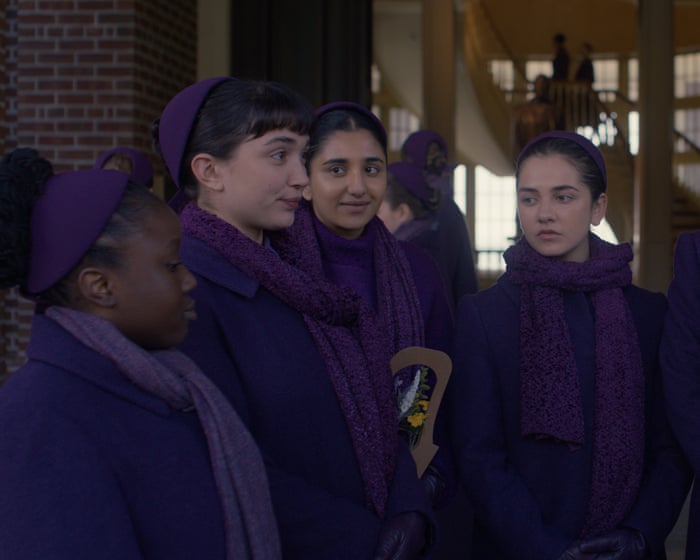
In some ways, it feels a bit lighter and brighter than its predecessor—almost like a young adult reboot. Set a few years after the end of The Handmaid’s Tale, it focuses on the next generation of women in Gilead. But it’s a YA version that still includes bloody punishments, rotting corpses hanging from gallows, and systemic indoctrination and abuse—made even harder to watch because the protagonists are so young. The visual style remains stunning, though. The color palette expands beyond the familiar red, white, and green. Young girls from the right class wear pink dresses and cloaks; older ones—called “Plums,” with all the connotations of ripeness—graduate to purple, including headpieces that are mandatory but far more stylish than the handmaids’ restrictive bonnets. Then, if they’re lucky enough to start menstruating, they move into the wifely shade of teal.
Agnes (played by Chase Infiniti) is the adopted daughter of Commander MacKenzie and his late wife, Tabitha. We also know she is June/Offred’s stolen first daughter, Hannah. Either way, the commander’s new wife, Paula (Amy Seimetz), wants the child off her hands as soon as possible.
Agnes attends an elite preparatory school run by Aunt Lydia—yes, that Aunt Lydia, the truly savage figure brought to life by the inimitable Ann Dowd. Whether this is the old Aunt Lydia or the newer, post-epiphany version from the end of The Handmaid’s Tale remains to be seen. But no matter how familiar you are with Gilead’s lore, the show’s team has done a good job making the story work.
Aunt Lydia puts Agnes in charge of showing a new student, Daisy (Lucy Halliday), the ropes. Daisy is one of the Pearl Girls, white-clad devotees of Gilead’s version of Christianity. They’re often recruited as orphans from outside the state by aunt missionaries and are generally suspected by other students of being spies for the teachers. (“The passion of the convert,” Agnes says in voiceover. “What a pain in the ass.”) The two girls’ increasingly close and complicated relationship forms the backbone of the ten episodes, which also unfold Daisy’s and Aunt Lydia’s backstories in flashback. In the present, Agnes must navigate getting her period and becoming “eligible.” In one scene, she kneels before her father in her new colored robes while his friends gaze at her—a sharp, unsettling reflection of teenage girls’ experiences with men, though here it’s condensed into a moment rather than drawn out over months or years. There are also revelations about her best friend Becka (Mattea Conforti) and Becka’s father, as life in Gilead grows increasingly intolerable for both girls.
Though slightly lightened by touches of humor—and mostly by the innate hope that comes with the protagonists’ youth—The Testaments, like its predecessor, is a study in groupthink, power, corruption, and how easily ordinary people accept evil practices. It is, in particular, about humanity’s cruelty toward women, the willingness of men to subjugate, to reduce others to servitude and mere body parts, and the grim truth that there is nothing new under the sun.
The Testaments is streaming now on Disney+.
Frequently Asked Questions
FAQs The Testaments by Margaret Atwood
Beginner General Questions
Q What is The Testaments
A Its the 2019 sequel to Margaret Atwoods classic dystopian novel The Handmaids Tale It picks up the story 15 years later and is told from three new female perspectives inside and outside the oppressive Republic of Gilead
Q Do I need to read The Handmaids Tale first
A Its highly recommended While The Testaments provides some context youll understand the world its horrors and the significance of certain characters much better if youve read the first book
Q Why is it called a brutal sequel
A The term brutal refers to its unflinching portrayal of Gileads crueltyincluding violence manipulation and psychological terror It doesnt shy away from showing how the regime operates and the extreme costs of resistance
Q Is it as good as The Handmaids Tale
A Its different The Handmaids Tale is a claustrophobic firstperson account of oppression The Testaments is a more plotdriven thriller that expands the world and shows its inner workings Many find it compelling and satisfying especially for its focus on resistance
Q Who are the main narrators
A The story is told by three women Aunt Lydia Agnes and Daisy
Advanced PlotFocused Questions
Q How does Aunt Lydias character change from what we knew before
A This is the books core Atwood reveals Aunt Lydias hidden history and complex longgame strategy for survival and sabotage from within the regime It recontextualizes her as a ruthless pragmatist playing a dangerous double game
Q Does the book provide more worldbuilding about Gilead
A Yes significantly Through Aunt Lydias eyes we see the political scheming power struggles and corruption among the Commanders and Aunts We also learn more about the Pearl Girls and the resistance network Mayday