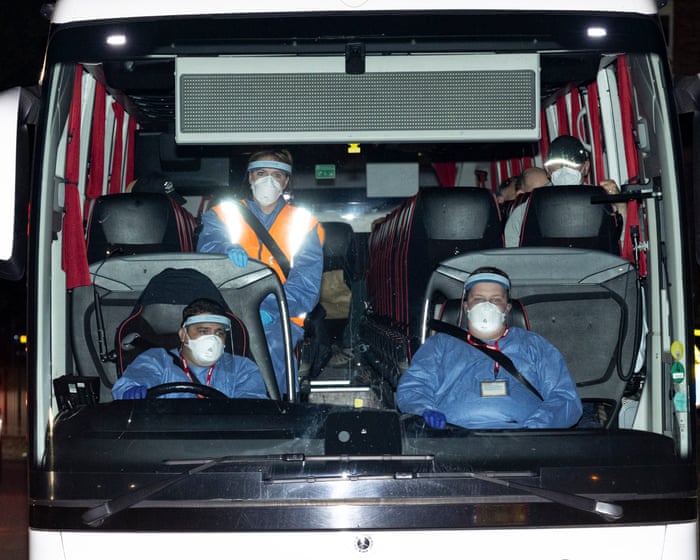
The complex operation to bring home the passengers and crew of the hantavirus-hit cruise ship, the MV Hondius, is nearly finished. Up to 150 people have started flying home on military and government planes from Spain’s Canary Islands. The World Health Organization has recommended—but not required—a 42-day quarantine after they land. Here’s what we know about how different countries are handling quarantine.
How did cruise passengers and crew leave the hantavirus-stricken ship?
Passengers wore blue medical suits and breathing masks as they left the MV Hondius and boarded smaller boats, according to observers. Those boats docked at a small industrial port in Tenerife. Evacuees then took Spanish army buses to an airport, with a protective barrier separating drivers from passengers. They changed into new protective gear, and photos showed them being sprayed down by medical officers on the tarmac before boarding charter flights home.
Will hantavirus cruise ship passengers quarantine when the flights land?
The WHO recommends a 42-day quarantine and “active follow-up,” including daily checks for symptoms like fever. This quarantine can happen at a staffed facility or at home in isolation. Some health experts worry people might not strictly isolate for six weeks. The WHO chief, Tedros Adhanom Ghebreyesus, says his organization doesn’t “force” its guidance.
Will countries manage hantavirus quarantine and isolation differently?
It’s still unclear. In the UK, the NHS says people will undergo medical tests at Arrowe Park hospital near Liverpool. The group will stay for an initial 72 hours, and then plans for further isolation will be assessed. In Australia, passengers will be taken by ambulance to a hospital for assessment and to set up suitable quarantine arrangements. The facility in Sydney’s west is designed to treat patients with “high consequence” infectious diseases, like Ebola, and has a dedicated elevator from a helipad and ambulance bay, plus its own sewage treatment plant. France said all its evacuees—one of whom now has symptoms—”have immediately been placed in strict isolation until further notice.” The French prime minister said he would issue a decree to authorize appropriate isolation measures to protect the public.
Are some countries enforcing stricter hantavirus rules?
Yes. Greece’s health ministry said a male evacuee will spend 45 days in mandatory hospital quarantine in Athens. Authorities said he will be placed in a specially prepared negative-pressure chamber at Attikon university hospital. In Spain, 14 citizens will be placed in biosafety isolation beds at the Gómez Ulla military hospital in Madrid.
How about the US, as it is no longer a WHO member?
The acting director of the Centers for Disease Control, Dr. Jay Bhattacharya, says the 17 Americans and one British national who live in the US will be flown to the University of Nebraska. At a quarantine facility, their risk levels for spreading the virus will be assessed. After that, they can choose to stay in Nebraska or go home, where state and local health agencies will monitor their conditions. The US health department confirmed on Sunday that one evacuee has mild symptoms and another has tested mildly PCR positive for the Andes strain of the virus. Complicating matters, some Americans are already back in the US, having left the ship in Saint Helena in the South Atlantic Ocean on April 24. At least four states—Arizona, Virginia, California, and Georgia—are monitoring them. In January, the US officially withdrew from the WHO. Some experts questioned whether that would weaken US access to global virus and disease databases.
What happens next?What should be done for the ship and crew affected by the hantavirus? The WHO says the ship should be checked for rodents, disinfected, and have proper rodent control measures put in place. Staff involved should wear protective gear, including eye protection, respirators, gowns, and gloves.
The Philippine government has confirmed that 38 Filipino seafarers from the ship will quarantine in Rotterdam before being sent home.
India has confirmed that two of its nationals who were crew members on the ship have been evacuated to the Netherlands, where they will be quarantined. They are described as “healthy and showing no symptoms.”
What is the public health risk? Three passengers—a Dutch husband and wife and a German woman—have died, and a few others have become sick with the disease. But officials have stressed that the risk to global public health is low.
“This is not another Covid. The risk to the public is low. So people shouldn’t be scared or panic,” Ghebreyesus said.
Frequently Asked Questions
Here is a list of FAQs about Hantavirus specifically focused on cruise ship passengers quarantine and general information
General BeginnerLevel Questions
Q What is Hantavirus Is it a new disease
A Hantavirus is a rare but serious virus spread by rodents not by other people Its not newdoctors have known about it for decades
Q Can I catch Hantavirus from another person on a cruise ship
A No Hantavirus is almost never transmitted from person to person You catch it by breathing in dust contaminated with mouse droppings urine or saliva
Q If a mouse is on the ship am I at risk
A The risk is very low inside a modern cruise ship because they have strict pest control Risk is higher in rural cabins barns or sheds where mice live
Q What are the first symptoms of Hantavirus
A Early symptoms feel like the flu fever muscle aches fatigue headache and chills After a few days it can cause severe breathing problems
CruiseSpecific Quarantine Questions
Q What happens to cruise ship passengers if a case of Hantavirus is found
A The sick person is taken to a hospital Other passengers are not required to quarantine because the virus doesnt spread between people The ship would likely do a deep cleaning and pest inspection
Q Will I need to quarantine in my cabin if someone has Hantavirus
A No Unlike COVID19 you dont need to isolate You can continue normal activities on the ship unless health officials find a rodent infestation in your specific area
Q Could the whole ship be held at port because of Hantavirus
A Its very unlikely The ship might be delayed for a few hours while health officials inspect for rodents but a full quarantine is not standard practice for this virus
Q Should I cancel my cruise because of Hantavirus news
A No The risk to cruise passengers is extremely low Its far more common to get the flu or norovirus on a ship than Hantavirus
Advanced Practical Questions
Q How do cruise ships prevent rodents from getting on board