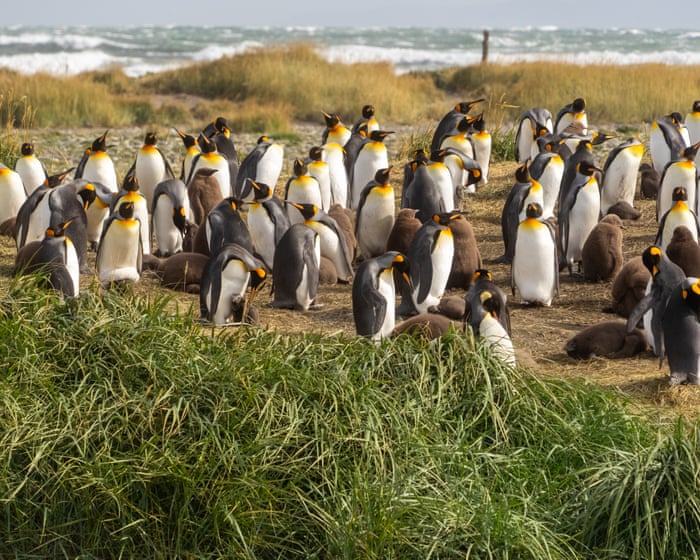
Five pairs of rubbery feet carry black-and-white bodies, covered in soft velvet, toward the rope line that separates the king penguins from the dozen or so visitors watching in awe. As these messengers shuffle closer, a hundred of their companions parade on a nearby bank, splashing in the water and feeding their chicks by regurgitating food into their open beaks.
The king penguin (Aptenodytes patagonicus) lives almost exclusively on islands in the Southern Ocean. But it has been coming to this windy bay in southern Chile’s Tierra del Fuego region for hundreds of years, likely because the shallow shores offer protection from marine predators and humans.
Early explorers named it Useless Bay because those same shallow shores made it nearly impossible to land boats, including industrial fishing vessels. Still, humans remained such a threat that no permanent colony of king penguins formed here until 2010. Then, as a colony began to develop, a local landowner and former kindergarten teacher, Cecilia Durán Gafo, now 72, decided to protect them.
“They dressed them up in caps and sunglasses, and took selfies. Horrible things,” she says.
Today, she runs a reserve that oversees the only continental king penguin colony in the world, one that has grown from a handful of penguins to nearly 200.
“It was only thanks to the reserve that [the penguins] got a safe space where they could build up and establish a colony,” says Dr. Klemens Pütz, scientific director at the Antarctic Research Trust.
Durán’s reserve is part of a growing global trend. A 2022 study in Nature Ecology and Evolution, which looked at more than 15,000 private protected areas, found that they helped conserve underrepresented ecosystems and highly threatened regions that government action alone couldn’t reach.
The first time Durán found king penguins nesting on her land was in the early 1990s. But soon after, she says, people claiming to be scientists arrived to take the birds away.
“They put [the penguins] in cages, and took them to Japan … supposedly for scientific research. Later, we found out [most] had gone to zoos [or homes] as pets,” Durán says.
After that, the penguins avoided settling in the bay for more than a decade. And when they reappeared overnight in 2010, Durán says, people began stealing eggs and mistreating them again almost immediately. “They dressed them up in caps and sunglasses, and took selfies,” she recalls. “Horrible things.”
The population quickly collapsed. Of the 90 king penguins, only eight remained a year later.
Durán called a family meeting, convinced they had to do something to protect the penguins. “But who was going to do it? ‘Mom!’ my two daughters said in unison.”
So she began patrolling the beach. “Every day I came out here with a thermos and a sandwich. I’d spend the whole day, frozen to the bone … making sure people didn’t disturb the penguins.”
The next year, Durán fenced off 30 hectares (74 acres) of her nearly 1,000-hectare farm as a protected area, allowing visitors to watch the penguins, but only from a distance.
Keeping humans out was only half the battle, though. Minks and grey foxes, invasive species introduced to Tierra del Fuego in the 20th century, posed a new threat to the penguins, which have no natural land predators.
“The mink doesn’t attack the adults, but goes after the chicks and eggs,” Durán explains.For the chicks and the eggs. At first, only one or two penguin chicks survived. Then we began our long battle,” says Durán.
For the first ten years, Durán’s solution was straightforward: lure the predators away, especially in winter, when adult penguins spend weeks at sea foraging and leave the chicks unprotected.
By then, she had a small team. They would buy leftover meat from local butchers, split the night into two-hour shifts, and scatter the scraps far from the reserve, training the predators to hunt elsewhere.
“It was wonderful because the nights were so full of stars, but the 3 a.m. shift, oof,” she recalls. “I went out anyway.”
View image in fullscreen
Minks and foxes initially threatened the colony, but the reserve’s team used meat scraps to teach the predators to hunt elsewhere. Photograph: Anastasia Austin/The Guardian
They also started using dogs. “They go out in the morning and afternoon to mark the territory… So the fox or mink smells it and leaves,” Durán says.
Over time, the reserve became more professional. In 2011, Durán began the process of legally turning the 30 hectares into a reserve for the next 100 years. “Whoever inherits it has to continue the conservation project,” she says.
Her on-site team of 12 now includes biologists, veterinarians, and ecotourism specialists. Ecotourism funds the operation, with an average of 15,000 visitors each year.
View image in fullscreen
Ecotourism funds the reserve, which sees an average of 15,000 visitors a year. Photograph: Anastasia Austin/The Guardian
The team also regularly works with universities to contribute to scientific research on penguins, birds, and plant life. Data collected has shown that king penguins from colonies thousands of kilometers away are coming to the bay. These new arrivals quickly adapt to the local diet, in what scientists call “exceptional foraging plasticity.”
This finding is significant: that plasticity “could hopefully help them survive major human-driven climate impacts,” says Pütz, the study’s lead author.
Meanwhile, Durán is seeing evidence that her approach is working, with more chicks leaving the nest as the most tangible result. “Last year, 23 chicks survived – a record,” she says.
Find more age of extinction coverage here, and follow the biodiversity reporters Phoebe Weston and Patrick Greenfield in the Guardian app for more nature coverage.
Frequently Asked Questions
Here is a list of FAQs based on the scenario of a kindergarten teacher accidentally becoming the guardian of 200 king penguins
BeginnerLevel Questions
1 How does a kindergarten teacher accidentally end up with 200 king penguins
It usually starts with a field trip to a zoo or aquarium A single penguin might follow her home and then a few more show up Before she knows it the entire colony has decided her classroom is their new home
2 Are king penguins dangerous to have in a classroom
Not typically They are generally curious and nonaggressive toward humans The biggest danger is tripping over them or getting your shoelaces pecked The real danger is the mess and the smell
3 What do you feed 200 king penguins
A lot of fish Specifically small fish like sardines anchovies and herring The teacher would need to order fish by the ton not by the pound
4 Where do they sleep
King penguins are used to sleeping on the ground in large tight groups They would probably take over the entire classroom floor the hallway and any available corner The teachers desk would become the new high ground
5 Is this legal
Almost certainly not Keeping 200 wild animals in a kindergarten classroom would violate health codes animal welfare laws and fire safety regulations The teacher would need to call animal control or a wildlife sanctuary immediately
Advanced ProblemSolving Questions
6 What is the biggest practical problem with having 200 penguins in a classroom
The guano King penguins produce a massive amount of very smelly acidic waste It would destroy the floor create a health hazard and require industrialgrade cleaning every few hours The smell alone would shut down the school
7 How would you keep the classroom at the right temperature for them
King penguins need cold temperatures Youd have to turn off the heat open all the windows in winter and install industrial air conditioning The classroom would be freezing for the teacher and any remaining students
8 What happens when the penguins start their breeding cycle
King penguins lay one egg at a time With 200 penguins