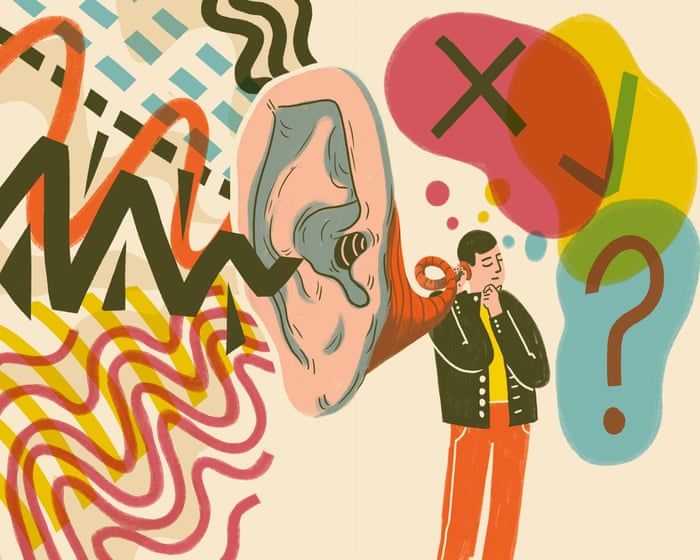
Can you tell if someone is lying? Close your eyes. You’re already twice as good at it as you were before.
Our voices can change in an instant. When adrenaline hits, your fight-or-flight response tightens the muscles around your larynx, making your voice sound high-pitched and shaky. When you answer a call from someone you love, your voice softens and deepens. When someone lies, the rhythm and tone of their speech shift. And oddly enough, you’re nearly twice as good at spotting that change if you only hear them speak—without seeing them.
Our voices reveal a huge amount of information with every sentence, and humans are remarkably skilled at picking up on these subtle cues. But what exactly are our voices giving away, and how does our brain process that information?
In college, I volunteered as a Samaritan. After initial training, I spent hundreds of hours listening to callers talk about everything from unrequited crushes to money troubles to losing someone they loved. The role of listening was vital—Samaritans helps thousands of people every year—but as I kept going, I became more and more fascinated by voices and how we interpret the information they carry.
For starters, humans are great at figuring out details from just a few words, partly because our physical makeup shapes many aspects of our voice. “Voices are an instrument, and they reflect our physical nature,” says Professor Sophie Scott, director of the Institute of Cognitive Neuroscience at University College London. “Think about a ukulele, a guitar, and a violin. Their sound depends on what they’re made of, how many strings they have, and how you play them. The voice is the same.”
We’re good at guessing height because taller people have longer vocal tracts, which produce lower resonances. A man’s voice is usually about an octave lower than a woman’s. As we age, the cartilage in the larynx can harden, making the voice hoarser or weaker. Interestingly, this can lower a woman’s voice and raise a man’s.
Research has even shown that women’s voices get higher in the days before and during ovulation, because the larynx reacts to estrogen levels. Your voice also reveals whether you’re smiling, since a smile changes the shape of your mouth and the sound of your voice, making it warmer, brighter, and slightly higher-pitched.
We often pick up on this wide range of information without realizing it. “We’re very good at telling if someone is sick just from their voice,” Scott says. “The vocal folds get inflamed and vibrate differently.”
We also make other judgments. “We can tell where someone is from by their accent, and we often assess their social and economic status,” Scott adds—though these aspects of our voices can change too. If you hear a lot of vocal fry—that low, Kardashian-style “whateverrrr”—you might guess what TV shows they watch. Even the late Queen’s voice changed significantly over her lifetime. “Voices are aspirational,” Scott says. “We had a charismatic senior person working here, and suddenly everyone started talking like her. You change your voice depending on who you’re talking to.”
I went to a French school until I was 13, and I can still tell right away if someone mostly speaks French. Different languages use different facial muscles, creating specific movements of the jaw, cheeks, and tongue. French speakers don’t use the muscles at the top of their cheeks the same way typical English speakers do, and you can usually hear it in their voice, no matter how perfect their English accent sounds. My father, on the other hand, grew up just outside Glasgow. His party trick was to tell someone which part of Scotland they came from, and then even name the town. But it was when heOld, clever Glaswegians could name the street they grew up on, and people would be amazed. Of course, that was a few decades ago. Accents used to change roughly every 25 miles across the UK. Nowadays, the differences are much less noticeable, and Scott warns that we shouldn’t rely too heavily on them. “People project a lot onto voices. Your reaction often says more about your own biases than about the other person.”
We make these judgments incredibly quickly. “When we hear someone speak, our brain starts evaluating voice cues within the blink of an eye, or about 200 milliseconds,” says Professor Silke Paulmann, executive dean of the Faculty of Science and Health at the University of Essex. “Before we’ve fully processed the words or their meaning, the brain has already begun its analysis. Many studies show that listeners pick up on cues about emotions, motivations, engagement, or attitude. I call this the ‘social intention’ of the speaker. In an instant, we can tell if someone sounds warm or cold, calm or stressed, positive or negative.”
These traits have developed over millions of years. The seemingly simple act of speaking and listening—a key step in the evolution from ape to Homo sapiens—is actually extremely complex. As listening evolved from a way to detect danger into a vital communication tool with complex language, our vocal structures, ears, and brains all had to adapt: vocal structures to make sounds, ears to hear them, and the brain to form and interpret those sounds.
This process likely began around 27 million years ago, when our ancestors started to tell the difference between vowel sounds. But progress was slow. Just as your tailbone is a leftover from having a tail, humans still have ear muscles that allow movement, like in cats and dogs. Sadly, we seem to have lost the ability to swivel our ears about 25 million years ago. Meanwhile, the hyoid bone in the throat—key for more complex sounds—appeared “only” about half a million years ago.
This evolution created quirks, and one of them makes us worse at spotting liars. Dora Giorgianni at the University of Portsmouth’s International Centre for Research—who found that people are better at detecting lies when they can only hear them—says this is because humans have a limited ability to process information. Both attention and memory can get overloaded when we have to follow audio and visual information at the same time. When I was listening at Samaritans, I found I could understand people better over the phone because all my focus was on their voice alone; from Giorgianni’s research, this seems to be true.
In Giorgianni’s tests, some participants watched a video with audio of a mock suspect being interviewed, while others only listened to the audio. “Participants who only listened to the audio were much more accurate at spotting lies—61.7%—compared to those who watched the video with sound—35%,” says Giorgianni. “When too much information comes at once—like visual details, facial expressions, body movements, tone of voice, and the actual words being said—the brain has to constantly choose what to focus on and what to ignore. This raises the risk of making wrong judgments.” Other research by the University of Portsmouth on juries during the pandemic found that wearing face masks actually helped juries tell truth from lies better.
“From an intuitive or evolutionary viewpoint, you might think that seeing facial expressions, gestures, and posture would help humans detect deception,” says Giorgianni. “But modern investigative settings are different from the environments our ancestors lived in. The cues that mattered for survival aren’t the same as those that tell a practiced liar from a truthful witness.”In an investigative interview, some of the clues we’ve been taught to look for—like talking faster or a rising voice—show up in some people but not others. These signs can also just mean someone is stressed, and you can be stressed without lying. “There’s no single verbal cue that reliably ‘gives away’ lying,” says Giorgianni. “Common beliefs about nonverbal signs of deception are often wrong, and a clear, reliable ‘Pinocchio’s nose’ simply doesn’t exist.”
Harriet Tyce, a novelist and recent contestant on The Traitors, knows how hard it is to spot a liar. “What’s most surprising about the difficulty of spotting a liar on The Traitors is that you go in knowing everyone could be—and pretty much is—lying about something. So in theory, it should be almost impossible not to notice,” says Tyce. “But I think we’re hardwired as humans to trust, and trying to override that instinct is nearly impossible.”
That doesn’t stop us from trying. Several companies offer AI-driven analyses to detect lying, tracking voice, facial muscle movements, eye movements, and brain activity. But Dr. Frederika Holmes, a consultant who specializes in forensic analysis of speech and language and often serves as an expert witness, says voice analysis still has limits.
“Voices aren’t like DNA, which doesn’t change over your life and can be directly compared from one sample to the next,” says Holmes. “Voices are flexible and change depending on the situation, so we can’t say anything with absolute certainty. We look at points of similarity and difference and reach a conclusion about how strong the evidence is.”
In the end, if you listen closely enough to a voice, it will reveal some of its secrets. But it still won’t tell you everything.
The Good Listener by Holly Watt is published by Raven Books (£18.99). To support the Guardian, buy a copy at guardianbookshop.com. Delivery charges may apply. Do you have an opinion on the issues raised in this article? If you would like to submit a response of up to 300 words by email for possible publication in our letters section, please click here.
Frequently Asked Questions
Here is a list of frequently asked questions about listening and learning to catch a liar written in a natural tone with clear simple answers
BeginnerLevel Questions
1 What is Listen and learn when it comes to catching a liar
It means focusing on what and how someone speaks rather than just looking for nervous fidgeting Liars often give themselves away through their words tone and the details they choose
2 Can you really catch a liar just by listening
Yes but its not a magic trick Listening carefully helps you spot inconsistencies vague answers or unnatural phrasing Its a powerful tool but it works best when combined with other observations
3 Whats the biggest mistake people make when trying to spot a lie
Relying on old myths like liars cant look you in the eye Many liars actually overcompensate by staring too hard Listening to their story is often more reliable than watching for shifty eyes
4 Is there a simple sign in a liars speech
One common sign is overcorrecting For example if you ask Did you take the money and they answer I absolutely 100 did not take the money the extra emphasis can be a red flag Honest people usually just say No
5 Whats the best question to ask a suspected liar
Ask for the story backwards Instead of What happened say Tell me what happened but start from the end and go back to the beginning Liars often have a rehearsed timeline and struggle to reverse it
AdvancedLevel Questions
6 How can I tell the difference between a liar and someone whos just nervous
Look for leakage in their language A nervous but honest person might stumble but their story stays consistent A liar will often use distancing language or avoid using I statements
7 What is the Pinocchio effect of language
Its not about a growing nose Research shows liars often use fewer firstperson pronouns to psychologically distance themselves from the lie They might