If I had to pick the most important moment of that crisis, it was just before a Juventus-Reggina match in February 2004. It was an evening game. We were six points behind the league leaders, with 13 matches left to play. So anything was still possible, but there was a heavy sense of negativity, like the season was already over. We had just come off two very strange and very different games. In our last league match, we had let in four goals against Totti and Cassano’s Roma. Then, midweek, we won the Coppa Italia semi-final against Inter at San Siro on penalties. Even though we were still in the Champions League and maybe even had a slim chance in the league, deep down I felt that everything was lost that season.
It was a classic winter evening in Turin—wet and cold—and the stadium was only half full. The speakers were playing a song that just sounded like an annoying buzz to me. During the warm-up, I prayed and went through my usual pre-match routine, but something felt off with my muscles. After two minutes, I put on my gloves, stood in goal, and realized I was struggling to breathe. I stood there, staring at the pitch, feeling a bit dizzy. What really scared me, though, was the tightness in my diaphragm, between my chest and stomach, like I had been hit.
Gianluigi Buffon: ‘You have a feeling that you’re unbeatable, almost all-powerful’
Read more
Ivano Bordon, the goalkeeping coach, looked at me and knew something was wrong. I tried not to meet his eyes because I didn’t want to worry him, but I kept going. Still, I was really struggling to breathe, and I felt a fear I didn’t understand. When you’re having a panic attack, you don’t know that’s what it is. When you’re having a panic attack, you think you’re going to die. I couldn’t handle the situation or focus on my routines because I had no idea what was happening to me. So I went up to Bordon and told him to get Antonio Chimenti, the backup goalkeeper, to warm up because I wasn’t feeling well.
As I spoke, I realized my words were coming out strange and didn’t make sense. Bordon is a calm guy. He looked at me and said, “Don’t worry, Gigi, you don’t have to play.” He understood I was having a panic attack. He didn’t call it that, but he told me, “Just stay here and walk around on your own for two or three minutes. In the meantime, I’ll tell Antonio to get ready. In 10 minutes, you can tell me if you want to play or not. You’re not forced to.”
“You’re not forced to.” That phrase freed my stomach from the weight of obligation. It let in enough air so I could breathe a little easier. The fact that he told me “you don’t have to play” gave me a choice and a chance to manage whatever was wrong with me. I let go of the anxiety about being the center of a controversy—”Why didn’t Buffon play?”—and tried to calm down.
After Bordon’s words, I walked for a few minutes in the noise of the stadium. It felt like one of those walks you take when you have a fever that’s cooking your brain. I tried to sort out my thoughts. “You don’t have to play. You can go home whenever you want,” I told myself to feel better. But I also knew I couldn’t—that if I left then, I’d never come back. So I held onto a simple thought: the game lasts 90 minutes. You stay on the pitch for 90 minutes. Then, when you’re home, you’ll still feel bad, you’ll die, and screw everything.
I got my mind straight: “Come on, Gigi,” I said to myself, and I gave myself strength. “When the game is over, you can stop playing football. Just get through this hour and a half, and then say goodbye to it all.” And as I muttered to myself, I could see Chimenti warming up.
View image in fullscreen
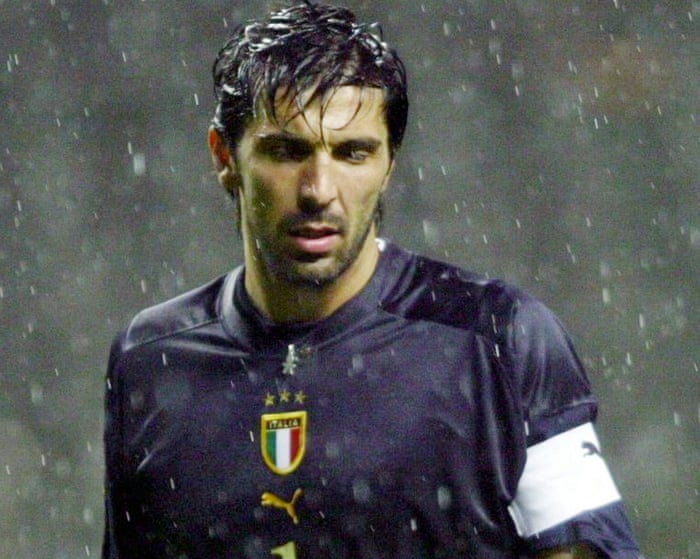
Gianluigi Buffon during Juventus’s 4-0 defeat at Roma in February 2004. Photograph: New Press/GettyThe first thing I thought was that if I didn’t play that game against Reggina, I’d never play again and would just disappear like a ghost. I was young, and I couldn’t really understand what that uneasy feeling was. I told myself it was a lack of courage. It was a fear that the Buffon I had built up in my mind couldn’t afford to have. For my self-esteem, for how I wanted to live my life, for how I actually lived, I was anything but weak. So I tricked myself. Then it would all be over.
I did about a minute and a half of the warm-up, then went to get changed. When I came back onto the pitch, I felt like I could breathe a little easier. That unexpected sense of relief gave me a rush of adrenaline. Adrenaline stops the panic that makes you short of breath. The effect doesn’t last long, but it’s enough to get you through a game. So much so that when we walked onto the pitch, after 10 minutes I made a save from a tough free kick, and by the end of the first half, I pulled off one of my best saves of the season—from Ciccio Cozza—while the score was still 0-0. The Reggina playmaker was one-on-one with me, and on the edge of the six-yard box, he tried three different moves. I stayed on my feet and blocked his lob with one hand. We won 1-0, and that save from Cozza gave me a big boost to finish the match.
The next day, I realized I’d have to learn to live with this discomfort. I couldn’t always be on the edge of disaster, searching for extra bursts of adrenaline just to play. Word got out that something strange had happened to me, but no one knew exactly what. Some of my teammates asked me about it, and even answering those questions felt hard because I didn’t know what to say.
Panic. That word wasn’t part of my vocabulary. For a couple of months, I’d been sleeping badly. I’d wake up soon after falling asleep, and negative thoughts would race through my head: I’d let my parents down, I’d let my fans down, I was about to throw away my career. “Someone who’s been lucky enough to live this life.” But it wasn’t luck—I earned this success. “Someone who makes a lot of money and is successful just because you kick a ball.” But kicking isn’t what matters to me. I’m a goalkeeper. I dive, I get injured, I hurt myself, I’m covered in cuts, bruises, bumps, and swellings.
Some of these thoughts told me to try not to think too much. Others told me to try to hide this negativity. But even if I tried—metaphorically—to put these thoughts on a paper boat and let them float down a river, they’d come back even more insistent and sneaky. I was afraid to go out, to talk to the people who loved me. I’d wake up groggy, with a tiredness that affected my whole body. My legs had no energy, and I started to lose confidence in my movements.
I talked about this with my closest friends, and then with Juve’s doctor, Dr. Riccardo Agricola. When he asked me questions, my answers were: “Stretched out,” “I can’t stand up,” “I’m really in the shit now.” I tried not to take myself too seriously, to laugh a bit at myself and my discomfort. But it wasn’t a healthy kind of self-irony. I was just hiding that dark feeling from myself.
One day, during one of my long monologues about this illness I couldn’t name, the weakness I felt, and how drained I was, Riccardo said something that hit me: “Gigi, it could be depression.”
Saved by Gianluigi Buffon is available now from the Guardian bookshop.
In the UK and Ireland, Samaritans can be contacted on freephone 116 123, or email jo@samaritans.org or jo@samaritans.ie. In the US, you can call or text the National Suicide Prevention Lifeline on 988, chat on 988lifeline.org, or text HOME to 741741 to connect with a crisis counselor. In Australia, the crisis support service Lifeline is 13 11 14. Other international helplines can be found at befrienders.org.
Frequently Asked Questions
Here is a list of FAQs about Gianluigi Buffons experience with a panic attack based on the headline provided
BeginnerLevel Questions
1 Who is Buffon
Gianluigi Buffon is a famous Italian soccer goalkeeper widely considered one of the best in history
2 What happened to him
He experienced a panic attack during a match He described it as feeling a fear I didnt understand
3 Did this end his career
No it didnt He sought help recovered and played at a top level for many more years
4 What is a panic attack
A sudden intense wave of fear or anxiety that can cause physical symptoms like a racing heart sweating and trouble breathing
IntermediateLevel Questions
5 What does a fear I didnt understand mean
It describes the confusing nature of a panic attack The fear felt real and overwhelming but there was no obvious danger or threat to trigger it
6 Why is this story important for athletes
It shows that even elite mentally strong athletes can suffer from anxiety and panic It helps break the stigma that professional athletes are immune to mental health struggles
7 How did Buffon overcome this
He worked with a psychologist to understand the root cause and learned coping techniques to manage the anxiety
Advanced Practical Questions
8 What specific symptoms did Buffon describe
He mentioned a sudden irrational fear a feeling of being trapped and a sense that he couldnt control his own body He felt like he was losing control on the field
9 Can a panic attack happen without a trigger
Yes This is called an unexpected panic attack Buffons case is a classic exampleit happened during a normal match with no obvious stressor
10 What practical tips can someone take from Buffons story
Seek professional help Dont ignore the symptoms A therapist can provide strategies
Dont blame yourself Its a medical condition not a sign of weakness
Use grounding techniques Focus on your breath or a physical sensation to stay present
Talk about it Sharing the experience with a trusted coach or teammate can reduce the fear of judgment