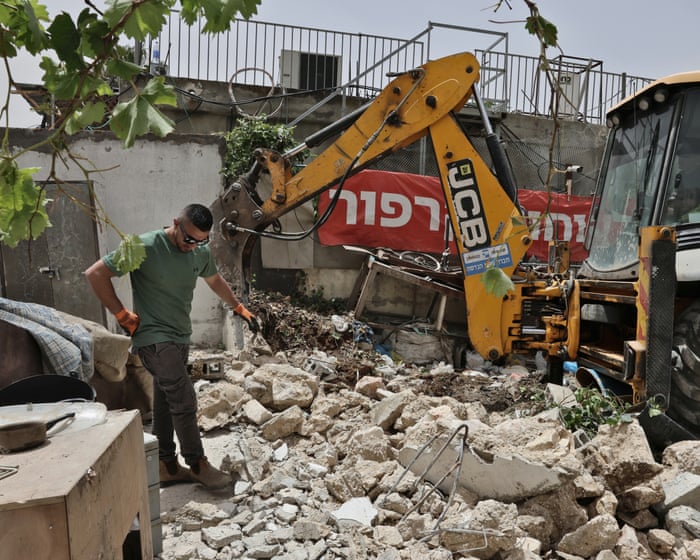
At the bottom of a steep, crowded valley just below Jerusalem’s old city walls, the ground has been shaken in recent weeks by the noise of jackhammers and bulldozers. These sounds have been part of Jerusalem for decades, as the Israeli state has worked relentlessly to give the occupied eastern part of the city a uniform Jewish identity, while erasing its Palestinian character. Usually, it’s state and municipal workers driving the bulldozers. But in the al-Bustan neighborhood, in the shadow of the 11th-century al-Aqsa mosque, the noise comes from a more recent development: Palestinians tearing down their own family homes.
“This is something really hard. This is something bitter,” said Jalal al-Tawil as he watched a tractor he had hired—with a front loader at the front and a jackhammer at the back—rip apart the last remains of the house his father had built, which itself stood on the site of his grandparents’ home. By Wednesday morning, most of the walls had been knocked down to their foundations, and the rubble was pushed into a single pile. Al-Tawil left the thick, twisted root of a 35-year-old grapevine for last. “It used to provide grapes for all of al-Bustan,” he said. The spring vine leaves had already started to grow along the trellis above him, but he accepted that they would never bear fruit again.
The experience of demolishing his own family’s home and history had drained al-Tawil, but it came down to harsh economics. The Jerusalem municipality told him it would cost 280,000 shekels (£72,000) if its workers demolished the house. Hiring his own equipment and labor would cost al-Tawil less than a tenth of that. “Also, if they do it, they will uproot the land and make a complete mess,” he said. For him, it was like being given the choice between suicide or being murdered.
More than 57 homes in al-Bustan, part of the larger Silwan district of East Jerusalem, have been demolished in the past two years, with at least eight more scheduled for demolition in the next few weeks. On the site, a biblical theme park called the Kings Garden is planned, supposedly where King Solomon relaxed three thousand years ago. The park is designed to be part of a growing, largely settler-driven archaeological project that focuses only on Jerusalem’s Jewish past and centers on what is called the City of David—despite many Israeli archaeologists arguing that the visible remains date from other periods, before and after King David’s iron-age rule.
Aviv Tatarsky, a senior researcher at Ir Amim, a group that advocates for a shared and equitable Jerusalem, says al-Bustan shows how Palestinians are being erased from both geography and history. “Israel is not willing to recognize the bi-national, multi-ethnic, multicultural reality of Jerusalem, and it is wiping out first and foremost Palestinians—but really anything that is not Jewish—and then covering it up with this Disneyfied nonsense,” he said. “If this continues to the end, Israelis will go there and see the story of the park, and they will be completely unaware that lives were destroyed, a whole community was destroyed to make space for it.”
The shadow of the Kings Garden theme park has hung over al-Bustan for nearly two decades, but the bulldozers were held back until now by Palestinian resistance, combined with international opposition and some hesitation within Israeli politics. All three barriers have fallen since the Hamas attacks on October 7, 2023, the resulting Gaza war, and the return of Donald Trump as US president. Ambassadors from other countries stillThey come to visit and promise support, but with Washington backing them, their combined efforts have proven useless.
“There are stray dogs roaming the neighborhood at night who feel safer and more secure than we do,” said Mohammad Qwaider, 60, a father of six. He recently tore down the part of his house that had been the family home for over fifty years, hoping to satisfy the planners. But this week, a man from the municipality came to warn him that the bulldozers would return to demolish the rest.
View image in fullscreen: ‘You cannot take our land’: Mohammad Qwaider, 60. Photograph: Quique Kierszenbaum/The Guardian
Qwaider has chronic back problems, a son with special needs, and a frail elderly mother who cannot move. He says they have no other options.
“If they demolish our house, we will put up a tent. We will not leave,” he said. “Maybe they misunderstand our mentality as Palestinians. We are not an easy target. You cannot take our land.”
His mother, Yusra, is confined to a bed in a small ground-floor room. Her life story reflects modern Palestinian history. She was born 97 years ago in Jaffa, but her family was forced to flee in 1948 during what Palestinians call the Nakba (the Catastrophe)—the mass displacement that is the other side of the coin of Israel’s independence that same year.
Nakba commemoration day fell on Friday, the day after Israeli Jews asserted their control with a nationalist march through the old city to mark Jerusalem Day, chanting “death to Arabs.”
View image in fullscreen: Yusra Qwaider, 97, is unable to move from her bed. ‘We are not leaving,’ she said. Photograph: Quique Kierszenbaum/The Guardian
From Jaffa, Yusra Qwaider’s family sought shelter in a village called Yalo in Jordanian-controlled territory west of Jerusalem. In 1967, they were driven out again during the six-day Arab-Israeli war, and Israeli forces demolished their house and the rest of the village. From there, they moved to the Jewish quarter of Jerusalem’s old city in 1970, but could only stay three years before large parts of the district were demolished by the city’s new rulers.
“After the Jewish quarter, we came here to Silwan. From here, we are not leaving. Not me, and not my children,” she said.
View image in fullscreen: Fakhri and Amina Abu Diab now live in a portable cabin amid the rubble of their family home. Photograph: Quique Kierszenbaum/The Guardian
Two doors down, Fakhri Abu Diab, the al-Bustan community leader, made the same decision when his family house was demolished in 2024. Now he and his wife, Amina, live in a portable cabin amid the rubble of what was once their four-generation family home. Only part of the kitchen of the old house remains standing among the ruins.
“This is where we used to eat with my children, my grandchildren,” Abu Diab said. “They demolished our past. They demolished our memories. They demolished our dreams. They demolished my childhood, our childhood, and they demolished our future.”
He compared the pain of living in the wreckage of his family’s history to a physical illness. “My heart is burning,” he said. “Maybe you see me sitting with you, talking to you, but from inside, I am burning.”
Abu Diab is still paying off the 43,000 shekel (£11,000) fine the municipality imposed to cover the cost of demolishing his home, at a rate of 4,000 shekels (£1,020) a month. He said he also had to pay 9,000 shekels (£2,300) for the sandwiches the police ate while enforcing the days-long operation.
The Jerusalem municipality did not respond to a request for comment on its actions in al-Bustan, but told the +972 news site that the planned theme park was “being constructed for the benefit of all city residents” and that al-Bustan’s houses were built illegally.
“This area was never zoned for residential use, and the Jerusalem municipality is now working to build a park in an area that suffers from a severe shortage of open public spaces,” it said.
The municipality also said it had tried “for yFor years, they tried to find a solution for the residents that would also include a housing alternative, but they showed no real interest in reaching an agreement.
Fakhri Abu Diab said that some homes in al-Bustan, like his own—which the municipality claims were built illegally—were actually built before the Israeli occupation.
Abu Diab pointed out that the community had long ago submitted a master plan for the area that included plenty of green space, but he said it was rejected at the political level. Regarding building permits, he noted that some homes, like his, date back to long before the Israeli occupation.
The municipality routinely denies building permits to Palestinians in East Jerusalem while regularly approving them for Israeli Jews. Abu Diab also argued that the same rules are never applied to unauthorized settler outposts, which keep appearing in East Jerusalem and the West Bank.
Amina Abu Diab, a schoolteacher and social worker, said her main concern now is for the children she cares for, who are facing a future of homelessness and uncertainty.
“A house is a child’s dream of the future. If someone comes to demolish it, they destroy those dreams and a child’s sense of security,” she said. “And then what do the children think of us? That we can’t protect ourselves or our children.”
Frequently Asked Questions
Here is a list of FAQs based on the situation you described using clear natural language and direct answers
BeginnerLevel Questions
Q Is it true that Palestinians are being forced to demolish their own homes for a theme park
A Yes In some cases Israeli authorities have issued demolition orders for Palestinian homes and structures in Area C of the West Bank citing a lack of permits This land is being cleared to make way for a planned theme park called Edenic near the city of Jericho
Q Why would someone have to tear down their own home
A If a home is built without a permit from the Israeli military administration the owners can be ordered to demolish it themselves If they refuse the military can demolish it and charge the owners a large fee for the cost of the demolition
Q What is the Edenic theme park
A It is a large privately funded tourism and entertainment project planned for the Jordan Valley It is designed to include hotels restaurants a zoo and amusement park rides
Q Is this happening in Israel or in the West Bank
A It is happening in the West Bank specifically in an area known as Area C which is under full Israeli military and administrative control
Q Can the Palestinian owners fight the demolition order in court
A They can try but it is extremely difficult and expensive The Israeli permit system for building in Area C is widely considered by human rights groups to be discriminatory and nearly impossible for Palestinians to navigate successfully
AdvancedLevel Questions
Q Why cant Palestinians just get a building permit in this area
A The Israeli military administration controls all planning and zoning in Area C Permits for Palestinians are rarely granted Many villages have had their master plans rejected for decades meaning no legal building is possible even to meet natural growth needs Meanwhile permits for Israeli settlements and projects are approved quickly
Q Is the theme park being built on private Palestinian land
A Yes according to human rights organizations and local reports The land was privately owned by Palestinian families The Israeli authorities have declared large parts of the Jordan Valley as state land which critics argue is a legal mechanism to transfer ownership from private Palestinian hands to the state for development
Q Does this violate international law
A Many international legal