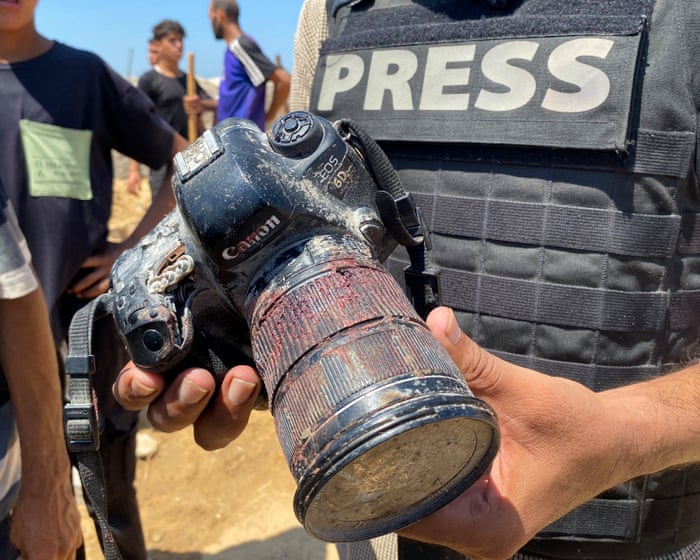
It has never been more dangerous to be a journalist than it is right now, and the threat is only getting worse. The Committee to Protect Journalists (CPJ) recorded 129 deaths of reporters and other media workers in 2025—the highest number it has ever documented, and five more than the previous record, which was set just last year.
I have worked for the Guardian for more than three decades and have covered some brutal wars, but I have never seen journalists so directly in the line of fire, actively targeted, as they are today.
The vast majority of journalist deaths in 2025 occurred in Gaza, the West Bank, southern Lebanon, Yemen, and Iran. According to the CPJ, Israeli forces were responsible for two-thirds of all journalist killings worldwide last year.
The Guardian’s former Gaza correspondent, Malak Tantesh, was evacuated at the beginning of October last year, along with her photojournalist sister, Enas, after 18 months of grueling and dangerous work. Their evacuation almost didn’t happen. The road out of Gaza was blocked with rubble, and by the time it was cleared, a gunfight broke out near the evacuees’ bus. The escorts from the International Committee of the Red Cross called off the mission. Thankfully, they changed their mind less than an hour later, and the bus carrying Malak and Enas, along with young Palestinians who had been awarded UK university scholarships, eventually reached safety. Their cousin Seham Tantesh has taken over their role and has been reporting for the Guardian ever since.
Before heading out on any assignment, Seham says she checks her planned routes against the latest incident reports. She avoids traveling alone whenever possible and always makes sure a relative knows where she is going.
The most dangerous areas in Gaza are near the “yellow line,” the boundary between Israeli and Hamas-controlled areas that was established under a partially observed ceasefire last October. Israeli troops regularly open fire on anyone approaching the line, and it is often hard to know exactly where the danger zone is. The yellow line is unmarked in some places and has shifted forward over time.
Seham says: “There is no truly safe place, and no time that can be considered less dangerous. Strikes can happen anywhere, at any moment.”
No place is more dangerous for journalists than Gaza, but the West Bank is not without risk. Settler violence is increasing, often with the approval of security forces, who also have a history of opening fire on journalists. When the Guardian’s chief Middle East correspondent, Emma Graham-Harrison, visits settlements or besieged Palestinian villages in the West Bank, she packs her body armor, helmet, and medical kit, and lets the international desk know where she is going and when she expects to return.
How to survive the information crisis: ‘We once talked about fake news – now reality itself feels fake’Read more
Journalists have also been killed by Israeli strikes in Lebanon. The Guardian’s correspondent in Beirut, William Christou, has lost four professional peers over the past three years and has been shot at twice. Whenever Will travels to southern Lebanon, the heart of Israel’s conflict with the Hezbollah militia, he makes sure to inform the UN peacekeeping force, Unifil, of his exact routes and timings.
Will uses his US passport “because I feel the Israelis are less likely to strike an American citizen.” Unifil passes the details on to Israeli forces in the area, but makes it clear to journalists that this is no guarantee they won’t come under fire. Still, at least there can be no excuses when journalists are targeted. Every time a Guardian correspondent goes somewhere dangerous, a risk assessment is carried out. It includes suggested ways to reduce the risk, and a managing editor decides whether the risk is acceptable. A chat group is usually set up so the journalist and editors can stay in constant contact throughout the assignment.
Efforts to reduce the risks to journalists’ safety are an essential part of bringing you the facts. Travel and precautions are often expensive. But we cannot stop reporting just because there is danger.Betraying people under threat—whose stories would otherwise go untold—would also let down our readers, who want to see the world as it really is and make up their own minds. In a dangerous world, gathering facts can be costly. To make sure everyone can access our work, it’s free to read, watch, and listen to online. That’s why we rely on contributions to keep reporting from every corner of the globe, including covering events that some governments would rather hide. States have vast resources at their disposal; ours are tiny in comparison, but we have our readers behind us.
One thing Guardian staff have done to defend press freedom… and one thing you can do
Read more
As the Middle East erupts and the war in Ukraine grinds on—four years after Russia’s full-scale invasion—the front line barely moves, if at all, and the conflict makes the front page less often. But the Guardian hasn’t let up its coverage, given the human tragedy the war represents and its importance for European security. Luke Harding, Shaun Walker, Peter Beaumont, Dan Sabbagh, Pjotr Sauer, and Charlotte Higgins have all reported from Ukraine, even as it becomes more dangerous to do so. Luke, Peter, and Dan, in particular, have spent time on the 750-mile front line, where drones are an increasing threat. In the east and south of the country, nets have been draped over main roads to protect both Ukrainian civilians and soldiers. Trips are carefully planned, and the Guardian team has invested in a detector that warns of incoming drones. When the alarm goes off, there are only seconds to take cover. It’s expensive, and while risks can be managed, they can’t be eliminated. But as Luke points out, “To get a true picture of the battlefield, you have to go there.”
Journalists heading to the front line expect to face danger. Less expected were the Guardian reporters who went to cover Donald Trump’s appearance at the White House Correspondents’ Association annual dinner in April. When shots rang out, David Smith, Rachel Leingang, Jeremy Barr, and Robert Tait took shelter under their table, alongside the Washington press corps in their dinner jackets and dresses. “It was a scene from a dozen Hollywood movies,” David recalled, except this time it was jarringly real. It was a shock but not a surprise, at a time when political violence is rampant, and the stakes will rise as congressional elections approach in November. The climate for journalism in the US has grown ever more hostile, with Trump and his top officials repeatedly singling out reporters whose work they don’t like.
In times like these, democracy and free speech rely more than ever on good, independent journalism. It’s the citizen’s sword and shield against authoritarianism. It doesn’t come cheap, but we hope you agree it’s a worthwhile investment. Please consider investing in it today.
As part of our annual support campaign promoting the defense of a free press, please consider backing our work today—or consider backing another independent outlet whose work you value. We’re hoping to get 60,000 new supporters or acts of support by May 21.
Frequently Asked Questions
Here is a list of FAQs about the topic Journalism has never been more dangerous written in a natural tone with clear direct answers
BeginnerLevel Questions
1 What does it actually mean when people say journalism has never been more dangerous
It means that journalists today face higher risks of physical harm legal threats online harassment and even death than in recent decades This is due to factors like war zones political instability digital surveillance and targeted attacks on the press
2 Is this just about war reporters in combat zones
No While war correspondents are at high risk danger now extends to local journalists covering protests corruption crime and politics Many are threatened kidnapped or killed in their own countries not just in active war zones
3 Why is journalism more dangerous now than say 20 years ago
Several reasons the rise of digital tracking makes journalists easier to target political polarization has made the press a enemy in many places and impunity for attacks on journalists is common meaning attackers rarely face consequences
4 How many journalists are actually killed each year
According to groups like the Committee to Protect Journalists and Reporters Without Borders dozens are killed annually with 2022 and 2023 seeing some of the highest death tolls in a decade Many more are imprisoned or forced into exile
5 Is this a problem only in certain countries
No its global While countries like Mexico India Ukraine and Myanmar have high death tolls journalists in the US Europe and Australia also face rising online harassment doxxing and legal threats
AdvancedLevel Questions
6 What is the impunity gap and why does it matter
The impunity gap refers to the fact that over 85 of journalist murders go unsolved This lack of justice emboldens attackers and creates a culture of fear making it even more dangerous for reporters to investigate powerful criminals or corrupt officials
7 How has digital surveillance changed the dangers for journalists
Governments and hackers can now track journalists phones emails and social media Spyware like Pegasus has been used to hack journalists devices steal sources and monitor their movements This makes protecting sources much harder