When I come back from working in Ukraine—where I’ve been traveling regularly since 2022—people often ask me, “What was it like?” There’s an unspoken understanding in that question that the answer won’t simply come from gathering facts. For good reason, a reporter keeps her eyes steady and focused outward, collecting essential information and passing it on as clearly and smoothly as possible. She reins in her own feelings and disciplines her subjectivity, while ideally recognizing it exists and understanding its shape. She knows the facts are what matter.
At the same time, feelings and impressions can’t be completely separated from the facts. If you’re functioning as a human being at all, feelings are unavoidable. They’re like the tentacles of empathy reaching out to try and understand people and situations. Feelings play a role in how we learn—they help us gain knowledge. Still, they need to be pushed into the background. Respect for your readers and the people you write about demands it; the rules and habits of journalism demand it.
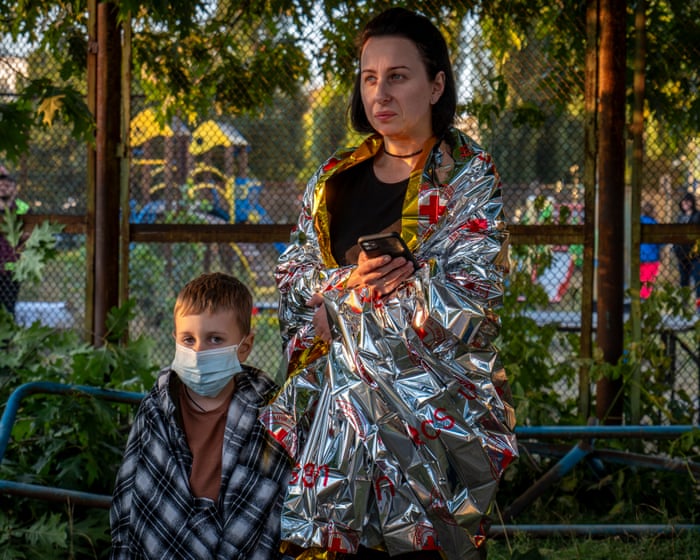
I’ve just come back from a month in Ukraine. I write about the war through the lens of culture—looking at how artists are shaping the future memory of the war in their work, and how language, history, and identity are tied up in it. I was behind the front lines, in the cities of Kyiv and Lviv, as well as Odesa and the Mykolaiv region. Broadly safe places, I suppose, though everything is relative. While I was in Ukraine, a woman sunbathing by the sea in Odesa was killed by a piece of shrapnel from a drone. One of the holiest sites in Eastern Europe, the Pechersk Lavra in Kyiv, caught fire after a drone hit it. Every morning, the civilian death toll crept up, and people dealt with losing loved ones, their homes, or their livelihoods—or they tackled smaller problems: windows and doors blown out, cars smashed by debris falling from the sky. Ukrainians also laughed at memes of exploding oil refineries in Moscow, and news headlines talked about Ukraine’s unexpected success on the front line.
But the question “What was it like?” has little to do with those headlines. It asks for a personal answer. It invites the reporter’s carefully disciplined feelings and impressions back into the room. It’s a question for the pub, or for a long walk. Or maybe not even that. Perhaps the real answer is, for some people, too private to speak about at all: it’s the diary entry, the flicker of images that dances in your mind before sleep, the hidden layers of memory that get buried and might resurface years later. I realized this once while walking through a park with a journalist who had reported from the Balkans in the 1990s. The memories that came back to her 30 years later had nothing to do with shifting front lines or statements from famous politicians. They were almost like vivid movie scenes: the hotel manager still in his suit and neatly knotted tie amid the bombed-out wreckage of his building; the look in the eyes of parents who hadn’t been able to contact their child for months. These weren’t stories—not in the journalistic sense, or in any sense at all. They were hauntings. They were answers to the question, “What was it like?”
So what was it like? When I try to answer, I don’t see a clear story line. What I see are layers of experience pressed together too tightly and too densely for comfort—like an archaeological dig where mismatched objects have been crushed out of shape into airless closeness. Sometimes, the best way to answer the question might be to look at the places where those mismatched objects touch. For example, not by telling the story of the ruined museum, or the weeping director cradling an unharmed ceramic jug that firefighters miraculously found in the wreckage. Nor by describing the conversations on the stages of the literature festival that my colleague, the photographer Julia Kocheto, and I attended.Va and I went together right after we had walked through those ruined rooms. To answer the question, what was it like? I think of the look on her face as she drove between the two places – she talked about the relentless bombing, killing, maiming, battering, and burning, and she asked, “How long will this go on? Until Kyiv is nothing but rubble, all of it? And until how many of us are left?”
What it was like was noticing the exact way a young father crouched low at Lviv railway station, his hands on his son’s knees as the boy sat on the platform, and how his son’s hands pressed back into his father’s. But it wasn’t even that: it was how pale the boy looked, how tightly he held his expression – he was maybe 10 or 11 years old. As the train pulled in and the family gathered their luggage, it was clear the boy and his mother were heading to Poland, and the father, who was of fighting age and likely already in the army, was not.
What it was like was that it was peony season, and the flower stalls were full of them: pink, cream, and scarlet. Young people were buying them for their sweethearts from the old ladies who had come in from the countryside. What it was like was, out of nowhere, a friend talking about how she really needed to update her emergency backpack because she kept eating her emergency food during non-emergencies.
There’s a poem, My Day, by the Ukrainian writer Iryna Tsylik, that captures this intense compression, this parade of conflicting experiences. “At 4am the air-raid siren woke me. / My son and I hunkered down in the corridor, / I listened to the rockets flying over us – / that unmistakable eerie thrum. / But we won that round of Russian roulette. / I dozed another hour. / I read the news of how many killed. / I made pancakes for my son.”
Oksana Maksymchuk, in her collection Still City, has a poem called The Fourth Wall, which also describes this wartime life. It begins: “No collapse, / just a gradual shrinking / of the present.” It ends with a sense of what it’s like to hear an air-raid warning: “We stop what we’re doing / stand by the curtain, our eyes / on the sky, fearing / how normal it all now feels / how boring.”
The Ukrainian artist Stanislav Turina recently wrote a series of 10 poems, all called My Perfect Day, in which he imagines breaking out of this endlessly painful, compressed present into a series of possible ideal futures. These poems are full of joy. One includes the lines: “The war ended a year ago. Rebuilding time. / We remember the fallen. Internal wounds heal. We recall the disa- / ster of the war. But pain and fear no longer rule us. Any of us.” Reading these poems, it’s hard to tell whether they are hopeful assertions of optimism – or desperate, speculative fictions.
Charlotte Higgins is the Guardian’s chief culture writer.
Ukrainian Lessons by Charlotte Higgins (Cape, £22) will be published in August. To support the Guardian, order your copy at guardianbookshop.com. Delivery charges may apply.
Ukrainian Lessons: Art in a time of war with Charlotte Higgins and guests
On Wednesday 30 September, join Charlotte Higgins and our panel of acclaimed Ukrainian writers to reflect on the profound connections between war, art and life. With Olia Hercules, Sasha Dovzhyk, Olesya Khromeychuk, and Shaun Walker. Book tickets here.
Do you have an opinion on the issues raised in this article? If you would like to submit a response of up to 300 words by email to be considered for publication in our letters section, please click here.
Frequently Asked Questions
Here is a list of FAQs based on the perspective that the true story of the Ukraine war is found in brief moments of despair and rescue
BeginnerLevel Questions
1 What do you mean by brief moments of despair and rescue
I mean the small humanscale events that happen between the big headlines A family huddled in a cold basement the moment a rescue worker pulls a child from rubble or a stranger sharing food These are the real stories not just troop movements
2 Why do these moments tell the story better than the big military news
The big news tells you what is happening These small moments tell you how it feels to live through it They show the courage fear and humanity that statistics cannot capture
3 Can you give a simple example
A good example is a video of an elderly woman being carried out of a bombed building by two soldiers The despair is her lost home The rescue is those soldiers choosing to help her That one minute shows the whole war
4 How do you find these moments
They are usually shared by people on the groundon social media in local news reports or by aid workers They are not staged they are real raw and often filmed on a phone
Advanced Deeper Questions
5 How do these moments of despair and rescue change the narrative of the war
They shift the focus from abstract front lines to real people They remind the world that this isnt just a political conflict its a daily struggle for life dignity and kindness in the face of horror
6 What is the psychological impact of seeing these rescue moments
For viewers they offer a sense of hope and connection For survivors being rescuedor even witnessing a rescuecan restore a belief in humanity Its a powerful counterweight to the trauma of despair
7 How do journalists or volunteers ethically share these moments without exploiting the victims
The key is consent and context A good story asks permission respects the persons dignity and focuses on the act of rescue not just the gore of the despair Its about showing resilience not just suffering
8