Sepehr
Family members gather to mourn Sepehr, who was 25 when he was killed in the January protests.
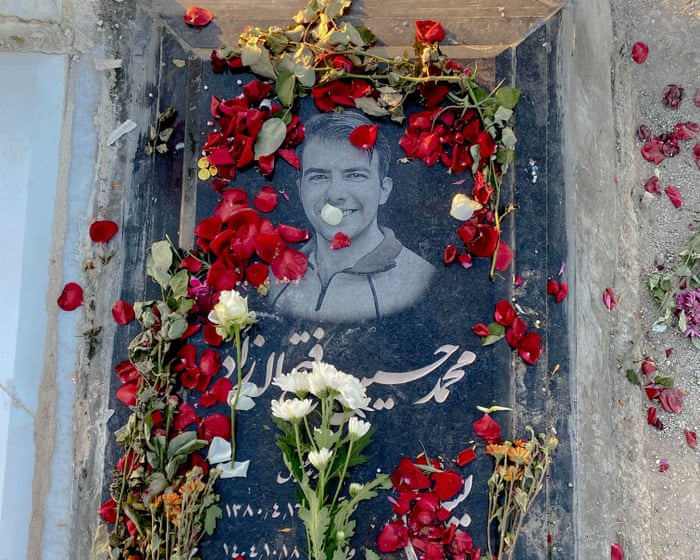
Sepehr, 25, was shot and killed during the mass street protests in January. His father became widely known because of a video he recorded on his phone in their hometown of Kahrizak, near the capital, Tehran. In the video, his father kept repeating: “Sepehr-e Baba, where are you?” It’s a tender Persian way of speaking, something like “my Sepehr, my child.” Sepehr became known by that cry, and the same words are now written on his gravestone: “Sepehr-e Baba, where are you?”
Today, there’s a crowd around Sepehr’s grave. People come, talk, stand for a while, and then leave. The mother of a 16-year-old boy killed during the nationwide women’s rights protests in 2022 is also there.
Sepehr’s father says he’s not afraid of being arrested. He speaks with a courage that seems to come from a place where grief has turned into something else. He gestures to the people around him and tells them they’re free to film and take pictures as they like.
“I’m waiting for these people to fall,” he says. “Don’t doubt it – they’re already finished. This regime will never go back to what it was before [the crackdown on protesters in January]. I’m telling all of you this.”
Mohammadreza
A woman at Behesht-e Zahra prays for those killed in the January protests.
Mohammadreza was 38 when he was killed in Tehransar, an area in western Tehran. At his grave are his sister, with long curly hair, and his elderly mother, who wears a pale blue headscarf. “My child had a hard life,” she says. “He didn’t have a good life.”
“I cursed [Ali] Khamenei,” his mother says. “I was very happy when they [the US/Israel] killed him. But my heart aches for these children of ours. I wish they had been here too; they had dreamed of seeing Khamenei gone. There’s so much longing in that. I miss my son. We have to endure.”
At his funeral, people said: ‘He saved our lives that night.’ He was very kind. He had so much loyalty and honor.
Mohammadreza’s sister says his wife now sleeps hugging her dead husband’s pillow, while his son comes and kisses his father’s grave and cries.
“My brother saved a lot of people the night [he was killed]. He brought everyone into the parking garage. At his funeral, people said: ‘He saved our lives that night.’ He was very kind. He had so much loyalty and honor.
“I want to write ‘javidnam’ [Farsi for ‘everlasting name,’ adopted by families to remember those killed in protests] on my brother’s gravestone, but we were afraid because they [Iranian police] have broken some of the stones. I’m waiting for a little time to pass, for things to calm down. Then I’ll write ‘javidnam’ on his stone. God willing, by next Nowruz [Iranian new year in March 2027], these pieces of shit will be gone.”
Sara
The gravestone for Sara, who was attacked during the street protests by plainclothes security forces with machetes.
From a distance, Mohammadreza’s sister points out Sara’s grave. Sara was 45 when she was killed during the January protests. A CCTV video of the moment she was attacked in the street by plainclothes security forces carrying machetes went viral on social media: her terrified gaze, alone, empty-handed, under the kicks of a plainclothes man with a blade.
No one is at her grave today. She has a large white gravestone, and in front of her name, in parentheses, is the word “darya” (Farsi for “sea”), which families use to represent eternity.
Nearby, another woman sits at the grave of her own javidnam. “They killed my cousin [in the protests] and this one [pointing to the grave] a day later. We found my cousin after four days, but we couldn’t find this one. My cousin was killed with bullets; this one with a knife.
“I wish…”They had seen Khamenei die. Let those bastards go to hell. They’ll get what’s coming to them in the end.”
Mohammad
[Image: The stone marking Mohammad’s grave. He was killed by members of the volunteer Basij paramilitary force during the January protests]
Mohammad, 28, was killed in Ariya Shahr, in northwest Tehran. Today, his father and younger brother are at his grave. They come from one of the poorer parts of the capital. His brother is washing the headstone.
“They had grabbed two girls and were dragging them,” his brother says. “He went to save them, and those bastards hit him instead. He was a boxer. His friends who were with him told us what happened. Four or five Basijis [the Basij is a volunteer paramilitary branch of Iran’s Islamic Revolutionary Guard Corps] had surrounded two girls. My brother and his friends beat them and helped the girls escape.
“But then the Basijis surrounded them on motorbikes. They beat them until one of them shot my brother in the side. He fell and said, ‘I’m burning, I’m burning.’ Then one of them came over and shot him in the head and heart too. Three times in total.”
Ali
[Image: Ali was shot dead in Moshiriyeh, south Tehran, during the protests. The mourner at his graveside says: ‘My friend is under the ground and I’m alive’]
Ali was killed by a bullet in Moshiriyeh, south Tehran, and still doesn’t have a gravestone. The last time I was here, I saw a young man sitting alone at his grave in the dusk, crying, playing a sad pop song on his phone.
“They killed my friend in Moshiriyeh. They arrested me too, but for some reason they let me go, and I wish they hadn’t. Since that day, my life has gone dark. My friend is under the ground and I’m alive.”
Today, Ali’s whole family is at his grave. His father is middle-aged, thin, with sunburned skin and a very calm face. Several of his teeth are missing. He thanks everyone who comes. Money is tight in Ali’s family, and buying a gravestone will be hard for them.
Ali’s father says: “My son was a footballer. He was 2 meters tall. A goalkeeper. We went to Kahrizak and identified him there. After everything happened on Thursday, we had no news of him until two or three in the afternoon on Friday. Then we went looking for him.”
Ali’s younger sister stands beside her father. He points to her and says: “His sister suffered so much. She was so close to him.” His mother wears a long black manto (coat) and has a gentle, kind face. She doesn’t speak. She just gives me a soft smile and thanks me for coming to her son’s grave.
Danyal
[Image: Danyal’s father and aunt sit by his graveside at Behesht-e Zahra]
Danyal’s father is sitting on a chair. His mother and aunt sit beside the grave. His father says: “These people – the Islamic Republic’s units – have no religion, no faith, no mercy, no decency. One of them was saying they should open fire on the opposing people with machine guns. Their brains have been washed like this.
“The Islamic Republic has done something to them, to the regime loyalists and supporters, so that they think anyone who says anything against the system should be lined up against a wall and shot. They come with that way of thinking and kill everyone. They killed my son.”
Danyal’s father says he has two sons, Danyal and Nima. Nima works in music. Danyal, his father says, was among the first people to be shot and killed in Fardis, west of Tehran. “We opened the body bags one by one, searching through the bodies.
“At one point I lost hope. I said: ‘That’s enough, leave it.'” Here, Danyal’s father begins to cry. “After days of searching, we found him and put him in the morgue.”
‘I should not have wished for war’: six ordinary Iranians on how the US-Israel conflict has changed them
Read more
The family says the mortuaries were full of bodies, with womenMen and women were screaming as they searched for their loved ones, unzipping body bags one by one. Danyal’s aunt said: “My other brother told me there was a girl whose body bag had been left open, and she was naked. I said, ‘God damn you. You killed so many people over a few strands of hair, and now you’ve left her here like this?’”
Danyal’s father said the Iranian security forces pressured him to declare his son a martyr. “They said we had to write ‘martyr of a terrorist attack.’ I told myself, because of this other child [his other son, Nima], we have to go along with whatever they said. Later, when things calm down, we’ll change it.”
Frequently Asked Questions
Here is a list of FAQs based on the article topic written in a natural conversational tone with clear and concise answers
BeginnerLevel Questions
Q What is this article about
A Its about the families visiting Irans largest cemetery to mourn the people who were killed during the nationwide protests in January 2023 following the death of Mahsa Amini
Q Why does the title say They made us call him a martyr
A Some families say the Iranian authorities forced them to officially register their loved ones as martyrs for the state even though the families believe they were killed by security forces They feel this label is a lie
Q What were the January protests about
A The protests started in September 2022 after Mahsa Amini died in morality police custody They grew into a widespread uprising against the Iranian government continuing through January 2023
Q Who is buried at this cemetery
A The cemetery holds the bodies of many protesters killed during the unrest as well as victims of the 2020 Ukrainian plane shootdown and other events
AdvancedLevel Questions
Q Why do families object to the martyr label
A They object because the term martyr implies the person died for a holy cause or at the hands of enemies of the state The families believe their relatives were unjustly killed by the government itself so calling them a martyr feels like rewriting history
Q How does the Iranian government use the martyr label to control the narrative
A By officially declaring protesters as martyrs the government can claim they died for the Islamic Republic rather than in opposition to it This allows them to take control of the mourning process and suppress the political message of the protests
Q What practical challenges do families face when visiting the graves
A They often face heavy security plainclothes agents watching them and restrictions on gathering Some families are even pressured to remove photos or signs that criticize the government
Q Is there a difference between how the government treats these graves versus graves of war martyrs
A Yes Official war martyrs graves are wellmaintained with statesponsored ceremonies The graves of protesters are often unmarked hard to find and families are discouraged