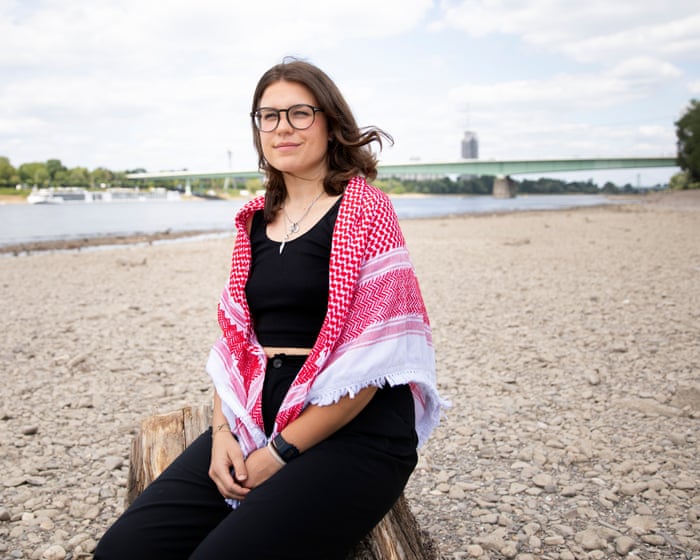
The third time Anna Liedtke was illegally strip-searched in an Israeli detention center, female prison guards forced her to her knees, covered her mouth to stop her from screaming, and raped her. This is according to interviews and a criminal complaint filed in Israel.
She said she heard male guards laughing during the attack, and believes they watched and may have filmed it. The assault happened in an area separated from the prison hallway by a partially drawn curtain, which her attackers had left open.
Liedtke, 25, joined a flotilla sailing from Europe to Gaza with humanitarian aid last autumn. Israeli forces intercepted her boat in international waters on October 8 and took her to Israel, where she was held for five days.
She said the abuse and violence directed at flotilla participants in Israeli prisons, including rape, was meant to intimidate. “It’s clear they want to break our will and silence us, making this so traumatic that we will never talk about Palestine again,” she told the Guardian.
Instead, she told friends and doctors within days. In December, she became the first flotilla activist to speak publicly about being raped in Israeli detention. More than a dozen others have reported sexual assault, most of them anonymously.
Now, lawyers acting for Liedtke in Israel have filed a complaint demanding authorities investigate her allegations. Israeli law defines rape as any non-consensual penetration.
“There is no reason for me to be ashamed,” Liedtke said in her first interview about the legal case. “Whenever we stay silent, they will do it to someone else.”
The complaint was sent to the Israeli attorney general, the legal adviser of the Israel Prison Service, the Department for the Investigation of Prison Guards (Yahas), and the commander of Givon prison. Liedtke’s lawyer, Muna Haddad, said it was a challenge to a “culture of impunity” for abuse of prisoners in Israel.
“It is Anna’s wish to seek justice and exhaust all options to hold the perpetrators accountable. We also want to raise awareness and see how the Israeli system responds when we demand an investigation,” said Haddad, a lawyer with Adalah, a Palestinian human rights organization in Israel.
“Sexual violence and rape are recurring violations that have been committed against Palestinian prisoners for nearly three years… We are now seeing an escalation where Israel is willing to extend this behavior to foreign citizens acting in solidarity with Palestinians.”
By refusing to be shamed, Liedtke has turned the attack into part of her activism, becoming a voice for those still in Israeli jails or who might be targeted in the future. She said: “I don’t think speaking out will end rape in detention. But as a political woman, I feel a responsibility to talk about it and, in doing so, fight against it.
“This is not just my personal experience—it is more systematic. And I cannot stress enough that it is far, far less than what Palestinian prisoners experience.”
Israel has normalized the torture of Palestinians held in its jails, while officials have celebrated the abuse of foreign activists and condemned the failed attempt to prosecute soldiers over a well-documented assault and rape.
In May, the UN added Israel to a blacklist for sexual violence in conflict, citing abuse by security forces, including the rape of male detainees. This month, Britain raised concerns about sexual assault in Israel’s detention centers at the UN Security Council.
Australian police are investigating rape and torture allegations made by flotilla participants in May, and French prosecutors have opened a war crimes inquiry into suspected torture and mistreatment of their citizens in Israeli detention.
Before setting sail, Liedtke was briefed by members of previous flotillas.She set sail from southern Italy on September 30th, aboard a large former ferry, with around 100 other activists. She tried to mentally prepare herself for the possibility of violence, including sexual assault, while in Israeli detention, but later realized that was nearly impossible.
She said: “You can know that they will sexually assault you, and you can tell yourself, okay, they will do that. But when it actually happens, it’s like you’ve never heard of it before. Because you don’t know how your body will react.”
Her advice to other activists now is both political and practical. “You have to be convinced that this is the right mission. And in the end, understand that nothing can truly prepare you.”
View image in fullscreen: Activists in orange life jackets sit on a flotilla boat, intercepted while approaching the Gaza coast, as Israeli navy soldiers sail it into the port of Ashdod. Photograph: Léo Corrêa/AP
On October 8th, at around 4:30 a.m., she was woken by the captain announcing: “This is not a drill, the Israelis are coming.” They boarded the boat, sent the activists to the canteen, and set sail toward the Israeli port of Ashdod, arriving in the evening.
Liedtke was taken for processing and said one fluent German speaker called her a “Nazi slut.”
The first sexual assault came shortly after, during a strip search, she said. Israeli law requires a detainee’s consent before a strip search, according to Liedtke’s lawyer. If consent is refused, a senior officer must come to hear the objections and authorize any subsequent search in writing. Strip searches are limited to visual inspection of a naked body and must take place in a closed room with only female officers present.
Liedtke said she refused to be strip-searched but was still forced to remove her clothes in an area only partly hidden by a curtain. Her naked body was visible to male soldiers walking past. “Some of them directly looked at us while they were walking past,” she said.
She refused to sign papers for rapid deportation because that would effectively mean admitting she had entered Israel illegally. Liedtke had been forcibly taken to Israel from international waters.
Later that night, she was driven blindfolded and handcuffed to Ketziot prison, where she was strip-searched again, fully naked, without her consent. “I told them I didn’t want to do this, and they had searched me just a few hours before, so why did they need to do it again?” she said. Those who agreed to the search were allowed to keep their underwear on, she added.
She was given prison clothes and taken to a dirty cell with no access to clean drinking water. She was kept from sleeping all night by loud music and repeated searches of the cell, including with dogs, and could hear screams from other parts of the prison.
On October 10th, Liedtke was moved again, to Givon prison. There, she was once again taken to an area only partly closed off from view by a curtain and ordered to strip.
When she refused, guards pulled off her clothes, groped her, and forced her to kneel. One of them inserted her fingers into Liedtke’s vagina and then her anus, Liedtke said.
“There were two, and then later three female soldiers who told me to take off my clothes,” she said. “They started touching me. I said no. I told them I didn’t want to be touched and that they were hurting me. Then they grabbed my hands so I couldn’t move, then they pushed me down, and I still tried to scream, and then they covered my mouth so I couldn’t scream.”
Humiliation added to the pain of the physical assault. “I remember the male soldiers laughing, just standing there laughing. I know they could see everything because the curtain wasn’t fully closed.”
Liedtke believes the attack may also have been filmed because of the large number of security and body cameras used in prisons. Video and images of abuse and torture of detained Palestinians and activists have been published in Israel by individuals and officials.
View image in fullscreen: Small boats in the flotilla leavingA port in southern Italy, setting sail for Gaza.
Photograph: Orietta Scardino/EPA
The activists were deported to Jordan on October 12. Liedtke had been on hunger strike the entire time, but said she wanted a cigarette more than food.
At a hotel in Amman, the group was met by doctors and psychologists. Liedtke took her first step toward going public, telling a friend and fellow journalist: “Make sure you include in your report that at least one woman was sexually assaulted.”
Back home in Germany, she decided to speak about the rape at a December conference on political prisoners. When she did, the intimidation gave way to unexpected relief, she said, “like a knot was slowly loosening.”
Other women from her boat reached out to say they had had “the same experience,” and messages of support outweighed the attacks from strangers.
“I was worried about mean comments, especially since it was female guards. I was worried people would question whether it was really rape. There were people online arguing about what I experienced, how they would define it, but it didn’t affect me much.”
She says she lives with trauma from the attack. “Right now, I’m okay. Some days I don’t remember anything, and some days I think it will never get better, but I think that’s normal.”
But she finds strength in the political commitment that originally brought her on board the flotilla, reinforced by the joyful welcome given to one flotilla boat that washed up empty on Gaza’s beaches. “This was worth it. Everything I went through was worth it for bringing at least a little hope that the next flotilla will come.”
The Israeli military “rejects allegations of abuse” by forces who intercepted Liedtke’s flotilla, a spokesperson said, referring further questions to the Israel Prison Service (IPS).
An IPS spokesperson said: “The allegations described in your inquiry are categorically denied and are entirely unsubstantiated,” and the IPS “rejects any allegation of rape, sexual assault, or systematic abuse by its personnel.”
Information and support for anyone affected by rape or sexual abuse is available from the following organizations. In the UK, Rape Crisis offers support at 0808 500 2222 in England and Wales, 0808 801 0302 in Scotland, or 0800 0246 991 in Northern Ireland. In the US, Rainn offers support at 800-656-4673. In Australia, support is available at 1800Respect (1800 737 732). Other international helplines can be found at ibiblio.org/rcip/internl.html.
Frequently Asked Questions
Here is a list of frequently asked questions based on the statement about a Gaza flotilla activist alleging rape in Israeli detention
General Context Questions
Q What is the Gaza flotilla mentioned in the statement
A It refers to a series of attempts by activist ships to break Israels naval blockade of the Gaza Strip usually to deliver humanitarian aid The most famous incident was the 2010 Mavi Marmara raid
Q Who is the activist who said this
A The statement is attributed to an unnamed activist who was part of a recent flotilla attempt Specific names are often withheld for safety and privacy reasons
Q What does break our will mean in this context
A It suggests the alleged rape was not just a violent act but a deliberate tactic to psychologically break the activists spirit silence them and deter others from participating in future flotillas
The Allegation Investigation
Q Is there proof that this rape happened
A As of now the allegation is a claim made by the activist There is no publicly available independent forensic or video evidence Human rights groups are calling for an independent investigation
Q Has Israel responded to the allegation
A Israeli authorities have denied the allegation They typically state that detainees are treated according to international law and that any specific claim would be investigated if a formal complaint is filed
Q Why would an activist report this after being released
A Survivors of sexual violence in detention often fear retaliation retraumatization or disbelief Reporting after release often to a trusted organization can feel safer than reporting while still in custody
Legal Human Rights Issues
Q Is rape illegal under international law
A Yes Rape is a war crime and a crime against humanity under the Rome Statute of the International Criminal Court and the Geneva Conventions especially when used against detainees
Q Can the International Criminal Court investigate this
A Possibly The ICC is already investigating alleged war crimes in the Palestinian territories If credible evidence emerges this allegation could become part of that broader investigation
Q What is detention without charge and why does it matter here