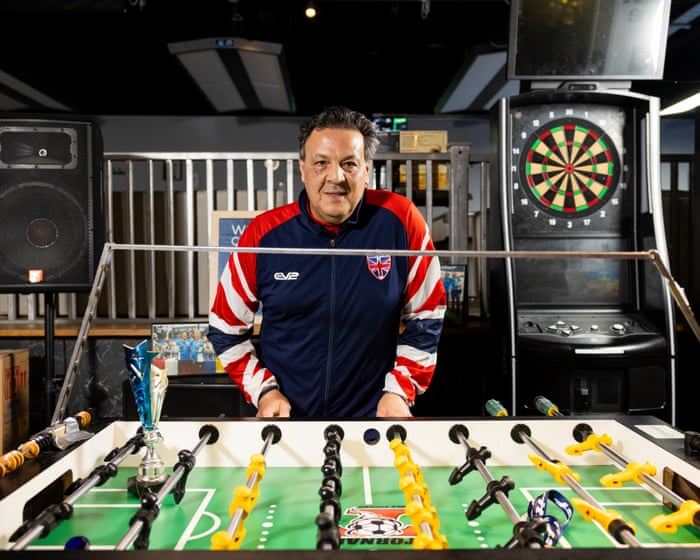
I was 12 years old the first time I played foosball—table football—in the summer of 1975 in Beirut. My hometown was under siege, torn apart by civil war. School was canceled, roads were closed. We couldn’t get to the beach, and the only place to go was the amusement arcade. Luckily for me, it was just across the street.
Alongside pool tables and arcade machines were a couple of foosball tables. I watched older kids play for hours, fascinated by a game where you could outsmart an opponent just two feet away and then celebrate right in their face. It cost 20 pence—or qurush in Lebanese money—to play: 10 pence for the table and 10 pence for the winner. Money was tight, so I made a deal with the arcade owner—if I cleaned the tables, I could play for free. With machine guns rattling nearby on the green line that divided east and west Beirut, I’d stuff a towel inside the goal and practice until I felt confident enough to play. I got really good. By the next summer, I was winning ten games in a row.
When I became a teenager, foosball took a backseat to girlfriends, wine, cigarettes, and a job at a casino. Then I met a British woman and we got married. In 1986, with the war still going on, we left Lebanon and settled in Manchester. We had a son, a daughter, and a foosball table in the kitchen. It stayed a hobby until 2004, when I was managing the city’s Hard Rock Casino. I bought a table for customers and put up a sign: “Beat the manager.” Our weekly challenge had 30 competitors, but I always won.
One day, a man named Khalid Sharif walked in. He said, “I’m the UK foosball number one—I’ve heard about you.” We played, and I won 10-0. The next week, he brought members of Britfoos, the British Foosball Association. I won again, and they asked me to join their team. The scene was well organized, with hundreds of players, tournaments abroad, cash prizes, and a World Cup. At this level, it was always teams of two—a striker and a goalie—instead of the one-on-one games I was used to. Khalid and I traveled the UK as a team in official matches, with me as striker and him as goalie.
In 2012, I had left casinos to open a Lebanese restaurant, Zaytoon, in Manchester. That’s when Team GB invited me to the World Cup in Hamburg as a substitute. More than 35 countries competed in a huge hall with 200 tables and big screens. There were junior teams, women’s, men’s, and seniors, all wearing their national kits and singing their anthems. It was incredible. In 2018, I got to play at the ITSF World Series in St. Pölten, Austria. We faced Germany in the final; it went to penalties, and we crushed them to win gold. A year later, our team went to the World Cup in Murcia, Spain. We made it to the knockout stages against Portugal, then the USA—20-time world champions and favorites, along with Germany—in the quarterfinal. It was a hot day, and we were the underdogs. The whole arena cheered for us. The format was ten games, four points each. We won all 40 points. The energy was electric. We faced the Netherlands in the semifinal, tied 39-39 until I pushed the last point into the net. Then came the final: Germany again. They beat us 40-24, but silver and second in the world felt good enough.
Foosball has taken me all over the world—to places like Vegas, Rome, and Germany. On Friday nights, we have team practice in Manchester. The game has given me an international family, friends, and even enemies. One of the German players is my nemesis; he’s won hundreds of games, but he still shakes with nerves when we compete. Afterward, we’ll grab a drink together. It’s an atmosphere of mutual respect.
Khalid is still my best friend. Without him, I’d never have known about the professional game. And now my son, George, travels the world playing with me. He’s a talented goalie.He’s a personal trainer who works with me three times a week and also helps rehab my shoulder from foosball injuries. At 62, I need to keep my stamina up.
I still run my restaurant, and I keep my foosball medals on display. Now I’m getting ready for the next World Cup in 2028. I play imaginary games in my head while I cook, memorize patterns of play, and rewatch footage of opponents when I can’t sleep. In foosball, having a game plan is crucial – and at the next World Cup, I want to win gold. As told to Deborah Linton
Do you have an experience to share? Email experience@theguardian.com
Frequently Asked Questions
Here is a list of FAQs about being a world champion foosball player covering beginner to advanced topics
Beginner Questions
1 Is foosball a real professional sport
Yes absolutely There are professional tours world championships and players who train fulltime The skill level is incredibly high
2 How do you even get good enough to become a world champion
It takes years of deliberate practice Most champions start by learning the basic shots then spend thousands of hours perfecting ball control passing and defense
3 Do world champions use special tables
Yes they typically train and compete on tournamentgrade tables like the Tornado or Bonzini These have faster rods better bearings and consistent bounce
4 Is it mostly about wrist strength
Not at all Its about fine motor control timing and strategy Wrist strength helps for powerful shots but precision and reading your opponent are far more important
5 Do you have to be young to be a world champion
No While many champions start young there are top players in their 40s and 50s Experience and mental game often outweigh raw speed
Advanced Questions
6 Whats the single most important shot to master
The pull shot Its the foundation of offense Most world champions also have a deadly snake shot
7 How do world champions defend against the snake shot
They dont just block they read the opponents body language and timing They use a technique called spider defense and anticipate the shot angle
8 Whats the biggest mistake amateur players make
Overdribbling and not passing Amateurs try to do everything with one man Champions use quick crisp passes between rods to create open shots and confuse the defense
9 How important is the bank shot
Extremely important at the pro level Its a primary way to score on highlevel defenders Champions can bank the ball off the side wall