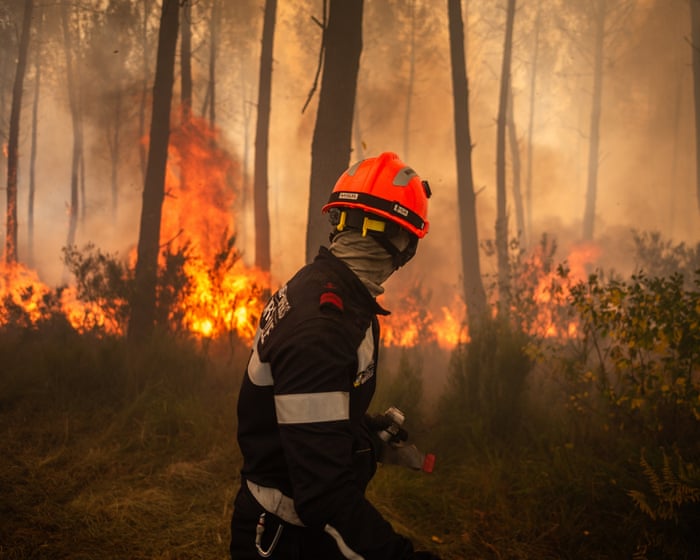
As dozens of wildfires raged across France this week during the fourth brutal heatwave of the summer, along with worsening air pollution, some wondered whether voters’ direct experience of the climate emergency would shift the political conversation ahead of next year’s presidential election.
Marine Tondelier, leader of the Greens, cut short a tour of France on medical advice—at seven months pregnant, she was told to avoid the smoke-filled air near a massive wildfire in Gironde in the southwest. She said the political class was still burying its head in the sand. Tondelier claimed the government had ignored her call for cross-party crisis talks to declare a national climate emergency this summer. She urged the creation of a new “climate welfare state” in France to support those affected, as around 260,000 people were evacuated due to wildfires across the country.
But this week, French politicians were instead caught up in arguments over budgets, crisis planning, and criticism of state funding for emergency services and firefighting equipment, including water-bombing planes. The deeper, longer-term issues—like cutting emissions and making structural societal changes to tackle climate heating—were largely pushed aside.
President Emmanuel Macron said it wasn’t the time to analyze lessons while France was still in “full battle” against the fires. Macron, whose decade in office ends next spring, returned to the war-like language he used during the 2020 Covid pandemic. As the Gironde wildfire burned an area four times the size of Paris, Macron flew to the crisis operations center in Bordeaux, saying France was facing its “hardest situation since the second world war.” He also described the situation as “totally atypical,” suggesting the wildfire was out of the ordinary. Climate experts, however, said that more forest fires were predictable as temperatures rise.
Most political parties won’t reveal their full election manifestos—and their positions on the climate crisis—until this winter. Some climate campaigners worry that by then, the fires and heatwaves may have faded from the media and people’s memories.
Marine Le Pen, who leads the far-right, anti-immigration National Rally (RN), is seen as having a strong chance of making it to the final round of the presidential vote. During the second round of the last election in 2022, Le Pen said, “I have never been a climate sceptic.” But the following year, she called the UN’s Intergovernmental Panel on Climate Change “alarmist,” and some RN politicians have previously questioned the role of human activity in climate heating.
The RN has also opposed the EU’s green deal, which aims to make the bloc carbon neutral by 2050. But since the heatwaves at the start of the summer, key figures in Le Pen’s party have tried to stress that the RN doesn’t deny the climate crisis. This week, the RN focused more on the heroism of firefighters and alleged underfunding of fire services by the state, rather than on long-term environmental action.
Earlier in July, radical left candidate Jean-Luc Mélenchon proposed reorganizing French regions into “eco-regions” to secure water supplies and address the climate crisis.
Rémi Lefebvre, a political science professor at the University of Lille, commented on the current wildfires’ impact on the presidential campaign: “Ecology will probably get more attention during the election campaign, but I’m not convinced it will reshape French political life.” He noted that serious wildfires in past years hadn’t forced a change in direction, and French politics had shown itself to be “too short-termist” to deeply rethink societal models.
Lefebvre said Le Pen didn’t take a stance ofDenying climate change is no longer an option—we’ve passed that point. But he said the bigger problem is that politicians aren’t taking action on climate issues. He added that many French people feel those in power are helpless to respond.
Frequently Asked Questions
Here is a list of FAQs addressing the question of whether Frances wildfires will change political action on climate change
General Context Questions
1 Is this the first time France has had wildfires like this
No but the scale and intensity are unprecedented France has always had summer fires in the south but the 2022 season saw megafires in regions like Gironde that were previously considered lowrisk The fires are now larger more frequent and happening in new areas
2 Why are these fires specifically linked to climate change
Climate change doesnt start fires but it makes the conditions perfect for them Rising temperatures and prolonged droughts dry out vegetation turning forests into tinderboxes Heatwaves also create fire weatherhot dry windy conditions that make fires spread explosively and become impossible to control
3 Havent French leaders already promised to act on climate
Yes France was a key architect of the 2015 Paris Agreement and has committed to carbon neutrality by 2050 However there is a big gap between longterm promises and shortterm actions Activists and scientists argue that current policies are too slow and often prioritize economic growth over emissions cuts
4 Are people actually connecting these fires to climate change or just seeing them as a seasonal accident
Public opinion is shifting While some still see it as a forestry or management issue the sheer scale of the 2022 fires made the climate link undeniable for most French citizens Polls show a significant increase in climate anxiety and a demand for stronger government action following the fires
Political Policy Questions
5 Will this actually change government policy or is it just talk
It forces a change in rhetoric but real policy change is slower The fires have forced the government to invest in more firefighting planes and equipment but critics say this is adaptation rather than mitigation The push to reduce emissions often faces resistance due to the cost of living and political backlash
6 What is the ecological planning that President Macron talks about
Its a buzzword for a topdown approach to coordinate all ministries and policies around the climate goal After the