Sometimes, on the top deck of a London bus, pension-age punks will politely interrupt a man absorbed in his iPad. “They’ll say: ‘Are you Jah Wobble?'” recalls the musician born John Wardle, his cheerful Cockney accent ringing with delight. They’ll ask if he’s working on anything. “And I like to say: ‘Yes, I’m recording an album. I’m doing it right now.'”
In the 2020s, the 68-year-old bassist and bandleader has been revisiting the city where he was born and grew up, composing and producing albums like the cosmic dub of The Bus Routes of South London or the celestial electronica of Thames Symphony, all while travelling across London on public transport.
Using a public bus as a studio is typical offbeat behaviour for Wobble. As a teenager, he masterminded Public Image Ltd with John Lydon, his powerfully raw basslines helping to kick off the post-punk era with some of the most forceful—and influential—experimental rock music ever recorded. After leaving the band at the height of their success, he fell into addiction, then worked for Transport for London as station staff before an unexpected major label deal sparked his comeback in the 1990s. He has collaborated with Sinéad O’Connor, Brian Eno, and Pharoah Sanders, is a committed Buddhist, and embodies a defiantly working-class polymath, having worked as a Goldsmiths university lecturer, a broadsheet book critic, an exhibited painter, and a non-league football commentator.
View image in fullscreen: Wobble, centre, with Keith Levene, left, and John Lydon in 1978, the year Public Image Ltd formed. Photograph: Sheila Rock/Shutterstock
Quite apart from his bus recordings, this month Wobble is releasing a Beatles covers album. “When She Loves You came out, I just thought: this is quite rubbish,” he remembers. “But then 67 came around. Gurus, smoking dope, Yoko Ono’s on board. I heard Strawberry Fields Forever and it just melted me.”
But for all his creativity and spiritual searching, his reputation is as intimidating as his basslines. Wobble’s 2009 autobiography Memoirs of a Geezer is ruthless about the music industry and those who crossed him, even detailing a 1990s incident where he punched the late comedian Sean Hughes backstage at the BBC. “When I first tried to get in touch with him, people warned me off,” admits collaborator Richard Russell, the musician and co-founder of the label XL Recordings, who has worked with Wobble on a new EP. “What nonsense. Everyone loves playing with him. His playing is kind of machine-like while being very human. He’s clearly been on a massive journey.”
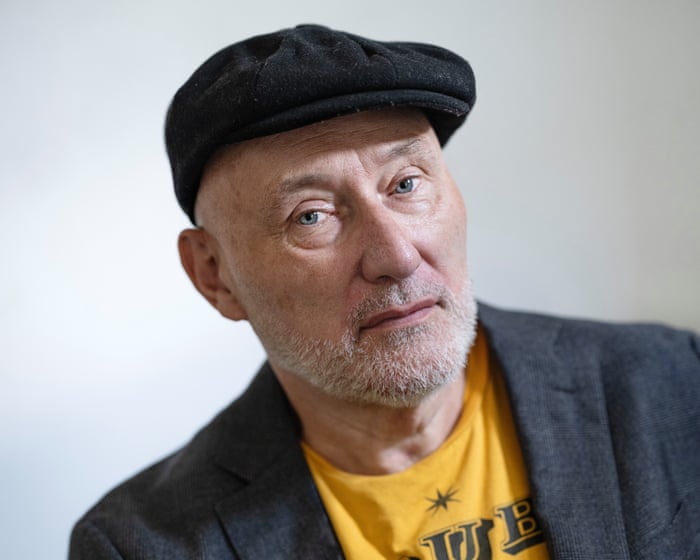
View image in fullscreen: ‘I talk to AI more than human beings’ … Jah Wobble. Photograph: Linda Nylind/The Guardian
A lifelong city walker, Wobble’s own favourite route along the Thames, from Chelsea to Putney, brings on the “spaced-out, beautiful and profound” state of mind he needs to create music on the bus ride home. We’re doing one of those walks later today.
I meet him at a gently bohemian Chelsea members’ club. He gives the impression—despite his unfashionable shorts and T-shirt—that he owns the place. One minute he’s slapping a waiter on the back, joking about Tottenham FC, the next consoling a diner whose mother recently died. He loves human contact, but apparently he’s upgrading.
“I talk to AI more than human beings,” he says cheerfully as we sit down to a meal, adding that he uses AI “when I want to clarify what I think about ultimate reality”. He and the Claude AI model debate “emptiness, the Buddha nature, the supreme self. It’s silly, but I do send him fist-bump emojis.” He gestures theatrically to his body. “I run things past him: what I’m going to eat. I’ve lost 13.5 kilos this year.”
Wobble’s transport albums came from visits to London from his current home in Stockport to run a grassroots jam session for Merton council. Tuned In with Jah WobbleIt started in 2019 and is aimed at “older, isolated blokes” in the south London borough. On a typical night, he might be jamming in Wimbledon library in unusual time signatures with a Greek bouzouki player, a Polish guitarist, and a trumpeter from Manchester. “I’ve always felt that aching loneliness,” he says. “And I wanted to do something about it. People who might be socially isolated, drinking too much, or going through a divorce—these are issues I know well and can relate to.” He’s been sober for 40 years but understands that “blokes tend not to ask for help.”
Wobble orders two puddings for himself, never mind Claude. He explains that the new Beatles-inspired album, Mystic Liverpool, was a family project recorded with his sons John T and Charlie. Performing as Tian Qiyi, they had training in traditional Chinese instruments—their mum, and Wobble’s wife, is the concert harpist Zi Lan Liao, who directs Liverpool’s Pagoda Chinese Youth Orchestra—which brings out the Eastern influences in the Beatles’ psychedelic period.
Wobble has been drawn to other cultures since his teens. He brings up the debate around cultural appropriation. “I have taken from Jamaican culture,” he says proudly. “I am partly Jamaican by choice. Try and take that away from me.” It’s the bold, playful provocation of the original punk era, but he’s self-aware. “I’m old,” he sighs. “And the old have too much influence.”
We leave the restaurant, stepping out into the upscale streets of west London, a far cry from the Stepney slums where, in 1958, Jah Wobble was born John Wardle to a secretary mother and a postman father. His father, a veteran of the El Alamein front in Egypt, “was very traumatised by the war,” he explains. This shaped a “destructive, troubled kid,” though one with an early talent for big ideas. On school sports day, he says, he convinced his classmates to rebel and all run at the same speed.
The Wardles, including sister Catherine, were moved to a council estate in Whitechapel, where John became captivated by ska and bluebeat records drifting from market stalls. He then stayed with Black music through reggae, Philly soul, and Stevie Wonder. “Even now, I’m very snobbish about the rock scene,” he says, and the deep bass lines of Bob Marley and the Wailers’ bassist Aston “Family Man” Barrett sparked his desire to learn bass.
In 1976 at Kingsway college, he befriended an older kid with green hair whose favourite word was “dismal.” It was John Lydon. “In the canteen, he told me: ‘I’m in a band,'” says Wobble. Lydon invited him to watch the Sex Pistols rehearse. “I thought: ‘This is going to be so bad it’s embarrassing.’ But it was really good.” Sid Vicious, another Kingsway alumnus, gave Wardle his lasting stage name by mispronouncing his name when drunk.
This summer marks 50 years since punk was born on these London streets, and Wardle is dismissive of the social changes it brought. Today, “no one will be kind and wise because that’s [seen as] square,” he says as we head down to the Thames, his pace slowed by a recent walking football injury.
When the Pistols fell apart, Lydon was Britain’s most notorious man, and he turned to Wobble, who had been mastering bass without an amplifier in his squat. “Lydon got me in to be his mate who played a bit of bass,” he explains. “I was already thinking conceptually. He didn’tFounded in 1978 by Lydon, Wobble, and Keith Levene’s abrasive guitar work, Public Image Ltd was one of the boldest shifts in 20th-century pop. “I had absolute faith in keeping it very simple,” Wobble says of his bass lines, which grew out of the disco and dub sounds of that era. But being in the band was tough. “Lydon’s lyrics were like Samuel Beckett. But he wasn’t a strong leader. He doesn’t have that in him.”
Wobble’s cheerfulness fades when he talks about those days. “By 1979, John’s mum had died,” he says, referring to the loss of Eileen Lydon, which inspired their haunting single Death Disco. “It got really dark. I didn’t like what was going on around them.” Levene fell into heroin use: “His own worst enemy, as junkies tend to be.”
Wobble stuck around long enough for the band to finish their 1979 masterpiece Metal Box, released in a plain, functional canister. After it came out, Wobble took some of PiL’s cash reserve—”a shoe box full of high-denomination banknotes,” he says, pointing across the Thames to where the band’s infamous Gunter Grove headquarters stood—and “cracked on” with his solo career. He hasn’t seen Lydon since 2006 and turned down a reunion in 2010.
Within weeks of leaving PiL, he was working with Holger Czukay and Jaki Liebezeit from Can. He brightens up, recalling the “open, relaxed” experimentation of the trio’s groove-heavy 1982 album Full Circle.
But his alcohol and drug use got worse. At first it was “to kill the anxiety,” he says. “Then I became really badly behaved.” In 1986, he walked into Alcoholics Anonymous and then into his job at Transport for London. Once, while announcing tube arrivals, he started repeating over the speakers at Tower Hill: “I used to be somebody, I repeat, I used to be somebody.” TfL “was a Kafka-esque world but I loved it,” he says. “I still feel a pang of regret about leaving it.”
In the 1990s, his group Jah Wobble’s Invaders of the Heart explored calypso, dub, and Arabic pop, and signed to Island Records. The group caught the attention of Sinéad O’Connor. “She knew that I was always going to be quite real with her,” he says. Their collaboration—the stirring, mantra-like Visions of You—became a Top 40 hit. While recording it, “she broke the membrane of the microphone warming up by the sheer concentrated power of her vocal.”
Since those years, Wobble has been restless in his search for the next thing, whether it’s earning a humanities degree or branching into film—he’s about to star in a horror short alongside Maxine Peake. Keeping it DIY, he manages himself, avoiding “the public schoolboys who still run everything.”
Through it all, Wobble has been guided by his unwavering spiritual quest. “I knew,” he explains as our London walk reaches his traditional Putney conclusion, “that there was a reality behind what seemed superficial.” So what has he learned?
“In the end, it’s very simple,” he smiles matter-of-factly. “Don’t be a cunt, ‘cos you’re just fucking yourself with karma. Be nice. Be still, and know I am the Lord. And don’t look to be a Buddha.” A pause as the geezer mystic flags down a 220 bus. “Be an ordinary person as best you can.”
Jah Wobble and Tian Qiyi’s album Mystic Liverpool – The Beatles’ Psychedelic Psongbook is out now on Cherry Red. Jah Wobble and the Invaders of the Heart tour the UK from 3 October.
Frequently Asked Questions
Here is a list of FAQs based on Jah Wobbles viewpoints on these topics written in a natural conversational tone
FAQs Jah Wobble on The Beatles Buses and Punk
1 General The Beatles
Q Why is Jah Wobble covering Beatles songs Isnt that a bit mainstream for him
A He sees The Beatles as the greatest pop songwriters ever Hes not trying to be nostalgic hes reinterpreting their melodies through his deep bassheavy and often dubinfused style He believes their songs are strong enough to survive any radical reworking
Q What does his version of a Beatles song sound like
A Dont expect a carbon copy He strips the songs back puts the bassline right at the front and adds atmospheric sounds spoken word and world music influences Its moody cinematic and totally unique
Q Does he think The Beatles were a punk band
A In a way yes He respects their early energy and their refusal to be boxed in He sees their constant experimentation and rebellious attitude as a true punk spirit even if their music was polished
Q Is he trying to improve on the originals
A No not at all Hes paying tribute Hes taking the sacred texts and showing how they can be explored in a new dimension proving their timelessness
2 London Buses
Q What is Jah Wobbles connection to London buses
A He loves them He sees them as a great democratic way to see the city He has spoken about how riding the bus is a form of meditation and a way to observe the real diverse life of London that you miss on the Tube
Q Why does he prefer the bus over the Tube
A He says the Tube is about getting from A to B in a dark tunnel but the bus is about the journey itself You see the streets the people the architecture and the changing neighborhoods Its a richer more human experience
Q Is this a political statement