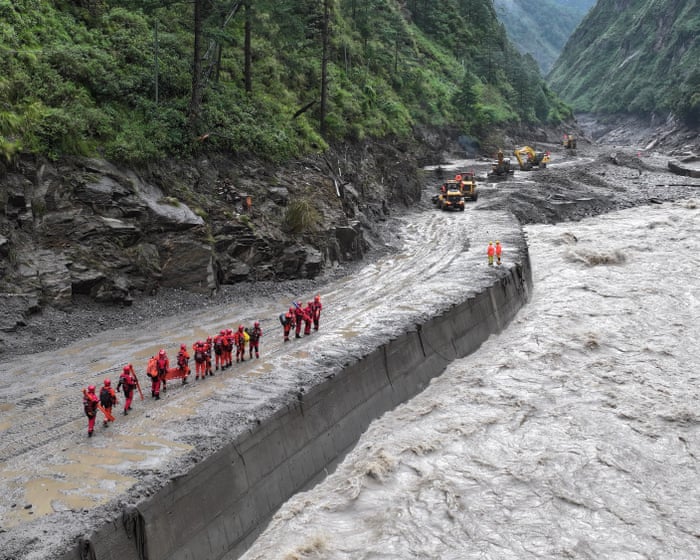
In the days since a massive glacier in the Himalayas broke off from a mountaintop and crashed into the valley below, the full extent of the destruction caused by the flash floods in Nepal and Tibet is still becoming clear. However, the situation is coming into focus much faster in Nepal than in China, where strict limits on information from one of its most sensitive regions are blocking the public from fully understanding what happened.
The floods wiped out villages along the Himalayan border area that sits between Nepal and China’s Tibet region. On Friday, the official death toll in Nepal rose to 538, while in China it was only five, even though the villages near the Gyirong border crossing are home to several thousand people.
1:17
Survivors pulled from mud in Nepal after deadly flash floods – video
In Nepal, journalists rushed to get as close to the disaster zone as possible to talk to survivors and rescue workers. Villagers gave detailed, moment-by-moment accounts of what happened when the floods—whose exact cause scientists are still studying—tore through their homes.
In China, state media aired several reports on the floods and sent their own journalists to the area, but the coverage focused on rescue efforts rather than the scale of the damage. In one broadcast from a relief center in Tibet, the journalist didn’t speak to any of the people sitting behind him.
Tibet, which came under Chinese control in the 1950s, is the most sensitive and tightly controlled region in the country. Sporadic protests, including self-immolations, by Tibetans seeking more autonomy and religious freedom have been suppressed by the authorities. International journalists can only visit Tibet on strictly organized government tours. Many Tibetans are not allowed passports and have very limited contact with the outside world. Tibetans can be punished for talking to journalists. Human rights groups have long criticized Beijing’s policies on Tibetan language and culture, which activists say are under threat.
Map of affected areas
This makes it hard to independently assess how the flash floods have impacted the Tibetan side of the border.
“Everything about Tibet is seen through the national security lens. So nobody is going to say or report anything that hasn’t been approved from the very top,” said Steve Tsang, director of the China Institute at Soas University of London. For anyone on the ground, “you can’t report a higher death toll, even if you’ve seen more bodies yourself, until the official statement says the number has gone up.”
What caused the catastrophic flood in Nepal and Tibet – and how does a glacier collapse?
Read more
China’s tight control over information is limiting international coverage of its relief efforts. This might mean China is missing a chance to share its own good news story.
Chinese emergency services, including the People’s Liberation Army, are far better equipped than their Nepalese counterparts. Navigating the difficult, mountainous terrain, where conditions are still dangerous, requires specialized skills. China has sent hundreds of emergency workers, but there’s little detail on what they’re doing. “The Chinese have missed a trick,” Tsang said. But “they don’t have that confidence. Their instinct is control.”
Still, China has been eager to stress that the disaster is a national priority. According to state media, China’s leader, Xi Jinping, chaired a meeting on Friday to direct rescue work. Xi called on authorities to “make every effort to search for missing people from China and abroad.” He also sent his deputy, Premier Li Qiang, to visit the affected area. According to the state-run Xinhua news agency, Li “emphasized that General Secretary Xi Jinping is deeply concerned about the people in the disaster-stricken areas.”
Frequently Asked Questions
Here is a list of FAQs based on your request The tone is neutral and focuses on the observable situation and reporting mechanisms
BeginnerLevel Questions
1 Why is it so hard to find clear information about the flood damage in Tibet
Information from the region is often tightly controlled by Chinese authorities This means that local media reports what the government approves and international journalists have very limited access to the affected areas This makes independent verification of the damage difficult
2 Are there any official numbers about the floods
Yes Chinese state media do release official figures regarding casualties and economic losses However these numbers are often released later than expected and are rarely updated with granular details about specific villages or remote areas
3 Can I see satellite images or photos of the flooding
You can see commercial satellite images from private companies that are sometimes published by international news outlets However highresolution realtime imagery of the specific disaster zone is often restricted or delayed and local photos from residents are hard to verify
4 Why doesnt the Chinese government just share all the data
The Chinese government treats disaster information in sensitive regions as a matter of national security and social stability They prioritize controlling the narrative to avoid panic and to manage the international perception of their crisis response
IntermediateLevel Questions
5 What specific mechanisms restrict the flow of information in Tibet
There are several layers strict internet firewalls block international news sites and social media Domestic social media platforms use keyword filtering to remove posts about the disaster Additionally the region requires special permits for foreign journalists which are rarely granted during a crisis
6 How does the Chinese media frame the floods compared to international media
Chinese media typically focuses on the rescue efforts and the leadership of the Communist Party emphasizing unity and the speed of the response International media tends to focus on the scale of the devastation the lack of transparency and the difficulty in assessing the actual death toll
7 Are local Tibetan voices being heard
It is very difficult Local residents often rely on state media for information While some videos and messages do leak out via encrypted apps or VPNs they are often removed quickly There are very few independent Tibetan journalists operating inside the region