Cheryl Johnson has a lifetime of political memories, stretching back to John F Kennedy’s assassination and the Black civil rights struggles of the 1960s. But one thing about today’s politicians bothers her more than anything else: the swearing.
“All this cursing in politics, we never heard that before,” said Johnson, a retired social worker who lives in the Pittsburgh area. “Words are very powerful, and the past 45 presidents of this country have not used such vile language.
“Is that how teachers, corporate leaders, nurses, doctors, dentists speak in their work environment? It’s not OK. It’s a decline in respect and honor, period.”
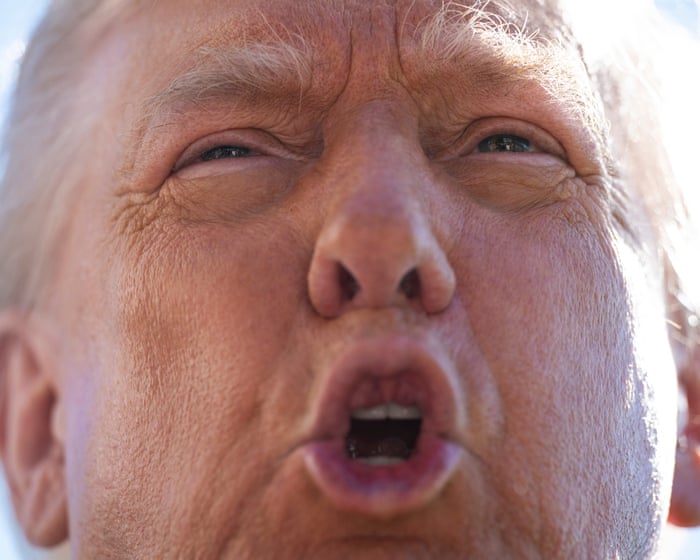
Over the past decade, Donald Trump has led the way in redefining what counts as acceptable language in public life.
He was already criticized for debasing and coarsening public discourse during his first presidency – when he was famously reported to have complained that the US was admitting immigrants from “shithole countries” – and he has let loose during his second.
He has repeatedly used words never before heard in public from a US president, at least not intentionally, and seems to have normalized them.
A taboo seemed to break in June 2025, when Trump profanely condemned Israel and Iran for continuing to fire at each other even after hostilities were thought to have stopped following a 12-day war. “They don’t know what they fuck they’re doing,” he told reporters on the White House lawn.
In case that was taken as a slip of the tongue, Trump indulged his growing taste for public obscenity again in October 2025, when asked about Venezuela’s then president, Nicolas Maduro. “He’s offered everything,” Trump claimed. “You know why? Because he doesn’t want to fuck around with the United States.” (Months later, Maduro was seized by US special forces. He is now in custody in New York, awaiting trial.)
Trump has used profanity even more starkly in recent social media posts, deploying it to raise rhetorical pressure on Tehran after it closed the Strait of Hormuz following Trump’s decision to launch the US-Israel war on Iran in February. “Open the Fuckin’ Strait, you crazy bastards, or you’ll be living in Hell – JUST WATCH,” he posted on his Truth Social platform in April.
“President Trump doesn’t have a very strong sense of decorum,” said Michael Adams, a professor of English language at Indiana University Bloomington and author of In Praise of Profanity, a study of swearing’s place in society. “The swearing has a whole range of aspects to it. Some of it is this emphatic diplomatic persona, and some of it is believing in the unpredictability of the president, and his general sense that he doesn’t care.”
## Civility in politics
Trump is hardly the first president with a taste for the profane. Lyndon Johnson and Richard Nixon were both renowned for liberal use of earthy vernacular, but in private. Their bad language was only exposed when tape recordings of their conversations were released after their presidencies.
In Nixon’s case, his swearing became an issue during Watergate, when the White House released heavily-redacted transcripts of his taped conversations – with repeated use of the telling phrase “expletive deleted”.
Trump’s increasingly cavalier approach to obscenity is a far cry from George W Bush’s mortified response when he was a US presidential candidate in September 2000. During the campaign, a live mic picked up his description of a New York Times journalist as a “major-league asshole”.
A chastened Bush, running on a pledge to restore civility to politics, voiced “regret” that his remark was heard.
These days, by contrast, politicians are only too keen for voters to hear what would once have been indiscretions, according to analysts. While Trump may have opened the floodgates, other officials and candidates – Republican and DemocratPoliticians from both parties are increasingly using profanity, and voters seem to be accepting it. Joseph Phillips, an American politics professor at Trinity College Dublin, attributes this to a search for authenticity at a time when politicians are held in low public esteem.
“The incentive for politicians to use profanity comes from a change in how people view the profession,” Phillips said. “The level of political trust that Americans have has declined a lot, and this has changed how people see politicians.
“Politicians have an incentive to counter the trend of appearing unscrupulous and unrelatable by doing a very cheap thing that we all can do — using language more typical of ordinary people, which includes cursing.”
Along these lines, US vice-president JD Vance has often used the word “shit” in speeches and on social media to provoke political opponents and critics. Speaking at a military base in Kentucky on Thanksgiving last year, Vance drew criticism after telling soldiers who raised their hands when asked if they liked eating turkey that they were “full of shit.”
Pete Hegseth, the defense secretary, has used crude terms to mock previous practices in the armed forces that he regards as woke, telling a gathering of generals at a marine base in Quantico, Virginia last September: “We’re done with that shit.”
Democrats have also embraced vulgar language. Minneapolis mayor Jacob Frey told Immigration and Customs Enforcement (ICE) agents to “get the fuck out” of the city after an agent shot dead a mother of three, Renee Nicole Good, in her vehicle in January. Earlier this week, Tammy Duckworth, a Democratic senator from Illinois, told a Washington thinktank she was “tired of fixing shit that Republicans break.” Arguing against being polite if Democrats regain control of the Senate in November’s midterm elections, she said: “Fuck that shit.”
While the long-term effect may be to reduce public respect for politics even further, those competing for office are unlikely to care. “The incentive of an individual politician is probably not to regain the esteem of the profession, but instead to ensure their own election or re-election,” argued Phillips. “It wouldn’t be the first time that politicians have run sacrificing a broader institution for personal gain.”
Adams, of Indiana University, said politicians were seeking “covert prestige” by resorting to coarse language. “There is a covert prestige to swearing that has to do with the swashbuckling image of the inveterate swearer — a sort of devil-may-care attitude that attracts people,” he said. “People do swear, and if you never swear, then people wonder if you’re really like them enough that you would be a good president for them.
“It’s comparable to when George W Bush and Barack Obama were campaigning and people asked: ‘Would you want to have a beer with them?’ It wasn’t a glass of vintage wine, or a very old single malt — it was a plebeian drink with the plebs. Swearing fits into the same rhetorical maneuver.”
Benjamin Bergen, a professor of cognitive science at the University of California, San Diego, and author of “WHAT THE F: What Swearing Reveals About Our Language, Our Brains, and Ourselves,” suggested the heated language was being fueled by the fact that “we are in a very strident time of political disagreement.” The polarized atmosphere, he said, could mean it is only a matter of time before previously unthinkable — let alone utterable — profanities crop up in presidential inaugural speeches or State of the Union addresses.
“I don’t see any reason why there’s anything special about a State of the Union address or a speech in front of the UN, or anything like that,” said Bergen. “I think the language norms are just changing.”
But the pendulum could eventually swing back from the current profane“Trends can shift,” he suggested. “If one generation of politicians is seen swearing all the time, the next generation might reject it completely.” In an interesting transatlantic difference, Phillips – who previously worked in the UK – said the US trend of swearing has not yet caught on in British and Irish politics. “We’re seeing similar declines in political trust in all three countries,” he said. “But the US is different in one key way: politicians there have more incentive to build personal brands. In the UK and Ireland, politicians’ fortunes are much more closely tied to their party’s. So there’s less incentive to change established behavior.”
Frequently Asked Questions
Here is a list of FAQs about the topic of profanity in political discourse specifically regarding Donald Trump bringing presidential swearing out into the open
Beginner Questions
1 What does Profane Trump mean
It refers to Donald Trumps tendency to use swear words and vulgar language during his speeches interviews and public appearances
2 Did presidents swear before Trump
Yes but usually only in private Most presidents were very careful to avoid swearing in public because they wanted to maintain a dignified image
3 What is the presidential swearing that is now out in the open
It means that using bad language is no longer hidden or whispered behind closed doors It is now broadcast on television and social media for everyone to hear
4 Why is this a big deal
It breaks a longstanding tradition For a long time the President was expected to be a role model for manners and decorum Trumps style changed that expectation
5 What kind of words does he use
He has used words like hell damn bullshit and shit in public rallies and speeches as well as derogatory nicknames for his opponents
6 Is it illegal for a president to swear
No There is no law that says a president cannot swear It is a matter of social norms and etiquette not legality
7 How do people react to this
Reactions are mixed His supporters often find it refreshing and authentic His critics find it rude unpresidential and damaging to the dignity of the office
8 Does this happen at official events
It has happened at political rallies and in interviews more often than in formal State addresses but it has occurred in settings that are widely broadcast to the public
Intermediate Questions
9 Why does Trump use profanity in his speeches
Analysts say he uses it to connect with his base show strength and prove he is not a typical politician It is a way to signal authenticity and relatability
10 How has this changed political communication
It has lowered the bar for what is considered acceptable language in political discourse Other politicians now sometimes feel they can be more casual or aggressive in their language to compete for attention
11 What is the authenticity benefit of swearing
Some voters feel that