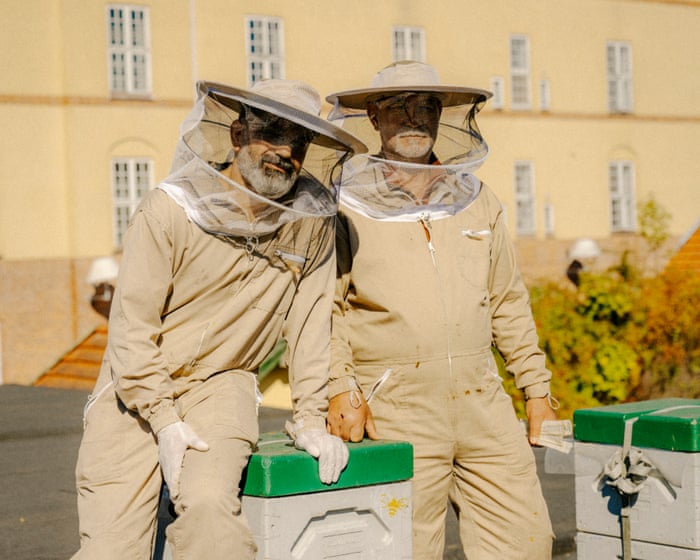
The bees at Bybi, a beekeeping collective in Copenhagen, live on the roof. Their home is a cluster of Victorian buildings in the heart of the city that looks like an idealised version of a modern social enterprise, made noble by the architecture of the past. It’s a place where cottage industry meets nature, where marginalised people are brought in from the edges and corporations wait to help, where jobs exist but much of the work is done by volunteers, and where — this part matters — a lot of time goes into discussing ideas.
Oliver Maxwell, Bybi’s 48-year-old founder, encourages me to look more closely at the buildings. They were once a prison, a workhouse and a hospital; their functions today — a homeless shelter, a young offender institution and, until recently, a job centre — are not so different. Maxwell says Denmark’s Victorian transformation, from “agricultural backwater to industrialised agriculture”, was reflected in how people were treated.
In the middle of it all is the collective, which resembles many things — a commune, a kitchen-table business, an art space. Everything smells of honey. Long drapes in earthy colours frame the entrance to a space where volunteers jar honey by hand. Small pots are stacked against a window in what looks like a random arrangement, but it turns out to be a stylistic map of the city: each jar comes from a particular street, with its own shade and taste, thanks to “the flowers people planted, the weather, the bees’ own decisions and choices”, as Maxwell puts it.
“Bybi is a constellation of time, work, money, community and connection, a place asking an open question: what would it take for bees, people and communities to thrive?” he says. Between 40 and 50 volunteers come and go throughout the year, with a core team of 15 handling practical, honey-related tasks and events.
They have 80 to 100 colonies, not just on this rooftop but all over the city — on businesses and conference centres, schools, municipal buildings, restaurants. They produce between four and six tonnes of honey every year. How that turns into money really depends.
Sometimes they give it away, at weddings and festivals. “Honey is an invitation,” Maxwell says. “It wants you to come in as a co-creator, with a joint responsibility for its health. We ask that you share it with someone you care for. And you plant a flower to help the bees.”
Sometimes they sell it the old-fashioned way, at a couple of boutique delicatessens around the city. Sometimes they ask people how much they want to pay; some are generous, some are not. Sometimes they discuss it in a reverse haggle, sitting in a group where they, as sellers, start low; the bidders tend to push the price higher by thinking deeply about what went into the honey.
Maxwell, an anthropologist, is originally from the UK. He spent time in Vietnam doing forest protection, then more time in Brighton training social enterprises, before arriving in Denmark in 2007 and setting up Bybi along similar lines in 2010. The plan was to employ homeless and other marginalised people, who would then be absorbed back into society. Honey would be made at the same time. Bybi also employed a social worker, “who was always a really nice person”.
The problem is, “it just doesn’t work”, he says. “The bottom half of the jobs market has fallen out and everyone else has to run faster and faster. The moment you make contact with the market economy, everyone just melts. We’re sitting here with a crisis of community, a loneliness crisis, a crisis in the meaning and purpose of work. People need to do stuff — we’ll find stuff to do. But the labour theory of value, where you create worth with your time, your boss takes it and gives you some back that you can live on? That does not work.”
They abandonedThe “giving homeless people jobs” agenda. Now people come because they want to, not because the job centre forces them to. About five people are employed, with more in the summer; there are dozens of volunteers, including disabled people who pack flower seeds. “They work as slowly as they like, and we give most of the seeds away for free,” Maxwell says. “It’s outside the logic of work.”
View image in fullscreen ‘The moment you make contact with the market economy, everyone just melts’ … Oliver Maxwell, founder of Bybi, and Anne-Louise Krogh Hornbech Jensen, who runs its projects and research. Photograph: Valdemar Ren/The Guardian
And yet jobs are found. Maybe that, like the honey, is a byproduct of the bees. Back on the roof, 53-year-old Aref Haboo, the head beekeeper, is looking for the queen among sheets of honeycomb. The Syrian Kurd, who came to Denmark in 2014, finds her on his first try, using an instinct honed over 18 years doing this job in the Afrin province of northern Syria, before Islamic State displaced him. Bees can recognise faces, apparently; they can also count and maybe even dream.
Anne-Louise Krogh Hornbech Jensen, 34, who wrote her dissertation on Bybi and now works here, says she always stays close to Haboo around the bees so she doesn’t get stung — which is as much proof as a bee could give you that they recognise faces. Haboo says Danish honeybees are less aggressive and more productive than Syrian bees.
This haphazard income stream isn’t the only thing keeping Bybi afloat. Its partners include universities, architects and corporations such as L’Oréal, which took some bees for the land behind a distribution centre. “The director became fascinated and stopped cutting the grass,” says Maxwell. “He got bat boxes, bird boxes, hedgehog boxes. They sponsored our work with schools. Employees collected the seeds and took them home, so the biodiversity of the field was spreading through the city. The director discovered a kestrel was nesting there when he found a dismembered rabbit.”
View image in fullscreen ‘You have to be OK with saying: “Our primary interest is not humans”‘ … Haboo tends to his colony. Photograph: Valdemar Ren/The Guardian
When rewilding, says Nicolas Hansen, a 27-year-old volunteer and nature management student, “you have to be OK with saying: ‘Our primary interest is not humans.’ You have to give nature its space.”
Those various sponsorships support schools programmes at Bybi, and they also collaborate with a lot of artists. People sometimes write messages to the bees, just catching them up on the news, recalling a preindustrialised era when many households would keep a hive or two and talk to the bees.
Refugees also work here, while people on incapacity benefits volunteer, but no one would call this a project for employing refugees or rehabilitating the economically inactive. “We also have corporate refugees volunteering,” Maxwell says breezily, describing volunteers burnt out by their high-flying jobs. Andrew Japp, a 52-year-old from Scotland, says: “I’d call myself more of a transient.”
Every society projects its image onto honeybees. Ancient Egyptians said they were the tears of the sun god Ra, to reinforce the divine right of the pharaoh, who was given the title Nesut-Bity, “he of the sedge and the bee”. To Aristotle, bees were the first “political animals”, organised in city states. In Manchester, the birthplace of modern capitalism, there is a bee on every lamp-post. All the language we use about them — hives, colonies, workers, queens — makes them not just capitalism’s mascot, but an attempt to reconcile the contradictions of the new, self-correcting market economy into a coherent picture, modelled in the natural world.
Skip past newsletter promotion
Free newsletter | Weekly
Sign up to Down to Earth
The planet’s most important stories. Get all the weHere is the text rewritten in fluent, natural English:
The Guardian’s environment news – the good, the bad and the essential
Enter your email. Sign up. After newsletter promotion.
“We use this language of hard work for them, but it’s completely wrong,” Maxwell says. “Their relationship with a flower isn’t labor – it’s sexual. It’s the reproduction of life through touch, taste, smell, dance, and color; the hairs on their eyeballs, the way they can hear through their feet. It’s an intense sensory experience, and it can only be understood as pleasure. They’re not following orders. They’re following their senses, which tell them it’s gorgeous.”
View image in fullscreen
‘Today’s conditions are full of possibilities for unlikely collaborations between people, plants, and animals’ … employees and volunteers at Bybi. Photograph: Valdemar Ren/The Guardian
Bybi’s mission is sometimes described as “degrowth” or “regeneration.” Both apply, but neither captures the urgency – that “we’re all living with this cognitive dissonance all the time, that everything bad is being hyperscaled, from AI to El Niño, yet we’re supposed to exist as if everything works and nothing has changed,” says Maxwell. “The problem is that we need to change our metaphors.”
When Bybi makes a decision, it often uses what the philosopher Bruno Latour called the “parliament of things” – an attempt to expand democracy to include nonhuman agents like animals, rivers, and plants. “Stay with the trouble,” is one of Maxwell’s catchphrases, referencing Donna Haraway’s 2016 book, in which she argues that in the face of ecological crisis, we shouldn’t wait in despair to be rescued: instead, form bonds of care and fight like hell.
Madeline Pugh, 26, is a student volunteer from the US. She says Denmark is the perfect sandbox for this experiment: “As a culture, it really appreciates and finds beauty in slow processes, taking time to build something with good intentions.” But it’s not a sweet story of easy integration and togetherness. Haboo’s life outside the bees is precarious – he got a speeding ticket the other day that could have jeopardized his citizenship application, even though he has been in Denmark for 12 years and his wife and children are here too.
“Danish society makes out it’s all about sourdough and pretty girls on bicycles, but it’s incredibly racist. It wins all the prizes for being livable, but not if you’re brown,” Maxwell says.
View image in fullscreen
‘Bees’ relationship with a flower isn’t labor – it’s sexual’ … a swarm of insects at Bybi. Photograph: Valdemar Ren/The Guardian
There is a raging debate about honeybees in Denmark, which is a kind of nativism with the sting removed (ironically): there are 293 species of bee in the country, but only one makes honey; all the others are, to varying degrees, endangered. People argue that honeybees aren’t properly Danish, that they are taking work from wild bees, that they are sexually promiscuous, that they spread diseases, and that they are a conspiracy of the EU and industrial agriculture. Honeybees are so connected with industrial agriculture that they have become a lightning rod for rural communities who feel trampled by it, who see themselves as the disenfranchised wild bee in this equation.
As much as honey is all around, Bybi isn’t taking the honeybee’s side in this culture war – it wants to introduce a relationship with bees that enriches conditions for all pollinating insects. That means more flowers planted and more spaces left to be rewilded, but also, on a deeper level, more people engaging with the interdependence between our activities and the ecosystems that sustain us.
But there is pushback to what Bybi does. Some say it shouldn’t be getting into bed with corporations, although Japp says the relationship with businessIt’s more like: “We don’t buy into your bullshit, but you should buy into ours.” People say it’s not scalable—they ask how it will feed the world and point to its reliance on volunteers as proof that it can’t survive on its own. “As if there’s a place on Earth where capitalism doesn’t exist,” Maxwell says, frustrated. “We have to start with the conditions we have today, which are messy and compromised, but also full of possibilities for unlikely collaborations between people, plants, and animals.”
As part of an internship at Gehl, a design consultancy focused on urban transformation and community-building, Pugh is working on a project about the eight components of awe, as defined in Dacher Keltner’s 2023 book, Awe. These are moral beauty (other people’s kindness or courage); collective effervescence (bees are good at this); nature; music; art; spiritual and religious experience; life and death (being present at one); and epiphanies. “A lot of people here are keepers of awe,” she says.
There’s no blueprint that could replicate the exact chemistry of people, place, and nature found at Bybi. But an experiment in cooperation across species and within our own—bringing in everyone from the suits to the left-behind—to build a sense of shared purpose and imagine a post-industrial future? That must be scalable. Do you have an opinion on the issues raised in this article? If you would like to submit a response of up to 300 words by email to be considered for publication in our letters section, please click here.
Frequently Asked Questions
Here is a list of FAQs based on the article topic regarding urban beekeeping and the modern economic system
1 What is the main argument of these urban beekeepers
They believe the current economic system is broken because it prioritizes infinite growth and profit over the health of the planet They argue that we need to shift from a system that extracts resources to one that regenerates them starting with local actions like beekeeping
2 How does beekeeping relate to fixing the economy
Beekeeping serves as a practical example of a regenerative economy It shows that we can create value while actually improving the environment rather than destroying it It is a model for working with nature instead of against it
3 What does regenerative economy mean
A regenerative economy is a system designed to restore and enhance the resources it uses Unlike our current industrial system which depletes soil and resources a regenerative system aims to leave the environment better off than it found it
4 Why do they think the current system is broken
They point to issues like climate change wealth inequality and the extinction of species They argue that an economy that requires constant destruction of nature to function is fundamentally flawed and unsustainable
5 What is the specific solution they propose
Their solution is to decentralize production and focus on local resilience By keeping bees in cities and producing food locally they reduce the need for long supply chains and create communities that are more selfsufficient and connected to nature
6 Can urban beekeeping actually replace the current economic system
No it is not a total replacement It is a seed or a model The idea is that if enough people adopt regenerative practiceslike beekeeping urban farming and local tradeit will eventually transform the broader economy
7 Is urban beekeeping difficult for a beginner
It requires dedication education and a bit of startup money but it is accessible Beginners need to learn about hive management local laws and bee biology It is a handson hobby that requires regular attention especially in spring and summer
8 What are the benefits of keeping bees in a city
Urban bees often thrive because cities have diverse plant life and fewer pesticides than rural farms They help pollinate local gardens and trees which increases food production