Ari Aster’s new film Eddington stars Joaquin Phoenix and Pedro Pascal as two men with opposing views on how to guide their small town through the COVID-19 crisis. The movie also explores America’s current political turmoil and technology’s growing influence on society.
Adam Curtis’s documentary series Shifty tackles similar themes but through the lens of British life during Margaret Thatcher’s era (late 1970s to early 1990s). Curtis argues that this period marked a major shift in power away from individuals and nation-states—a transformation still unfolding today.
Earlier this summer, the two filmmakers met in London to discuss their work, the ideas that drive them, and the dangerous allure of nostalgia.
Ari Aster: My family lives in New Mexico, where I grew up. In 2020, a COVID scare brought me back home, and I found myself surrounded by people who were completely disconnected—living in different realities, unable to understand each other.
By early June, when tensions peaked, I started writing down what I sensed in the air. I didn’t know if things would explode or if lockdown would ever end, but I knew something was shifting. I’d also always wanted to make a film about New Mexico, so it naturally evolved into a Western.
Adam Curtis: What I love about your film is the sense that before COVID, there was some kind of guiding authority—a “daddy” in the room. Then, when the pandemic hit, that authority vanished, leaving everyone adrift. The last remnants of centralized power disappeared, and people could no longer see what united them.
AA: They’re all connected in that they care about the world and sense something’s wrong—but that’s where the connection ends. Each clings to their own vision of America, yet they’re not even on the same page.
AC: That’s your starting point: Daddy’s gone, they’re on their own, each with their own dream of America. But they’re like billiard balls—colliding, amplifying each other’s distorted realities, spiraling into chaos.
AA: Exactly. They’re all paranoid. As those collisions intensify, I wanted the film itself to succumb to that paranoia. It begins with a broad, objective perspective, but that objectivity gradually unravels. I’m not sure if the film is apolitical or omnipolitical, but these competing fantasies start to dominate—that’s the idea.
AC: When society encourages extreme individualism, people get trapped in their own minds. It’s great when things go well—you’re the center of your universe. But when things go wrong, you retreat inward, trusting only your own ideas. You cling to them fiercely because they’re your only anchor. I think that’s where we are now.
AA: We’ve become completely isolated, unable to reach each other.
AC: In Shifty, I traced the roots of this in Britain, trying to approach it with empathy. And Ari, your film doesn’t judge its characters the way so many others do. You meet them on their own terms. You might not sympathize, but you understand why they’ve withdrawn into their own realities. You’re showing what happens next.
AA: They’re all unmoored, but…They’re holding onto some kind of lifeline. Shifty really struck me because it felt like looking into a mirror from the past. It was startling to realize that what seems unprecedented today is actually the latest ripple from something that began long ago. The technology has evolved, and because these issues have been magnified over time, the distortions have grown more extreme.
AC: The hardest thing to do—especially now—is to make the recent past feel strange again. It’s nearly impossible, yet that’s the challenge I set for myself. It’s like the Mona Lisa—when you point it out, people don’t really see it. They just think, Oh, that’s the Mona Lisa, and move on without truly looking.
What I aim for is breaking that automatic recognition. It’s about reshaping shared experiences so they feel new. When we live in constant fragmentation, the past never solidifies. In earlier times, those fragments of experience would spread over decades—enough time for most to fade, leaving only a few to form a coherent historical narrative.
Now, those fragments keep replaying endlessly, as your film shows. That’s why people struggle to see how trapped they are in their own perspectives—there’s no story explaining how they got here. Instead, we get a shallow political cycle: leaders rise, disappoint, and fall. That’s all we’re told anymore.
AA: Eddington is an environmental film, but not one that dictates how to think or feel. The real issue is how atomized we’ve become—unable to connect. As long as that division persists (and many benefit from it), nothing changes. By approaching the subject as objectively as I can, I hope to reach even those alienated by my side of the cultural divide.
AC: A true political film makes people question themselves. But for decades, so-called “political” films have done the opposite—flattering audiences, reinforcing their beliefs, and feeding their self-righteousness. That’s why many “radical” films are actually reactionary.
Progress is impossible unless people examine their own certainties and the harm they might cause. This applies to well-meaning liberals, far-right extremists, and tech-bro conspiracy theorists alike—they all risk becoming part of a system that thrives on division and outrage. If Eddington provokes that self-righteous backlash, Ari, take it as proof you’ve succeeded.
AA: There’s a feedback loop of nostalgia—not just nostalgia and trauma. We keep digging into the past to explain our present: This happened, so that’s why I’m like this. But as you’ve always said, the real question is—where is the future? Nobody believes in it anymore.Where are our new ideas? Where is our vision for the future? Nobody believes in the future anymore—I don’t either, and yet I’m desperately searching for it.
AC: You’re right about trauma. Over the last few years, people have turned inward, blaming their past for how they feel. They’re not just revisiting old music or films—they’re replaying their own memories, digging through fragments to explain why they feel anxious, afraid, or lonely. This gets labeled as “trauma.” Real trauma is specific and terrifying, but now the term has expanded so much that people constantly blame themselves by reworking their past—almost like AI does, feeding you recycled versions of your own history.
The universe isn’t purely rational. It’s filled with strange emotions, myths, and ghosts—things that often aren’t even real.
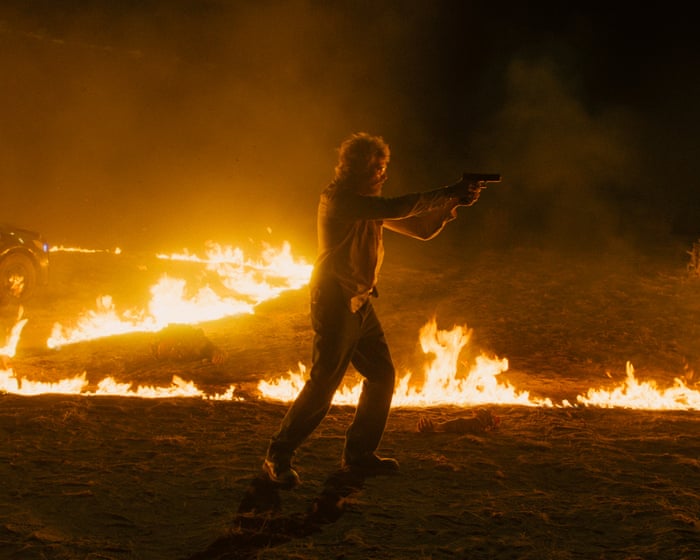
AA: Every character in Eddington is living in their own movie. The film is a western, but Joe (Joaquin Phoenix’s sheriff) has absorbed westerns into his identity—his walk, his role, even becoming a sheriff in the first place. He’s shaped by John Wayne, by ‘80s and ‘90s action films. By the end, he’s living in his own action movie, shooting at phantoms. And that’s true for every character. The only real thing happening in Eddington is the construction of a massive data center. In a way, all their stories are just data.
AC: Don’t give it away!
AA: Right, sorry—I won’t. But you’re right—there’s something outside they don’t see.
AC: Political filmmaking today should remind us there’s more beyond the internet. Everything in movies now feels filtered through it, but we know the internet isn’t everything. There’s something else out there, but no one’s talking about it. What I love about Eddington is that by the end, you hint at that—something beyond the fear and hysteria trapping us in our bubbles.
People turn to conspiracy theories because no one in power tells them real stories. Those in charge just want to manage you, and managers don’t tell stories—they repeat. That’s why people don’t trust them. The key is to acknowledge that uncertainty.
That’s why I call my series Shifty—because nothing is certain. The only way to deal with it as a journalist is to admit that and explain why the world feels this way.
The BBC created BBC Verify to restore certainty, which is important—rationality helps us navigate complexity. But it’s not enough, because the universe isn’t purely rational. It’s also full of emotions, myths, and ghosts—things that aren’t real.
A strong system of power takes those chaotic emotions and shapes them into a dominant story. But when that system collapses—like now—those forces spiral out of control, spreading uncertainty and suspicion.
BBC Verify is important, but it’s not enough—because the universe isn’t just rational.Modern journalism and films should focus on explaining how we’ve reached this point—recognizing that uncertainty defines our current reality because that’s how people experience the world today. If we don’t address this, audiences trapped in their own bubbles will distrust us. They know journalists, politicians, and experts grapple with the same doubts. We’re aware they know this, and that awareness breeds toxicity.
AA: Absolute certainty is gone for good. With deepfakes and AI-generated content, we can no longer fully trust what we see or hear.
AC: That means the boldest path forward is to move beyond relying on movies and mainstream culture as glimpses of the future. They offer nostalgic escapes, but real progress—real politics—will emerge from somewhere else, where we might reclaim the true complexity of reality in a meaningful way. I don’t know where that will be, but it won’t come from films or my own pretentious TV projects. It just won’t.
Eddington releases in the UK on 15 August.