Many of us, no matter our age or fitness level, know we should exercise more, but we’re not sure how to start. So what’s the best exercise for improving health, longevity, and overall well-being? Here, personal trainers share the top moves for any need or ability.
Deadlift
Rachael Tate, Norfolk
“The deadlift is the king of exercises. It’s a compound move that works many muscles, from your feet and grip to your entire back. It’s also practical—it’s the same motion you use when picking up something heavy.
Keep your back flat and your core engaged. Hinge at your hips to lift dumbbells, a barbell, or even buckets of water off the floor, then stand up straight. Start without any weight to get the movement right, making sure you feel it in the back of your body. Then gradually add weight.”
Plank
Mollie Millington, Hatfield
“I’d recommend doing a plank every day. It’s a full-body workout you can do anywhere. Start on all fours, then extend your legs behind you so you’re on your toes. You can keep your arms straight with only your hands on the ground (a high plank) or bend your elbows and rest on your forearms (a low plank). From the side, your legs and torso should form a straight line from your heels, through your knees and hips, to your shoulders. Don’t stick your bottom up or let your hips sag. If it’s too hard, do the plank on your knees, but keep that straight line from your knees to your shoulders.
The key is to keep tension in your abs. It really builds your core, and a strong core helps you move and do everyday activities.”
Sled Push
Rhiannon Cooper, Wolverhampton
“This strength-based cardio exercise is great for feeling strong and powerful. It’s also very safe—even beginners can lean in with their body weight and get those feel-good endorphins.
You’ll need a metal sled that you can load with weight plates. Place your hands halfway up the vertical poles (the contact points) and step back into a split stance, like a big step or lunge. Keep your shoulders, back, and core tight, with your arms almost straight but slightly bent at the elbows. Drive your body weight forward, and the sled will move with you. Take a step forward and keep pushing. One rep is the length of the track, usually 10–20 metres (33–66 feet), depending on your gym.”
Dead Hangs
Rob Ghahremani, Mind Over Matter Fitness, Nottingham
“This exercise is great for spinal decompression, mobility, and shoulder health. As a wheelchair user, I find it especially important as we get older. It improves grip strength, engages your back and core, and helps correct your posture—which is useful if you work at a desk or hunch over your phone.
Set a bar above your head, reach up, and hang from it, holding your body weight for as long as you can. You might only manage five seconds at first, then six the next day. The more you do it, the more your body will adapt over time.”
Sitting to Standing
Dom Thorpe, Stevenage
“When working with various disabilities, the important thing is that exercise can be any movement.The important thing is that exercise can be any kind of movement. Just because your legs don’t work the way they used to, or you can’t do the usual cardio or squats, doesn’t mean you can’t exercise.
“One of the best exercises is a simple sit-to-stand. If you need support, hold onto a table or a rail to help yourself get up. Don’t worry about specific numbers—everyone is different. Find your starting point and aim to improve over time.”
Lunge
Nick Bender, Yoked Fitness, London
View image in fullscreen
‘Functional, accessible, and vital for quality of life.’ Photograph: Posed by model; Ugur Karakoc/Getty Images
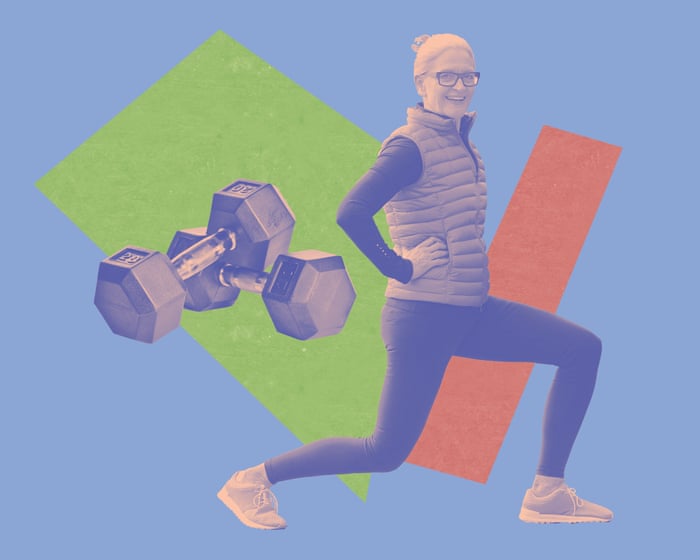
“Falling is a big concern for anyone over 60. While the fall itself is scary, what people often fear more is the embarrassment of not being able to get back up. If there’s nothing nearby to hold onto, you need the strength to do a lunge. That’s why I’d choose the body-weight lunge. It’s functional, accessible, and vital for quality of life. If you have limited time or motivation, the lower body is more important for overall health than the upper body. Strengthening the pelvic area, your glutes, hip flexors, and hips is crucial.
“To do a lunge, take a big step forward and try to touch your back knee to the ground. Start with a medium-wide stance, lower until your back knee gently touches the floor. Keep your hands off your knees if you can, your torso upright, and your upper body weight evenly balanced. To make it easier, hold onto a countertop. To make it harder, hold a dumbbell in one hand. Do two sets of 15 reps for each leg, three times a week, to build resilience as you age.”
Farmer’s carry
Ollie King, Sheffield
View image in fullscreen
‘A farmer’s carry builds grip, core, and posture while carrying over to everyday life.’ Photograph: Posed by model; Nemanja Mohenski/Getty Images
“Simple and very underrated, a farmer’s carry builds grip, core, and posture, and it translates to everyday life: carrying shopping, kids, or anything heavy.
“Pick a pair of dumbbells or kettlebells you can hold comfortably, one in each hand. Stand tall with your shoulders down and back, and a slight brace through your core, then just walk. Keep a ‘tall posture’ the whole time, and don’t let the weights pull you forward or side to side. Keep your shoulders down; if you’re leaning or wobbling a lot, the weights are too heavy.”
Squat with heel raise
Dr Kate Ella, Edinburgh
View image in fullscreen
‘This movement does it all.’ Photograph: Posed by model; Carrastock/Getty Images
“As a former orthopaedic surgeon who has fixed hundreds of fractures, I’ve seen first-hand how important balance and strength are, and this movement does it all. Start with your feet hip-width apart, then squat down to wherever feels best for you. Lift your heels off the ground and, staying on your tiptoes, push back up to standing. Finish by lowering your heels to the ground, ready to repeat.
“This strengthens your glutes, quads, hamstrings, and calves, making walking and running easier. It also challenges your balance and core strength. I do it every night.”
Neck flexor exercises
Shona Vertue, Australia
View image in fullscreen
‘If I had to choose one area everyone should be training, it would be the neck.’ Photograph: Posed by model; Niko_Cingaryuk/Getty Images
“Given how much time we now spend on devices, I’m seeing a gradual decline in neck strength. If I had to choose one area everyone should be training, it would be the neck, and specifically exercises that strengthen the deep neck flexors through controlled retraction.
“Lie on the edge of your bed and slowly lower your head back off the edge, then curl your chin towards your chest. That’s one rep. It’s like a crunch for your head.”
Single-leg work
Sarah Milne, London
View image in fullscreen
‘Don’t be put off by the “single-leg” description: many of these exercises allow you to support yourself with both legs, butBut one leg carries most of your weight.’ Photograph: Posed by model; Hirurg/Getty Images
“Single-leg exercises – like a deadlift, squat, bridge, and Bulgarian split squat – have so many functional benefits. They can be gentle or intense, with lots of variations even before you add weights. That makes them doable for the most cautious beginner and just as challenging for an experienced strength trainer.
“Our posture and imbalances tend to catch up with us around middle age. This can limit our training and show up as back and hip pain and stiffness. The glutes are the biggest muscle group, and they’re often underused, but single-leg exercises use just one glute to power your whole body, while the rest of your muscles work as stabilizers.”
“Don’t let the term ‘single-leg’ put you off: many of these exercises let you support yourself with both legs, but one leg carries most of your weight and does most of the work – like Bulgarian split squats. In that move, one foot is a long step in front of you, and the other leg is bent behind you, with your toes or the top of your foot resting on a bench or similar platform. From this upright split, lean forward just a little, keeping your chest proud, and lower your back knee until it touches the floor or gets as close as possible. Then engage your whole body and push the ground away with your standing leg to come back up. Repeat as many times as you like, then switch legs.”
Walking
Rehana Ameen, Batley
View image in fullscreen
‘You will feel better.’ Photograph: Posed by models; Catherine Falls Commercial/Getty Images
“People don’t realize how good walking is for you. If you ever go to the doctor with back pain, they’ll ask about your activity level and get you walking, because they know movement can be a cure. But I’d put more emphasis on mental health: you will feel better if you walk.
“If you’re new to walking, all you need is about 30 minutes at a gentle, leisurely pace, three to four times a week. That’s what I do myself.”
Step-ups
Dafydd Judd, Cardiff
View image in fullscreen
‘Start with one step on the stairs, then build up to skipping a step.’ Photograph: Posed by model; Kentaroo Tryman/Getty Images/Maskot
“Trying to add more movement outside the gym is a great way to start. Take the stairs instead of the lift, or look for reasons to get up and move around, especially if you work from home. Any time you can be on your feet is a big bonus.
“Start with one step on the stairs, then build up to skipping a step. That increases your range of motion because you really have to push yourself. Step-ups work your quads, glutes, calves, and hamstrings; they also stretch your hip flexors. If you hold weights in your hands, it becomes a full-body movement.”
Face pull
Jack the Fitness Butler, Essex
View image in fullscreen
‘It’s not a movement that really burns.’ Photograph: Posed by model; GCShutter/Getty Images
“This targets lots of underused muscles in the mid-back and improves posture. If you’re rounding your shoulders and upper back because you lack strength in your mid-back muscles, the face pull is the best exercise to help fix that and start correcting it over time.
“You can do it at home with a resistance band, or at the gym with the rope attachment on the cable machine. Grab the rope or resistance band, with one hand on each end. With your elbows flared out, pull the ropes or band toward your face and to either side of your ears, focusing on trying to squeeze your shoulder blades back and down. It’s not a movement that really burns, but it’s so important for your posture and upper-mid back.”
Jumping
Anika Crane, Newport
View image in fullscreen
‘It will tone your legs like nothing else.’ Photograph: Nikola Ilic/Getty Images
“As much as I’d love everyone to sprint, that’s a big ask. Instead, jump. Our bones get weaker as we age. It’s better toTrain in a safe environment and don’t be afraid of it. “Squat, then come all the way up and keep going until you lift off the floor. For a lower-impact version, squat and then rise all the way up onto your toes. When you’re ready to start jumping, do it as fast and explosively as you can. But start gently, because if you haven’t jumped in a while, you might feel sore. It will tone your legs like nothing else.”
Copenhagen Plank
Omar Mansour, London
“Most people neglect the adductors (inner thigh muscles), which are crucial for pelvic stability, knee control, and injury prevention. Weakness here is often the missing link in issues like groin strains, knee pain, and lower-back problems. That’s why the Copenhagen plank is so valuable, especially for runners and hybrid athletes.
Lie on your side next to a bench or box. Place your top leg on the bench (ankle or knee, depending on your level), with your bottom leg resting on the ground. Keep your elbow directly under your shoulder, like in a side plank. Lift your hips and bottom leg off the floor, keeping your body in a straight line. Hold this position or do controlled reps. You should feel your inner thigh working hard.”
Turkish Get-Up
Estela Llanos, Bristol
“It’s not just an exercise; it’s a skill. Lie on your back with a weight pressed straight up in your right hand and your right knee bent. Roll up onto your left elbow, then push up onto your left hand. Bridge your hips high and sweep your left leg back into a half-kneeling position. Stand up straight, then reverse the entire motion—undoing each step—with control back to the floor. Repeat on both sides.
What makes it so powerful is that it combines all the basic human movement patterns into one smooth sequence: a lunge, a hip hinge, and rotation, all while holding a weight overhead. It also includes rolling from the floor, something we naturally do as children but lose as we age. It improves shoulder and upper back stability and mobility, as well as hip mobility. I’ve coached it to people in their mid-60s and beyond.”
Kettlebell Swing
Zavia Hill, Manchester
“These can be done at any stage of a fitness journey, whether you’re just starting out or you’re a pro athlete. Explosive hip drives build glutes, hamstrings, and core—foundations that build strength and power, which are key for real-world strength too. The rapid hip extension is the same pattern used in sprinting and jumping. And they provide cardio without long, slow sessions, as the swings quickly elevate your heart rate.
Place the kettlebell about a foot in front of you. Stand with your feet slightly wider than shoulder-width apart. Hinge at your hips, grab the handle with both hands. Brace your core and engage your glutes to stand up. Bring your shoulders back and down. Let the kettlebell swing up to shoulder height and then back down. It’s important to hinge from the hips with a straight back.
Ultimately, I don’t believe there’s a one-size-fits-all approach to exercise, and kettlebell swings definitely aren’t my personal favorite. But speaking objectively, they’re great for full-body work, can improve blood sugar regulation, and can be done anywhere. So no excuses!”
Do you have an opinion on the issues raised in this article? If you would like to submit a response of up to 300 words by email to be considered for publication in our letters section, please click here.
Frequently Asked Questions
Here is a list of FAQs about the article All the right moves 17 personal trainers share the one exercise they always recommend from planks to face pulls
Beginner Questions
1 What is the main point of the article
Its a roundup where 17 different personal trainers each pick the single best exercise they think everyone should do They explain why that one move is so effective covering everything from classic planks to less common moves like face pulls
2 Im new to exercise Will these moves be too hard for me
Not necessarily Many of the recommended exercises like the plank or glute bridge are great for beginners because they use your own body weight and can be modified The trainers usually offer easier versions to start with
3 Why would trainers only recommend one exercise
They arent saying you should only do that one move They are highlighting the one exercise that gives the most bang for your buckthe one that fixes a common problem or builds a strong foundation for other exercises
4 What is a face pull and why is it recommended
A face pull is an exercise where you pull a cable or resistance band toward your face Trainers love it because it strengthens your upper back and rear shoulders which helps counteract the effects of slouching and improves posture
5 Is the plank really that important
Yes many trainers picked it Its not just about abs it builds overall core stability which protects your lower back and makes every other exercise safer and more effective
Intermediate Advanced Questions
6 Are the recommended exercises mostly for building muscle or for fixing pain
A mix of both Some like the squat or deadlift are for building totalbody strength Others like the glute bridge or face pull are specifically chosen to fix muscle imbalances and prevent common injuries like lower back pain or shoulder tightness
7 Ive been training for years Will any of these exercises challenge me
Yes The specific