Nearly 500 people have been arrested in France on suspicion of starting wildfires since the start of the summer, according to authorities. This comes as firefighters across half a dozen European countries battle intense blazes during a record-breaking heatwave.
A fire swept through homes in a Croatian holiday resort on Friday, killing one person, injuring 40, and forcing 1,200 to evacuate, officials said. The EU warned that pockets of “very extreme” wildfire conditions stretched across the continent.
Europe is the world’s fastest-warming continent. What is to blame? Read more
Hundreds more people were evacuated from villages in western Germany and south-west France, while stranded holidaymakers were picked up from beaches threatened by flames in Greece, and the army rescued historic relics in Spain.
With three in five Europeans facing temperatures of at least 30C on Friday and about 150 million enduring 35C or more, France’s interior ministry said 474 people, including 183 minors, had been detained over wildfires in the country since 1 July.
About 70% of those arrested were suspected of deliberately starting fires, and the rest of doing so accidentally. French media said a 15-year-old boy had been detained in connection with a fire near Bordeaux airport that killed two firefighters in July.
French authorities on Friday evacuated more than 525 people from the village of Luglon in the south-west region of Landes after a new wildfire tore through almost 1,100 hectares (2,700 acres) of tinder-dry pine forest in less than 24 hours.
“The situation is unfavourable and the fire remains raging,” Gilles Clavreul, a regional official, told reporters, adding that 500 firefighters were tackling the flames and six water-dumping aircraft had been sent to assist. Roads to the village were closed.
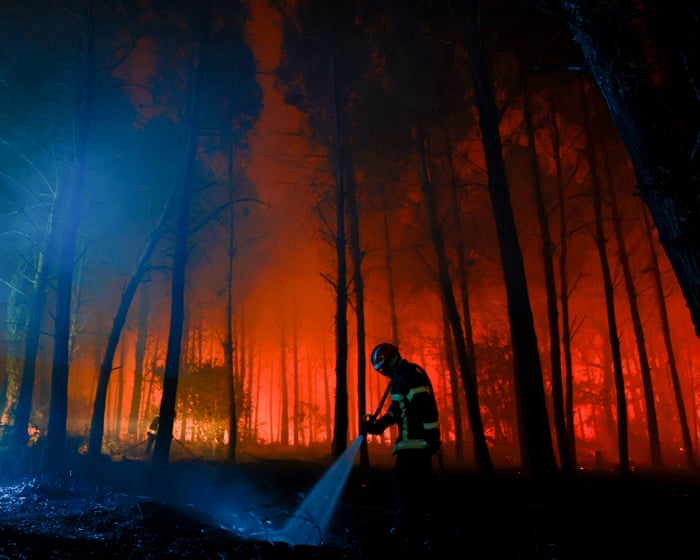
View image in fullscreen: A firefighter with the French air force looks on as a wildfire burns through the Landes forest in Luglon, south-west France. Photograph: Romain Perrocheau/AFP/Getty Images
Luglon is about 62 miles (100km) south-east of the popular holiday destinations of Arcachon Bay and the Lège-Cap-Ferret peninsula, where two huge wildfires destroyed more than 50,000 hectares in late July, forcing the evacuation of as many as 220,000 people.
Scientists say climate breakdown is causing more frequent and more extreme weather events, evaporating soils and waterways, fuelling wildfires, and leading to thousands of excess deaths in France. Europe is heating at about twice the global average rate.
The EU’s Copernicus climate change service warned in its weekly outlook of “very extreme” conditions across a large area of central and eastern Europe, with other pockets over southern Britain, Ireland, northern France, and southern Sweden.
The average high across western Europe on Friday was forecast to be 31.2C, which is 8C above what was typical from 1961 to 1990, data from the Reuters Climate Monitor showed. The temperature for Europe as a whole was 1.6C above the 1961-1990 norm.
In western Germany, more than 2,000 people fled their homes early on Friday morning to take shelter in a nearby primary school after a wildfire in the nearby Hürtgen forest spread to within a few hundred metres of the village of Gey.
“This forest fire threatens to hit the local community hard,” Mona Neubaur, the deputy premier of the state of North Rhine-Westphalia, posted on social media. Unexploded second world war ordnance was also hampering firefighting efforts.
View image in fullscreen: A police helicopter carries water to be dumped on a wildfire in the Hürtgen forest in western Germany. Photograph: Roberto Pfeil/afp/AFP/Getty Images
The news agency dpa reported explosions could be heard as munitions detonated in the flames, forcing firefighters to stay out of the area, not far from the Belgian border, for safety. German army tanks and helicopters were providing support.
In Croatia, a wildfire driven by strong winds descended on the tourist town of Lokva Rogoznica on the Dalmatian coast overnight. Police said they had located the body of one person while searching the area.Crews were still working to contain the burned areas on Friday afternoon. Emergency shelters were opened in several nearby towns. Of the 36 people treated by ambulance services in the city of Split, about 15.5 miles to the north, 14 were admitted to hospital and seven had life-threatening injuries, according to local health officials.
Croatia’s prime minister described the blaze that spread to Omiš as “one of the worst fires in recent years.” Photograph: Tom Dubravec/AP
“It was a strong fire, it swept everything in its way … there has been huge material damage,” said Slavko Tucaković, the regional chief fire commander, on Friday. He added that the blaze appeared to have calmed down by Friday morning.
The prime minister, Andrej Plenković, said during a visit to nearby Omiš, where evacuees were sheltering in a sports hall, that the fire was “one of the worst fires in recent years” but “most importantly” there had been no confirmed deaths so far.
A painting is removed as a wildfire nears the San Juan de la Peña monastery in Aragón, north-east Spain. Photograph: UME/AFP/Getty Images
In north-east Spain, an army unit removed the remains of three 11th-century Aragonese kings from the San Juan de la Peña monastery after it was threatened by a wildfire, and took them to a museum in nearby Huesca. The fire, which started on Monday, intensified on Thursday, authorities said, driven by higher temperatures and strong winds that allowed it to burn through more than 9,000 hectares, forcing the evacuation of 16 towns and villages.
Local residents and tourists are evacuated from Siviri as a forest fire threatens the resort on Halkidiki peninsula, Greece. Photograph: Alexandros Avramidis/Reuters
A much larger wildfire in southern Spain also worsened on Thursday. It has so far burned 31,000 hectares in the province of Huelva and forced the evacuation of about 700 people.
In northern Greece, a fleet of small boats evacuated about 500 holidaymakers from beaches on Thursday as a forest fire threatened Siviri and Fourka, two popular resorts on the Halkidiki peninsula, south of the city of Thessaloniki. The 2-mile-long fire front, with flames up to 30 metres (98ft) high, was brought under control later in the day, the regional civil protection chief said, though crews remained on alert for flare-ups. Two injured firefighters were taken to hospital, the fire service added.
The remains of homes in Stoke-on-Trent smoulder on Friday as wildfire raced across the West Midlands. Photograph: Christopher Furlong/Getty Images
A maximum level-five alert for fires was issued for much of the Greek mainland, and local officials in Halkidiki have banned access to the region’s dense pine forests. Winds of up to 62 mph are forecast for Friday.
In the UK, wildfires raced across the West Midlands, burning several houses to the ground in “one of the most significant” incidents the region’s fire service has ever had to deal with, said the regional fire chief, Simon Tuhill.
Reuters and Agence-France Press contributed to this report.
Frequently Asked Questions
Here is a list of FAQs regarding the recent arson arrests in France and the ongoing European wildfires
General Background Questions
1 What is happening in France right now
French police have arrested hundreds of people suspected of deliberately starting fires This comes as France along with other European countries is battling severe wildfires that have been spreading rapidly due to hot dry and windy weather
2 Are all these wildfires actually caused by arson
No While hundreds have been arrested on suspicion of arson many fires are also started accidentally or by natural causes like lightning However the sheer number of arrests suggests that a significant portion of the fires are being set deliberately
3 Why are the wildfires spreading so fast this year
Europe is experiencing intense heatwaves and a severe drought The vegetation is extremely dry acting like tinder Combined with strong winds this allows even a small fire to turn into a massive blaze very quickly
4 Is this happening only in France
No its a widespread problem across Europe Countries like Spain Portugal Greece and Italy are also battling major wildfires though the recent wave of arson arrests is particularly notable in France
5 Why would someone deliberately start a wildfire
The motives vary Some are arsonists who set fires for thrill or psychological reasons Others have more calculated motives such as insurance fraud clearing land illegally for development or farming or settling disputes
Arrests Legal Consequences
6 What happens to someone arrested for arson in France
They face serious legal consequences Depending on the severity and intent they can be charged with criminal damage or endangerment If convicted they face heavy fines and imprisonment potentially for decades if someone is injured or killed
7 Are the police just arresting anyone or do they have evidence
Police are using advanced techniques including drones CCTV and witness statements to track fires back to their points of origin They are focusing on people seen near the start of fires or acting suspiciously in highrisk areas
8 Have any of the arrested people been convicted yet
In many cases the suspects are being held in custody while investigations continue Some have already appeared in court and received swift sentences to act as a deterrent but many cases are still pending