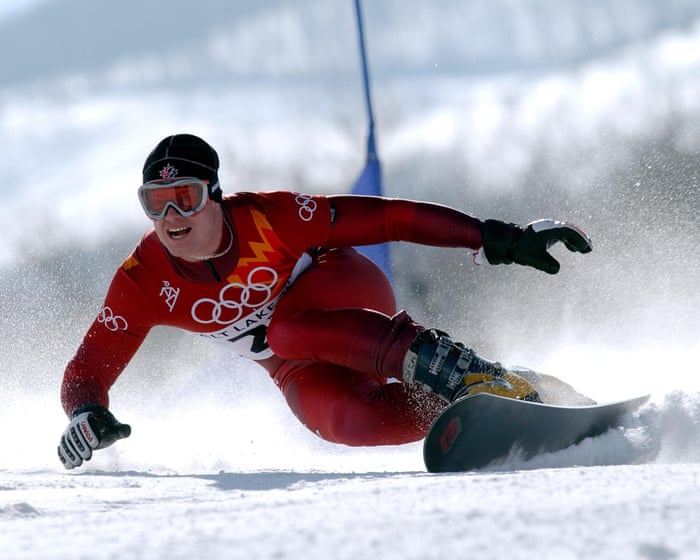
To compete at the highest levels of snowboarding, racers must master carving, edging, and balance at unimaginable speeds. They learn to read the snow’s subtle changes and adjust their bodies to cross the finish line faster than anyone else.
Canadian snowboarder Ryan Wedding had these skills, along with the competitive drive that pushes amateurs to the elite level—a fierce instinct to win that sometimes showed as a desire to dominate his rivals.
These traits didn’t help him as much as he’d hoped at the 2002 Winter Olympics in Salt Lake City. On an icy course, he misjudged his turns and failed to reach the podium.
But that relentless drive for success seems to have fueled his rapid rise as the alleged leader of a major drug trafficking ring. U.S. authorities claim the operation brought in $1 billion a year from cocaine sales. Wedding is accused of ordering the murders of those who stood in his way.
On Friday, top U.S. law enforcement officials announced Wedding’s arrest, marking the end of his journey from a promising young athlete to a drug boss reportedly nicknamed “El Jefe,” “Giant,” and “Public Enemy.” His story reads like an airport thriller, with allegations of a murdered witness, a corrupt lawyer, and cocaine shipments moving undetected across borders.
While the core of the story is true, some analysts suggest U.S. authorities may have exaggerated the scale of Wedding’s operation, creating a high-profile kingpin to capture amid the Trump administration’s push for Mexico to crack down on drug trafficking.
By all accounts, Wedding’s early years in Thunder Bay, Ontario, were far from a life of flashy cars, cartel alliances, and international manhunts. His grandparents owned the Mount Baldy ski resort, a modest hill where he developed the skills to compete on the world stage.
After his Olympic disappointment, Wedding’s life took a sharp turn. A profile in Toronto Life said he worked as a club bouncer and trained aggressively to build his physique. He flipped properties, collected expensive cars, and began dressing in styles popular with the gang members who frequented his clubs.
In 2006, he was named in a search warrant for a marijuana-growing operation in British Columbia but was never charged. Four years later, however, he was convicted of conspiracy to distribute cocaine after trying to buy the drug from a U.S. government agent and was sentenced to four years in prison. This caused him to miss the chance to compete before a hometown crowd when Vancouver hosted the 2010 Winter Olympics.
Prosecutors say he used his prison time to build key relationships with drug dealers, expanding his network and developing trusted contacts that would later give him extensive reach.
The alleged scope of his network became clear in January when Jonathan Acebedo-García, a Canadian citizen, was killed at a popular restaurant in Medellín, Colombia. According to CBC News, Acebedo-García met Wedding in a Texas prison and began working with him after their release. He became a trusted ally—until he started working as an FBI informant. Wedding later called him “the rat” and a “snitch.”
Prosecutors say Wedding showed his capacity for revenge by using a Canadian blog called The Dirty Newz to track down Acebedo-García and his wife. Authorities allege the website’s owner…He had agreed not to post about Wedding. Instead, he allegedly accepted money to share a photo of Acebedo-García, which he did on November 5, 2024, with the caption: “This guy single-handedly took down one of the strongest underworld networks this world has seen. Good chance he’ll never be found again.” The website Dirty Newz has since been seized by U.S. authorities.
Nearly three months after that post, gunmen located Acebedo-García, who had been living in Medellín for a year. They followed him to the upscale neighborhood of El Poblado.
There, at 2:30 p.m. on January 31, he ordered food at Mi Arepa, a popular restaurant chain specializing in traditional cornbreads. While he was eating, a gunman entered the restaurant and shot Acebedo-García five times in the back of the head, killing him instantly, before fleeing on a motorcycle.
Wedding is believed to have sent a bejeweled necklace to one man involved in the killing and circulated a photo of Acebedo-García’s body to his associates as a warning against disloyalty.
The brazen daylight murder in Medellín is the latest in a string of contract killings that prosecutors have linked to Wedding. In 2023, gunmen attacked a rental home in Caledon, Ontario, believing they were targeting rival criminals who had stolen a drug shipment. Instead, they killed Jagtar Singh Sidhu, 57, and Harbhajan Kaur Sidhu, 55, who had arrived in Canada four months earlier. Their daughter, Jaspreet Kaur Sidhu, was shot 13 times and left critically injured. The following year, 39-year-old Mohammed Zafar was shot dead while sitting in his car in the driveway of his Brampton, Ontario, home over what police say were drug debts.
On December 5, Ontario’s law society suspended the license of a lawyer who the FBI says advised Wedding to have a key witness murdered.
Deepak Balwant Paradkar, a lawyer based in the Toronto suburbs, used the social media handle @Cocaine_lawyer and cultivated a reputation for helping high-profile drug dealers evade charges.
“[Paradkar] told [Wedding], ‘If you kill this witness, the case would be dismissed,’” said Bill Essayli, the first assistant U.S. attorney for the central district of California. “That lawyer is now in custody, and he’ll be extradited and brought to justice here in the United States.”
Paradkar has been released on bail pending extradition proceedings and has said he intends to fight the charges.
For years, Wedding evaded capture by hiding in Mexico, allegedly under the protection of the Sinaloa Cartel. In November, the reward for information leading to his arrest was increased to $15 million—a bounty that placed him on the same level as the most powerful cartel bosses in Mexico.
“Make no mistake about it, Ryan Wedding is the modern-day iteration of Pablo Escobar,” said FBI Director Kash Patel. “He is the modern-day iteration of El Chapo Guzmán.”
But security experts in Mexico were skeptical about comparing Wedding to figures like El Chapo, who co-founded and led the Sinaloa Cartel, one of the world’s most powerful criminal organizations, until he was extradited to the U.S. in 2017.
“There’s no indication [Wedding] controls territory, nor that he’s at the head of an armed militia, nor that he’s a major player politically,” said Stephen Woodman, a security analyst in Guadalajara, Mexico.
And though U.S. authorities claim Wedding’s enterprise was trafficking 60 tons of cocaine a year, this figure has been met with doubt by some experts.The figure does not appear in the indictment, which only references specific instances involving a few hundred kilograms at a time.
“I’d say this is a very performative administration that likes to put faces on the issue of international drug trafficking,” said Woodman. “And you can expect films and documentaries to be made about this guy.”
Frequently Asked Questions
Of course Here is a list of FAQs about Ryan Wedding framed in a natural conversational tone
Basic Questions Who is Ryan Wedding
Who is Ryan Wedding
Ryan Wedding is a former professional snowboarder from Canada who competed in the 2006 Winter Olympics in Turin After his athletic career he became the subject of a major international drug trafficking investigation
What is he accused of
Wedding is accused of being a highlevel organizer in an international cocaine trafficking ring allegedly smuggling hundreds of kilograms of cocaine from Peru to Australia Authorities labeled him an alleged kingpin or mastermind of the operation
Did he actually compete in the Olympics
Yes He represented Canada in snowboard cross at the 2006 Turin Games where he finished in 33rd place
When was he arrested
He was arrested in Perth Australia in December 2022 following a lengthy multinational investigation
Advanced Questions The Case Details
How did an Olympic athlete get involved in this
The exact motivation isnt publicly confirmed but investigators and media reports suggest he struggled to transition after his sports career facing financial pressures and finding a new thrill in highstakes criminal activity His international travel experience and connections may have also played a role
What evidence is against him
Authorities allege they have extensive evidence including encrypted phone communications surveillance financial records and testimony from cooperating witnesses that detail his alleged role in coordinating shipments and finances
What are the specific charges he faces
He has been charged with multiple serious offenses including conspiring to import a commercial quantity of a bordercontrolled drug In Australia this carries a potential maximum penalty of life imprisonment
Where is the case now
As of late 2023early 2024 the case is still proceeding through the Australian court system Pretrial hearings and committal proceedings are ongoing to determine if there is sufficient evidence for a trial A trial date has not yet been set
Was anyone else arrested
Yes The investigation dubbed Operation Ironside led to hundreds of arrests worldwide In this specific syndicate several other alleged associates in Australia and South America were also charged
Common Points of Confusion Practical Context